
How To Make Productivity Soar: Four Stages of AI Transformation
- 作者提出AI应用的四个阶段:让现有工作更轻松、消除主要步骤、借助Agent重构流程、由人训练和管理自主智能体。
- 第一阶段如Microsoft Copilot总结会议和邮件,员工通常提升10%至15%以上效率,但工作方式变化不大,有时工具反而拖慢进度。
- 第二阶段岗位不变但大量步骤被自动化,软件工程师用copilot生成70%代码,企业可获得50%至75%的生产力提升。
- 第四阶段AI招聘官可自动完成需求收集、职位描述、薪酬对标与候选人排序,人的职责转为训练、监控和管理这一“数字员工”。
- 作者认为AI不是替代岗位的技术,而是赋能“超级员工”的技术,将带来更高价值、更高薪酬的岗位,详情将见其2025预测报告。
AI 根据原文整理,以发布日期为准(2024-12-01)
本文目录(1 节)
We’ve been doing a lot of advisory work on skills and job design and now that AI tools have arrived, we’re reinventing work faster than ever. So let me give you some thoughts on this process, and you can also learn more from my recent podcast.
As you know, there are many types of AI business tools: Copilots, Assistants, Agents, Talent Intelligence Systems, and embedded applications. Each of these products are built on an AI-first foundation and they layer on domain expertise, use-case analysis, and iterative design to build smarter and smarter systems.
Self-driving cars started as voice assistants, automatic braking, and lane warnings. Now they keep you in the lane and slow your car when the speed limit changes. And soon enough they’ll be driving for us, so we can sit in the back seat and read a book.
Our HR Assistant Galileo started as a research and problem solving tool, and it’s rapidly becoming an AI coach, benchmarking tool, recruiting, and change management system. So all these tools go from simple use-cases to deeper applications and autonomy over time.
As the tools get smarter and more domain focused we are going to have to rethink our jobs and business processes. And unlike ERP, where we essentially trained people to “adopt” the system, now a lot of the groundbreaking applications come from the bottom up. Individuals will discover capabilities for AI and then apply them in increasingly innovative ways.
And over time, as they get smarter, our jobs move more to “supervisors” and “trainers” of AI, not just consumers. For example if our self-driving car took a bumpy route, we may “retrain it” to take a longer but smoother road.
As I discuss in the podcast, I believe there are four stages of adoption today. And we’re in the middle of doing all four at the same time.
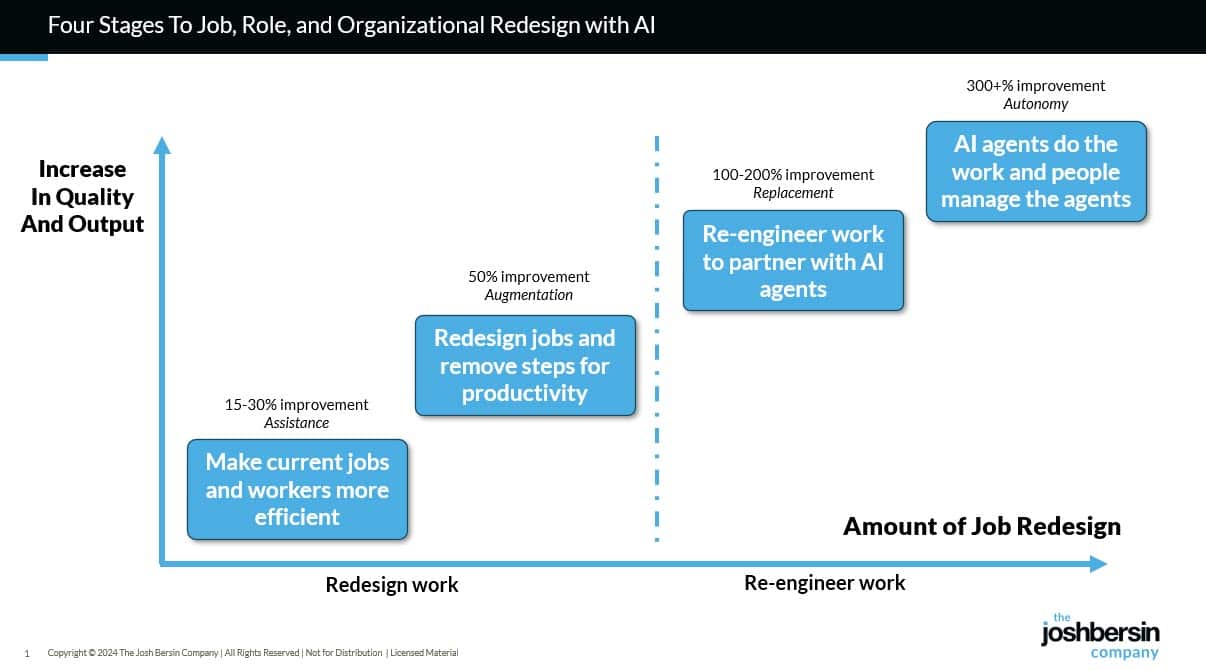 |
Level 1: Make existing work easier. (Same job, better tools.)
This is where we click on the Microsoft Copilot or Zoom or Teams and the system analyzes a meeting, summarizes emails, or writes a document with our help. We do our jobs the same way we did before, but we now have a “super-productivity” tool to make it easier. These “add-on” use cases are emerging everywhere, and they already feel like a commodity.
In most cases employees see 10-15% or more improvements here, but life isn’t that much different. And sometimes the tool slows us down (Copilot doesn’t create slides well at all yet) and may actually get in the way. But we can expect this mode to continue and most of us figure this out on our own.
Level 2: Major steps eliminated, but the job is the same. (Same job, tools eliminate work.)
At level 2 we automated a lot. Software engineers now use copilots to develop 70% of their code, so they’re spending more time testing and prompting the AI. Their individual coding skills may atrophy, but they can now work on more architectural issues.
The “job” of software engineer may still be the same, but the output is far greater. So we’re making the same pay, doing the same work, but using highly automated tools.
This includes scenarios like chip designers, software engineers, supermarket checkout clerks, nurse scheduling jobs, and even recruiting assistants. Paradox customers, for example, virtually eliminate “scheduling assistants” for recruiting.
At this level companies can see 50-75% productivity improvement, and free time to focus on quality management, customer service, and ongoing improvements to the tools.
Level 3: Re-engineered work, partnered with agents. (New job, redesigned process, agents automate work.)
At level 3 we go further: we re-engineer the process and the work. Imagine how McDonald’s replaced its counter workers with a kiosk, eliminating the “may I take you order please?” role.
This took some major design effort but resulted in a whole new set of roles, workflow, and management structure in the restaurants. The “cost per burger” went down, and the customer experience is almost as good (not quite).
Here we need to be careful because sometimes the “self-service, AI-enabled” experience doesn’t work. A good example is the supermarket self-checkout. It rarely works well and usually takes longer than standing in line. But it will get better, and the resulting experience is faster throughput, more data (the self-service agent might offer you a discount since it knows your buying history), and far superior employee roles.
In level 3 the employees are still involved, and we are more or less “working with the machine,” aiding and supporting the process.
Level 4: Autonomous intelligent agents, people training and managing the AI. (New job, redesigned process, people “manage” the agents.)
At level 4 we go even further. Imagine an AI recruiter (Paradox does this) that could email a hiring manager and his team, gain feedback and requirements on a job and role, consolidate input, and create a total description. This Agent could then review this job against the company culture and pay policies, compare the job against similar jobs in the external market, and tweak the level, job title, and description to be competitive. And then it could start sourcing, and give the hiring manager and human recruiter a set of candidates ranked by various criteria.
That process, which takes dozens of steps for a recruiter, could be fully automated and vastly improved. The Agent could even look at prior hires and get even smarter about who to source based on the success of other candidates.
Now the human job is to “train” and “monitor” and “manage” this AI Agent, who has effectively become a digital employee. (Note: Salesforce is doing a terrific job of building this out for sales and service.)
The Rise of the SuperWorker
Our thesis is that AI is not a “job-replacement” technology, it’s a “SuperWorker empowerment” technology. In other words, most of these scenarios result in higher value jobs, higher pay, and value creation (not cost reduction) in the business.

This is happening fast.
We’re in the middle of a big study in this area and I’ll be explaining this more in our upcoming 2025 Predictions report. The upside of all this will be new and higher paying jobs, faster response to business change, but a lot of IT, design, and data management to do. But based on our research, this is coming soon.
读完之后,你可能需要
相关文章
 微软向6万名员工开放自愿离职:AI时代,企业正在重新定义组织与人才管理2026-10-26
 全球劳动力报告深度解读:AI时代最大的挑战,不是裁员,而是员工的工作已经改变,组织却还没有跟上2026-10-06
 2027年CHRO信心继续降温:北美华人HR需要看到的,不只是招聘变化2026-10-01