OpenAI 推出“ChatGPT for HR”实用场景指南,助力人力资源团队全面提效
近日,OpenAI Academy 在其官方平台发布了《ChatGPT for HR》专题资源,系统展示了 ChatGPT 在人力资源(HR)工作中的实际应用场景与 Prompt 模板,覆盖员工全生命周期管理,从招聘、入职、绩效,到调查、沟通与合规研究等多个环节。该资源旨在帮助全球 HR 团队利用生成式 AI 提升工作效率、洞察深度与沟通一致性。
根据 OpenAI 官方介绍,本次公开的 HR 应用案例分为多个板块,涵盖 政策与沟通撰写、人才获取与面试设计、员工参与与反馈分析、绩效与发展管理、合规与多元平等(DEI)规划 等关键领域。每个场景均附有可直接复制的 ChatGPT Prompt,方便 HR 专业人士快速落地使用。
例如,在内部沟通与政策制定方面,ChatGPT 可以帮助起草员工手册摘要、政策公告、常见问答及内部培训脚本;在招聘与入职环节,HR 可通过 Prompt 生成职位说明、行为面试题、入职计划表等内容;在员工调查与反馈分析中,ChatGPT 能对离职问卷、满意度调查、开放式回答进行语义分析,提炼主题与趋势,为管理层提供决策依据;而在合规与组织研究部分,系统还可协助分析全球法规差异、撰写合规报告,支持 HRBP 的战略研究工作。
业内专家认为,这份资源的最大价值在于其“可操作性”与“模板化”。不同于以往泛泛而谈的 AI 概念介绍,《ChatGPT for HR》提供的内容更像是一套可直接落地的工作工具,帮助 HR 团队将生成式 AI 技术真正嵌入日常流程。
目前,该资源已在 OpenAI Academy 网站公开上线(academy.openai.com/public/clubs/work-users-ynjqu/resources/use-cases-hr),无需额外注册即可浏览。这也是 OpenAI 在企业应用方向上进一步细化行业场景的重要一步,尤其在人力资源领域,为全球 HR 从业者提供了可复制、可扩展的 AI 实践框架。
HRTech 观察认为:AI 已经不再只是“辅助工具”,而正在成为 HR 专业能力的加速引擎。通过标准化的 Prompt 与结构化思维框架,HR 可以在更短时间内完成高质量内容生成与数据洞察,从而将更多精力投入到战略与人本决策之中。
?原文参考:OpenAI Academy: ChatGPT for HR Use Cases
员工体验
2025年10月15日
员工体验
The best HR & People Analytics articles of July 2025HR如何在AI时代掌握主动?David Green发布的7月《Data Driven HR Monthly》汇集全球顶尖报告与实践,聚焦“技能+任务”新范式、AI对员工体验与倦怠的双面影响,以及CHRO在企业AI战略中的领导地位。BCG数据显示,印度AI使用率达92%,但全球员工对AI培训满意度仅36%。Upwork报告揭示:高效AI用户更易疲惫离职。McKinsey与Gartner呼吁HR重构组织模型与人才规划体系。本期还探讨神经多元、NASA人才图谱与“Vibe Coding”等创新实践。
I always enjoy spending time in India, so I was delighted to arrive in Delhi yesterday ahead of People Matters Tech HR later this week. I’ll be delivering the opening keynote on how HR leaders can ace the next curve of change as well as leading a workshop on the science of better decisions. I’m looking forward to catching up with fellow speakers such as Jason Averbook (tip: subscribe to his Now to Next blog, if you don’t already), Pushkaraj Bidwai, Mukesh Jain, and Shefali Raias well as immersing myself in what is happening in the Indian HR tech scene.
In this month’s edition of the Data Driven HR Monthly, which comes against the backdrop of CEOs flexing on the impact of AI on jobs, I’ve included new research from BCG and Upwork on AI at work, and the role of HR. Marc Effron is spot on here with his assessment that CHROs need to be leading the strategic conversation with the executive team on their desire to reduce costs through job reduction enabled by AI: “CHROs can lead this conversation through organization, operating model and job design, where we should be experts.”
I expect plenty of discussion at Tech HR on this topic as well as the wider impact of AI on work, the workforce, and the workplace. One of the messages, I’ll look to get across in my keynote is:
AI guides, but humans decide. We must prioritise the ‘H’ in HR.
This edition of the Data Driven HR Monthly is sponsored by our friends at TechWolf
Skills, Tasks, and Workforce Intelligence: Navigating the AI Transformation
This month’s edition highlights an important conversation from the TechWolf Podcast, recorded live in New York, featuring Marc Steven Ramos, global learning leader with 25+ years’ global transformation experience with Google, Microsoft, Accenture, Novartis, Oracle, and Cornerstone, and Jeroen Van Hautte ?, CTO & Co-Founder of TechWolf.
The discussion explores how task-based intelligence complements skills data to create a complete view of workforce capabilities, empowering organizations to navigate one of the largest business transformations in history: the AI-driven redefinition of work.
Skills without context can be ambiguous. Tasks ground them in real work, and that’s where change, productivity, and AI come together — Marc Ramos
Why This Matters Now:
The pace of change in the workforce is unprecedented. Leading enterprises are already recognizing that workforce intelligence - the ability to understand, predict, and act on how work is changing in real time - is no longer optional.
From skills to skills + tasks + jobs: Combining these data points allows organizations to connect individual capabilities to tangible outputs and outcomes.
AI as a catalyst: AI is accelerating job evolution, making real-time visibility into tasks and skills essential for workforce planning and redeployment.
Strategic urgency for boards: Workforce automation isn’t a distant trend — it is reshaping workforces today, creating pressure on executives to act on reskilling, redeployment, and workforce design at speed.
To really understand a skill, you need to understand the context in which it’s applied — the tasks. And that’s where AI can add transformative clarity — Jeroen Van Hautte
For HR leaders, this is an opportunity to lead. With skills and tasks as the foundation, HR is uniquely positioned to drive cultural alignment, manage change, and deliver on the board-level mandate to prepare workforces for the AI era.
Listen to the Episode: ?️ Marc Ramos & Jeroen Van Hautte on Tasks, Skills & the Future of Work (TechWolf website summary)
To sponsor an edition of the Data Driven HR Monthly, and share your brand with more than 145,000 Data Driven HR Monthly subscribers, send an email to dgreen@zandel.org.
JULY ROAD REPORT
Until flying to Delhi yesterday, as mentioned above for Tech HR India later this week, July had been a light month of travel other than a short trip to Switzerland to run an AI workshop with the HR leadership team of one of the companies that are part of the Insight222 People Analytics Program. For those interested, one of my speaking engagements from earlier this year, at the Wharton People Analytics Conference, is now available to view (see below). In the talk, I explore the critical role of data democratisation and adoption in driving workforce insights, enhancing decision-making, and scaling HR’s strategic impact. I also share best practices from our work and research at Insight222 for making people analytics accessible to leaders and employees alike, the challenges of adoption, and the key investments required to unlock the full potential of workforce data. Enjoy!
Share the love!
Enjoy reading the collection of resources for July and, if you do, please share some data driven HR love with your colleagues and networks. Thanks to the many of you who liked, shared and/or commented on June’s compendium.
If you enjoy a weekly dose of curated learning (and the Digital HR Leaders podcast), the Insight222 newsletter: Digital HR Leaders newsletter is usually published every other Tuesday – subscribe here – and read the latest edition.
HYBRID, GENERATIVE AI AND THE FUTURE OF WORK
BCG - AI at Work: Momentum Builds, but Gaps Remain | JOHN BRAZIER AND NICK SOUTH - BCG’s AI at Work 2025 report: Four takeaways for HR leaders
Companies are realizing that merely introducing AI tools into existing ways of working isn’t enough to unlock their full potential. The real magic happens—and value generated —when businesses go further and reshape their workflows end-to-end.
BCG’s annual AI at work global survey of employees is packed full of insights and guidance for business and HR leaders looking to maximise value, adoption and employee experience with AI. The key takeaways include: (1) AI is now part of our daily work lives: 72% of respondents are regular AI users (although adoption amongst frontline employees has stalled at 51%). (2) Investment in training, leadership support and access to the right tools can break this ceiling: Yet only 36% of employees are satisfied with their AI training. (3) The Global South is showing higher adoption of AI. India leads the pack with 92% of regular users compared to the US (64%), UK (68%) and Japan (51%). (4) The next frontier: from adoption to value with end-to-end redesign. One-half of respondents say their company is starting to reshape processes. These companies also invest more in their people – and it pays off (see FIG 1). (5) AI agents are not widely deployed. Only 13% see agents integrated into broader workflows (see FIG 2). Kudos to the authors: Vinciane Beauchene, Sylvain Duranton, Nipun Kalra, and David Martin. For HR leaders, I also recommend reading John Brazier’s interview with BCG’s Nick South about the implications of the report’s findings for HR on the UNLEASH blog.
FIG 1: The relationship between workflow redesign due to AI and investment in people (Source: BCG)
FIG 2: Use of AI agents (Source: BCG)
GABBY BURLACU AND KELLY MONAHAN - From Tools to Teammates: Navigating the New Human-AI Relationship
Full time employees getting the most done with AI are also the most burned out, disengaged, and disconnected from their teams.
In their study for the Upwork Research Institute, Gabriela (Gabby) Burlacu and Kelly Monahan, Ph.D. identify a crucial message for the future of work: while AI is undeniably boosting productivity – with a reported 40% jump for many workers – it's also creating a human paradox. Alarmingly, top AI performers are experiencing high burnout (88%) and are twice as likely to leave, often feeling disconnected from strategy and even trusting AI more than human colleagues (see FIG 3 and 4). The report offers three urgent calls to action for business leaders: (1) Redesign work for human-centered, AI-empowered talent and workflows, prioritising autonomy, trust and psychological safety. (2) Cultivate flexible and resilient talent ecosystems, combining full-time employees, freelancers, and AI capabilities to create agile, resilient, and high-performing teams. (3) Redefine AI strategies to focus on the end-to-end human experience, including new roles, norms, and governance. For HR leaders, these findings are a wake-up call. We must prioritise the relational side of AI, ensuring human connection, well-being, and purpose are augmented, not eroded. It's about preventing burnout in our most productive AI users, fostering alignment, and learning from agile models like freelancers to build a truly sustainable human-AI collaborative future.
FIG 3: The human cost of AI productivity (Source: The Upwork Research Institute)
FIG 4: The rise of human-like relationships with AI (Source: The Upwork Research Institute)
COBUS GREYLING - Do AI Agents Substitute Human Workers — Or Enable Humans To Succeed In New Ways? | L. ELISA CELIS, LINGXIAO HUANG, AND NISHEETH K. VISHNOI - A Mathematical Framework for AI-Human Integration in Work
AI Agents are good at tasks not jobs…
In his article, Cobus Greyling provides an insightful and accessible analysis of a new study by Elisa Celis, Lingxiao Huang, and Nisheeth Vishnoi, which presents a mathematical framework that models jobs, workers, and worker-job fit, and introduces a novel decomposition of skills into decision-level and action-level subskills to reflect the complementary strengths of humans and GenAI. Greyling’s incisive analysis offers a helpful perspective for HR leaders navigating the future of work. His core message is clear: AI agents are fantastic at tasks, not entire jobs. They're not just substitutes, but powerful amplifiers of human capability, especially for less experienced workers, effectively compressing productivity gaps and fostering extraordinary collaboration. Here are four key learnings for HR: (1) Agentic AI Augments Human Potential: AI agents boost efficiency and performance, particularly for junior talent, by handling structured tasks and freeing humans for higher-order work. (2) Redefine Skills & Development: While AI takes on the mundane, HR must strategically ensure continuous skill development, focusing on uniquely human capabilities like judgment, creativity, and complex problem-solving. (3) Design for Human-AI Synergy: Organisational design must pivot to foster premium collaborations between humans and AI. It's about combining complementary strengths to achieve outcomes greater than the sum of the parts. (4) HR Leads Strategic Integration: Our role in HR is pivotal. We must orchestrate the strategic integration of agentic AI, balancing its efficiency gains with the imperative to preserve and nurture human ingenuity, driving both innovation and connection.
FIG 5: Al for work: skill difficulty continuum (Source: Cobus Greyling)
PEOPLE ANALYTICS
KETAKI SODHI AND COLE NAPPER - Who Needs a “Human in the Loop” When AI Gives Itself Feedback
Ketaki Sodhi, PhD, Program Owner for Agentic Listening and Analytics at Microsoft, and Cole Napper provide a fascinating perspective on the "human in the loop" concept for Generative AI, provocatively asking: which human, and how? This isn't just a technical question; it's where I/O Psychology and People Analytics come into their own. The article frames AI "evals"— the systems for assessing whether AI outputs are useful, accurate or aligned —as essentially performance management for Large Language Models. Just as we've wrestled with defining "good" in complex human knowledge work for decades, we now face the same challenge in building AI systems. In a world of infinite " " answers, AI evals demand the same nuance we apply to human systems: competency models, multi-rater input, calibration, and context. One of the key takeaways from Ketaki and Cole is that true success lies not in chasing perfect answers from AI, but in designing smart, human-informed systems. These are the systems that can discern between good, better, and what genuinely drives impact for your organisation. For people analytics leaders and I/O psychologists, this is a clarion call to leverage their deep expertise in human performance to shape the very fabric of our AI-driven future.
FIG 6: Source – Ketaki Sodhi
BEN BERRY - The future is built by everyone: What is Vibe Coding and why should People Analytics teams adopt it | ROSARIO GERMINO - From People Analytics to People Economics and Impact | ADRIAN PEREZ – GitLab People Analytics Team Handbook | DOMINIK TOMICEVIC - Can NASA’s People Graph and LLMs Revolutionize Workforce Planning? | MORGAN DEPENBUSCH - How to let color do the storytelling
In each edition of the Data Driven HR Monthly, I feature a collection of articles by current and recent people analytics leaders. These are intended to act as a spur and inspiration to the field. Five are highlighted in this month’s edition: (1) In a particularly insightful piece, Ben Berry examines whether vibe coding, a product management practice of using AI tools to rapidly build functional prototypes to help turn rough ideas into working concepts, should be adopted in people analytics. (2) In her thoughtful article, Rosario Germino argues that to elevate people decisions to the same level of strategic investment as product or finance, we need a new way of thinking—and a new kind of function – People Economics and Impact, which she then breaks down into the why (see FIG 7 on the multi-dimensional aspect of informed decision making), what and how. (3) In a recent post, Adrian M. Pérez provides open source access to GitHub’s People Analytics Team Handbook, a rich resources covering areas such as (i) data governance framework, (ii) tools and methodologies, (iii) survey administration, and (iv) Tableau dashboard strategies. (4) Dominik Tomicevic provides a compelling account of how NASA’s People Graph is supporting a range of priorities from upskilling to workforce planning – with insights from the NASA team of David Meza, Madison Ostermann and Katharine Knott, MBA: “Knowledge graphs offer flexibility, since you don’t need a full schema upfront. We began with known relationships and expanded as we uncovered more insights in the data.” (5) In an edition of her excellent Trending Up newsletter, Morgan Depenbusch, PhD offers some compelling guidance on the use of colour in data visualisation and storytelling.
FIG 7: Informed decisions are multi-dimensional. Financial logic makes them investable (Source: Rosario Germino)
THE EVOLUTION OF HR, LEARNING, AND DATA DRIVEN CULTURE
MCKINSEY - HR Monitor 2025
The gap is widening between what is needed from an efficient, effective HR function and what most organizations currently offer
McKinsey's HR Monitor 2025 benchmark study of workforce and HR trends across Europe, delivers a sharp analysis of the critical shifts shaping the HR profession, emphasising that the next 12-24 months are decisive for the function. The report identifies five key trends: (1) Workforce planning is not approached strategically enough – see FIG 8 - (“…with rapid changes driven by gen AI and shifting skill needs, workforce planning must move beyond short-term staffing forecasts to include a longer-term view and future-scenario planning”). (2) Talent acquisition is becoming more complex: with only 56% offer acceptance rates, 18% of new hires leaving during their probationary period and the overall hiring success rate in Europe standing at a lowly 46%, a more strategic and coordinated approach to attracting and hiring talent is required. (3) Employee development continues to be highly fragmented (“To prepare the workforce for future challenges, organizations must connect performance management, learning and development, and talent development in one cohesive strategy”). (4) Employee experience is essential—and underdeveloped (“A more tailored, data-driven approach to the employee experience is needed to build motivation and long-term commitment to employers”). (5) Gen AI and shared-services centres could boost efficiency and effectiveness (“HR departments must modernize their operating models by expanding SSC adoption and using automation and gen AI to increase speed, scalability, and strategic impact”). For Chief People Officers, the message is clear: You must align HR strategy directly with business priorities, strengthen your HR operating model, and aggressively build digital and AI skills within HR. This is about laying the foundation for a modern, AI-enabled HR function that is both deeply people-centric and laser-focused on organizational performance. Kudos to the authors: Julian Kirchherr, Vincent Bérubé, Charlotte Seiler, Dr. Kira Alexandra Rupietta, Kristina Stoerk, Nina-Marlene Senst, and Simon Gallot Lavallée.
...with rapid changes driven by gen AI and shifting skill needs, workforce planning must move beyond short-term staffing forecasts to include a longer-term view and future-scenario planning
FIG 8: Engagement in workforce planning (Source: McKinsey)
FIG 9: Predicted impact of gen AI on HR department (Source: McKinsey)
ESER RIZAOGLU AND STEPHANIE CLEMENT - How CHROs Can Prepare Their Function and the Enterprise for AI Transformation
CHROs play a key role in safely using AI at scale to deliver business outcomes.
Recent research by Eser Rizaoglu and Stephanie Clement for Gartner provides a helpful roadmap for CHROs steering their organisations through AI transformation, by focusing on HR's pivotal role in shaping the future of work. The report highlights three key actions for CHROs to enable their organisation's AI approach: (1) Assist in delivering business outcomes using AI: Leverage GenAI for HR productivity first, then expand to drive enterprise-wide improvements with a broader AI portfolio. (2) Manage behavioural outcomes of AI: Cultivate a culture of innovation, build human-centred change management plans, and introduce new HR roles to foster human-machine partnerships. (3) Enable workforce readiness for AI: Implement AI literacy programs for all (see FIG 10), while targeting upskilling efforts on segments most impacted, building empathy, and tracking readiness indicators. For CHROs in Steady-AI-Pace organisations, the focus is on foundational AI literacy and policy. Those at an Accelerated-AI-Pace must deepen this by targeting high-impact workforce segments and deploying AI champions to drive effective, human-centric change.
FIG 10: AI Literacy Program Roadmap (Source: Gartner)
DAVE ULRICH - Navigating Eight Paradoxes of AI for HR
When algorithms combine with human empathy, judgement, and creativity, sustained progress occurs.
In his article, Dave Ulrich highlights eight paradoxes on the AI for HR agenda that he believes business and HR leaders need to navigate to move up the s-curve and waves of HR impact (see FIG 11) to deliver more value. As Dave explains: “Navigating (not just managing) paradox means highlighting and working through opposing ideas—each of which is valid—that combine to create more value.” The eight paradoxes identified in the article are: (1) AI and AI: Artificial Intelligence * Authentic Intimacy. (2) Remove jobs and redefine work. (3) Bottom line efficiency and top line growth. (4) Distribute and concentrate power. (5) Lower and increase risk. (6) Expand perspective and reduce cognition. (7) Provide answers and explore questions. (8) Isolate and connect.
FIG 11: Five stages of AI for HR evolution (Source: Dave Ulrich)
EMPLOYEE LISTENING, EMPLOYEE EXPERIENCE, AND EMPLOYEE WELLBEING
JARED WEINTRAUB - A day in the life of a GenAI-enabled workforce
Deloitte forecasts that 25 percent of companies currently using GenAI will launch agentic pilots this year, rising to 50 percent by 2027
Jared Weintraub, PhD, SPHR's article for Deloitte paints a tantalising picture of a 'Gen-AI enabled workforce,' showcasing how AI agents are already transforming our daily work. Through a fictional Fortune500 company, Jared brings to life three key personas: (1) New Hire (Riley): Experiences personalised onboarding, with AI agents helping her navigate culture and quickly excel in her role. (2) VP (Taylor): Sees optimised leadership workflows, receiving instant summaries, personalised action items, and even real-time feedback on calls. (3) CEO (Angelina): Gains powerful support for strategic decision-making, with AI agents providing real-time insights and even coaching for high-stakes events like public town halls. These examples demonstrate AI's profound potential not to replace workers, but to fundamentally enhance human potential, leading to a significantly improved employee experience where individuals, teams, and organisations can thrive and perform at their absolute best. Thanks to Brian Heger for highlighting in his excellent Talent Edge Weekly.
WORKFORCE PLANNING, ORG DESIGN, AND SKILLS-BASED ORGANISATIONS
SCOTT REIDA AND KRISTIN SABOE - Applying the Rule of 72 to Workforce Skill Obsolescence and Productivity Degradation
Amazon's Scott Reida and Google's Kristin Saboe, Ph.D. introduce a powerful financial concept to HR: the "Rule of 72." Traditionally, it's a shortcut to estimate how long an investment takes to double, by dividing 72 by its annual growth rate. They ingeniously flip this, applying it to skill evolution: by dividing 72 by a role's weighted average 3-year Compound Annual Growth Rate (CAGR) of its skills, one estimates the "years to obsolescence" if no upskilling occurs. This provides critical directional clarity on how fast job competencies are shifting. Their framework, illustrated in FIG 12, categorises skills into four key zones: (1) Emerging (low adoption, high growth, representing the cutting edge). (2) Table Stakes (widely adopted, foundational must-haves with steady growth). (3) On the Cusp (moderate adoption, sustained expansion, offering long-term value). (4) Sunset (declining demand, requiring intentional upskilling). This enables smarter workforce planning. HR can now target training budgets where skill erosion is rapid, shifting from reactive to proactive strategies. It transforms talent into a dynamic portfolio , informing sharper hiring and career development in our accelerating world.
FIG 12: Categorising skills into four key zones (Source – Scott Reida and Kristin Saboe)
McKINSEY - The new rules for getting your operating model redesign right
When people feel invested in and supported, they are more likely to embrace change, contribute meaningfully, and sustain the behaviors that drive long-term impact.
New research from McKinsey updating their nine golden rules for operating model redesign, which finds that five original (evergreen) rules have stood the test of time while four new (evolved) rules have emerged (see FIG 13). The study identifies a key finding: redesign success jumps from 59 percent when using all nine original rules to 97 percent when using all nine in the refreshed set. The article also presents four broad redesign themes for leaders to focus on: (1) Create alignment among leaders and decision-makers, grounded in strategy. (2) Invest deeply in rewiring workflows. (3) Make significant investments in people. (4) Create a performance-oriented culture for durable impact. For Chief People Officers, the key takeaway is that they need to become the architects of dynamic, human-centric operating models. Their focus shifts from traditional talent management to proactively designing how work gets done, emphasising skills and capabilities over static roles. CPOs should also lead on ethical AI integration, foster a culture of continuous learning, and empower leaders. This creates a workforce built for perpetual reinvention, driving sustained value in an increasingly uncertain world. Kudos to the authors: Brooke Weddle, J.R. Maxwell, Tristan Allen, Deepak Mahadevan, Elizabeth Mygatt, and Olli Salo.
FIG 13: The refreshed golden rules of organisational redesign (Source: McKinsey)
LEADERSHIP, CULTURE, AND LEARNING
JEFF WETZLER - The Right Way to Prepare for a High-Stakes Conversation
Curiosity increases your ability to process new information and respond creatively to complex problems. It activates the brain’s learning and reward centers, increasing your capacity for insight and creative problem-solving.
In his recent HBR article, Jeff Wetzler introduces a helpful concept for leaders: The Curiosity Check (see FIG 14). This diagnostic is designed to fundamentally shift your mindset from defensive certainty to productive curiosity, and so improve your effectiveness in high-stakes discussions and boost your influence. It’s all about unlocking crucial, often hidden, insights. Wetzler outlines three actionable steps: (1) Choose Curiosity Over Certainty: Actively ask yourself "What am I missing?" challenging your assumptions. (2) Make It Safe to Speak Up: Create an environment where people feel secure sharing their true thoughts, proving safety through action, not just words. (3) Pose Quality Questions: Shift from shallow or leading questions to open-ended, neutral, and deeper inquiries that encourage genuine reflection. Wetzler brings this to life with examples, highlighting how leaders often miss critical information when they assume team alignment, never probing for the "unspoken thoughts" that hold the real insights. This approach empowers you to tap into wisdom you might otherwise completely overlook. Thanks to Amy Edmondson for highlighting.
FIG 14: The Curiosity Curve (Source: Jeff Wetzler)
MCKINSEY RESEARCH AND INNOVATION LEARNING LAB – Reimagined: Development for the Future of Work – Evolving Trends in L&D Article | Full report
Leaders must prepare for a future defined by radical candor regarding the impacts of AI on work and the workforce.
The 2025 McKinsey Learning Perspective spotlights three interconnected themes crucial for people development in a rapidly changing world: (1) Fluid Development Ecosystems: Organisations must design work to be inherently developmental, shifting from rigid structures to dynamic, data-driven ecosystems. This means de-siloing HR functions and embedding learning into daily work, making growth continuous and seamless. The goal is to make daily challenges catalysts for growth, supported by real-time data and foresight. (2) Responsible AI Adoption: This defining moment demands leaders preserve employee trust by showing AI will help them thrive, not just automate work. It's about fostering powerful human-AI collaboration, offloading repetitive tasks to AI to unlock human creativity and higher-order skills. Responsible adoption hinges on equipping employees with uniquely human capabilities like critical thinking and judgment. (3) Resilient and Adaptable Individuals and Organisations: Thriving organisations anticipate challenges, adapt, and grow, building structural and cultural foundations for resilience. This involves unlocking the potential of diverse, multigenerational workforces, supporting recuperation to prevent burnout, and enabling organisational resilience through sustainable workflows. It means seeing resilience as a shared, cultivated capability, not just an individual trait. Read the article by Heather Stefanski, Benjamin Hall, Jake Gittleson, and Jessica Glazer, and then dive into the full report, which also includes contributions from the likes of Sandra Durth.
DIVERSITY, EQUITY, INCLUSION AND BELONGING
ROBERT D. AUSTIN, NEIL BARNETT, CHLOE R. CAMERON, HIREN SHUKLA, THORKIL SONNE, AND JOSE VELASCO - How Neuroinclusion Builds Organizational Capabilities
Leaders should consider neuro-inclusion as a strategic capability-building opportunity rather than a diversity initiative
In a rapidly evolving world, neuro-inclusion is emerging as a critical organisational capability, as highlighted by Robert Austin, Neil Barnett, Chloe Cameron, Hiren Shukla, Thorkil Sonne, and Jose Velasco in the MIT Sloan Management Review. This isn't merely a diversity initiative; it's a strategic imperative that unlocks competitive advantage by leveraging the rich, natural variation in human cognition. By intentionally designing processes for neurodistinct individuals, organisations can profoundly improve: (1) Hiring, by tapping into overlooked talent pools with unique skills (as seen with SAP attracting highly credentialed candidates often missed by traditional interviews); (2) Innovation, through diverse perspectives that spark novel solutions (Microsoft's Teams ‘Blur’ feature emerged from a neurodistinct engineer's insights); and ultimately, (3) Culture, by fostering a more adaptive and truly inclusive environment for everyone. As the article reveals, EY, Microsoft, and SAP are prime examples of organisations already reaping these benefits, demonstrating that embracing neurodiversity enhances collective intelligence and drives superior business outcomes.
FRANK DOBBIN AND ALEXANDRA KALEV - Achieve DEI Goals Without DEI Programs
Many management innovations designed to improve performance actually boost workforce diversity as well, without inviting the backlash of formal DEI programs.
Frank Dobbin and Alexandra Kalev, in their recent HBR article, challenge the traditional view of DEI. They argue that as formal DEI programs face headwinds, HR leaders can still drive significant diversity, equity, and inclusion by focusing on high-performance management techniques that naturally foster inclusion and improve business outcomes, all without the ‘DEI program’ label. They highlight five powerful techniques and provide examples of how these have been implemented by companies: (1) Referral programs: Companies like Oracle use these effectively, often boosting representation organically. (2) Skills upgrading: Walmart exemplifies this, investing in employee upskilling that broadens opportunities for diverse talent (see FIG 15). (3) Mentoring programs: IBM has long leveraged robust mentoring to support career progression across all groups. (4) Scheduling flexibility and stability: Gap demonstrates how providing predictable yet flexible schedules empowers diverse workforces. (5) Performance-based retention: Amazon uses data-driven approaches to identify and retain top performers, inherently benefiting those who excel regardless of background (also see FIG 15). This approach embeds DEI within the fabric of how we manage and develop our people, making it an undeniable component of business success. It’s about doing good by doing well.
FIG 15: Walmart and Amazon’s changing workforces (Source: Dobbin and Kalev)
HR TECH VOICES
Much of the innovation in the field continues to be driven by the vendor and analyst community, and I’ve picked out a few resources from July that I recommend readers delve into:
LISA K. SIMON - How Much Is a Skill Worth?
In her article, Lisa K. Simon, Chief Economist at Revelio Labs, presents the findings of a new paper, she co-authored with David Dorn, Ludger Woessmann, Moritz Seebacher and Florian Schoner, which finds that the number and type of skills workers report are strong predictors of how much they earn: “In fact, differences in skills predict earnings better than differences in education or past experience. Workers who list more skills tend to be in better-paid jobs. On average, each additional skill listed on a resume is associated with 0.67 percentage points higher earnings.” Another finding is that not all skills are valued equally, with occupation-specific and managerial skills providing the largest boost to income, while a higher prevalence of general skills is associated with lower earnings (see FIG 16). Thanks to Seth Hollander, MBA for highlighting the article and paper.
Workers who list more skills tend to be in better-paid jobs. On average, each additional skill listed on a resume is associated with 0.67 percentage points higher earnings.
FIG 16: Only having general skills on a resume is associated with lower earnings (Source: Revelio Labs)
WARDEN AI - State of AI Bias in Talent Acquisition
This is an excellent new report from Jeffrey Pole and the team at Warden AI, which provides a comprehensive and data-driven review of AI bias, compliance and responsible AI practices in talent acquisition – the area of HR, which perhaps has the most significant adoption of AI. With a foreword by Kyle Lagunas, and contributions from the likes of Hung Lee (see quote below) and Sarah Smart, Sultan Murad Saidov and Trent Cotton, key findings include: (1) 75% of HR leaders say bias is a top concern when adopting AI. (2) 15% of AI systems fail to meet fairness metrics for one or more demographic group. (3) AI scores 0.94 vs 0.67 for humans, outperforming on average across fairness metrics (see FIG 17). (4) AI is up to 45% more fair than humans for women and racial minority candidates. Congrats too to Jeff and the team for raising $1.6m in a recent funding round.
We are right to worry about AI bias, but we should not forget that the baseline, human only judgment, is far from bias-free - Hung Lee
FIG 17: AI outperforms humans across fairness metrics (Source - Warden AI, State of AI Bias in Talent Acquisition)
COLE NAPPER - From HR Skills…to HR Jobs
When new trends emerge at work, they are likely to first appear as skills. As skills evolve, they consolidate into job titles and full occupations.
The prolific Cole Napper highlights Lightcast data to paint a compelling analysis on the journey of people analytics, workforce planning and talent intelligence from trends to skills to jobs: “When new trends emerge at work, they are likely to first appear as skills. As skills evolve, they consolidate into job titles and full occupations.” In the article, Cole presents data visualisations and analysis on how job postings mentioning each of the three skills fluctuated over time, how this translated into job titles, and the wage premium (see FIG 18) that these three categories have on HR salaries in general (on the theme of people strategy and analytics salaries, read this post by Pallavi Narang) Look out for Cole’s book, People Analytics: Using data-driven HR and Gen AI as a business asset, which is available for pre-order now ahead of being published on August 26.
FIG 18: Median salaries in HR areas (Source: Lightcast)
PODCASTS OF THE MONTH
In another month of high-quality podcasts, I’ve selected four gems for your aural pleasure: (you can also check out the latest episodes of the Digital HR Leaders Podcast – see ‘From My Desk’ below):
PETER FASOLO - Leading with impact as a chief human resources officer – In this must-listen episode of Capital H, Peter Fasolo, Ph.D., former chief human resources officer at Johnson & Johnson, joins host Kyle Forrest to discuss the power of systems thinking, board collaboration, aligning your people agenda with enterprise strategy, and more.
ANGELA LE MATHON - AI-Native HR Operating Model & AI Agents for Skills/Tasks – The brilliant Angela LE MATHON joins Cole Napper to discuss how AI is transforming the work that people analytics does and how the function operates as well as envisioning a new AI-native operating model for HR.
SVENJA GUDELL, BROOKE WEDDLE, AND BRYAN HANCOCK - What the labor market isn’t telling you—yet – Svenja Gudell, chief economist at Indeed, joins Brooke Weddle, Bryan Hancock, and host Lucia Rahilly, on an episode of McKinsey Talks Talent to help leaders make sense of the current collision of labour market trends: generative AI, agentic AI, an aging workforce, shifting priorities, and more.
BEN WEIN – How Bristol-Myers Squibb used skills data to solve a life-or-death talent shortage – Ben Wein, Director of Workforce Skills Enablement at Bristol Myers Squibb, joins Julius Schelstraete ? on The TechWolf Podcast to share how BMS is becoming a skills-based organisation—starting with a business-critical talent shortage in cell therapy manufacturing. Ben explains how BMS uses skills data to drive faster hiring, smarter workforce planning, and ultimately, patient impact.
VIDEO OF THE MONTH
DJ PATIL - Data, Decisions, and the Future of Work: How AI and Curiosity Are Redefining Careers
Many of the videos of the talks at the recent Wharton People Analytics Conference are now available on the Wharton School YouTube channel, including my talk on How Top Companies Scale People Analytics Adoption. There are some wonderful talks from the likes of Amy Edmondson, Ravin Jesuthasan, CFA, FRSA, Ben Waber, Karalee Close, Guru Sethupathy and Michael Fraccaro, but perhaps my favourite session of the two days was former US Chief Data Scientist DJ Patil’s fireside chat with Eric Bradlow on how firms can harness data science to navigate the future of work. They explore the evolving relationship between AI and human collaboration, the promises and pitfalls of algorithmic management, and how leaders can build ethical, resilient, and high-performing organizations in an increasingly data-driven world.
BOOKS OF THE MONTH
Given it’s the summer in Europe and North America, here are two books to read while you are getting some well-earned relaxation time:
PETER HINSSEN – The Uncertainty Principle - Peter Hinssen's The Uncertainty Principle, his fifth book, is a vital read for HR leaders. It argues we're in a "Never Normal" world, where constant change is inevitable. Hinssen transforms uncertainty from a threat to an opportunity, urging us to move faster and think bigger. For HR, this means embracing ambiguity, leading cultural shifts, leveraging people data, and redefining talent and leadership for relentless evolution. It's about equipping our people to thrive and transform every challenge into a strategic advantage. For a preview of the book, I recommend Peter’s recent discussion with me on the Digital HR Leaders podcast: Uncertainty as an Opportunity: HR's role in Shaping the Future.
JENNY DEARBORN AND KELLY RIDER - The Insight-Driven Leader: How High-Performing Companies are Using Analytics to Unlock Business Value - Jenny Dearborn, MBA and Kelly Rider's The Insight-Driven Leader is an inspirational guide to unlocking serious business value through people analytics. This book shows how to transform raw data into powerful workforce insights, solving critical challenges and driving success. You'll learn: (1) How to move beyond traditional rear-view HR metrics to actionable insights. (2) Real-life case studies from leading organisations, as well as cautionary tales. (3) Recommendations for becoming an insights-driven organization using workforce analytics. The book is a must-read for leaders aiming to align data with strategy and build a truly insight-driven culture.
FROM MY DESK
July saw four new episodes of the Digital HR Leaders podcast – all sponsored by our friends at Mercer (thanks IŞIL ÇAYIRLI KETENCI):
ANSHUL SHEOPURI - How People Analytics is Powering Business Strategy - Anshul Sheopuri, Executive Vice President of People Operations & Insights at Mastercard, joins me for a conversation on how to embed analytics into enterprise-wide decision-making at scale. Thanks to Sasha Houlihan for organising.
PETER HINSSEN - Uncertainty as an Opportunity: HR's role in Shaping the Future – As highlighted in the Books of the Month above, Peter Hinssen joined me to discuss what it really takes for HR to embrace uncertainty and lead in this era of the ‘Never Normal.’
RAVIN JESUTHASAN AND BRIAN FISHER - The Skills Revolution: Your Playbook for Workforce Agility – Ravin Jesuthasan, CFA, FRSA and Brian Fisher join me to explore why skills-based workforce planning has surged to the top of the HR agenda - and what leading companies are doing to turn intent into action.
AMY BAXENDALE - How Arcadis Built a Skills-Powered Organisation – Amy Baxendale , Global Future of Workforce Director at Arcadis, provides a detailed guide on the journey the company has embarked to become a skills-powered organisation. The episode includes discussion on the business case, securing sponsorship, setting up governance, the partnership with Mercer and Eightfold, and the early benefits:
We are early in the journey, but we are seeing some promising signs of progress. Our time to hire is trending downwards - that has a direct commercial impact for the business. We've also actually been able to calculate the financial impact of work that's being completed through gigs and show the actual impact on EBITDA
LOOKING FOR A NEW ROLE IN PEOPLE ANALYTICS OR HR TECH?
I’d like to highlight once again the wonderful resource created by Richard Rosenow and the One Model team of open roles in people analytics and HR technology, which now numbers over 525 roles with half of these being new.
THANK YOU
To HR magazine and Charissa King for including me again in their annual HR Most Influential list as one of the ten most influential practitioners
The Talent Games for including the Digital HR Leaders podcast at #6 in its 27 Best Leadership Podcasts for HR Leaders.
Steve Sands for including my work as part of his Human Resource Management Analytics night class at the National College of Ireland.
A huge thank you to the following people who either shared the June edition of Data Driven HR Monthly and/or posted about the Digital HR Leaders podcast, conferences or other content. It's much appreciated: Emmanuel Duncan, Rob Baker, FCIPD, MAPP, Richard Hall, Robert Rogowski, Catherine de la Poer, Caroline Lambe, Jeremy Sholl, Narelle Burke, Edan Halili, Francesca Caroleo (SHRM-SCP, ICF-ACC), Uwe Gohr, Joseph Frank, PhD CCP GWCCM, Randeep Kaur, Aaron Chasan, Danial Singh Kang, Jorge-Luis Gonzalez, Anisha Moosaأنيشا موسى?????, Carlos Lopes, Danielle Farrell, MA, CSM, Kris Saling, Hiroyuki MIYAI, Ph.D., Yukiko Hosomi, Dr. Christoph Spöck, Joachim Rotzinger, Kevin Le Vaillant, Seung Won Yoon, Alexis Fink, Timo Tischer, Dr. Tobias Bartholomé, Jose Luis Chavez Vasquez, Meg Bear, Abhinav Tiwari, Esther Abraas, Gareth Flynn, Elizabeth Musso, Jana Glogowski, Maarten van Beek, K Nair, Joonghak Lee, Sameer Tahir, Robert Allen, Volker Jacobs, Bilal Laouah, Florent Maire, Oliver Kasper, Jaap Veldkamp, Patrick Coolen, Jeff Wellstead, Jean-Francois (Jeff) BOUBANGA MIGOLET, Dan George, Shujaat Ahmad, Alexandra Nawrat, People Edge Consulting Ltd., Andrew Spence, Roshaunda Green, MBA, CDSP, Phenom Certified Recruiter ?, Austin Brockert, MBA, Dan Riley, Sanja Licina, Ph.D., Anna A. Tavis, PhD, Stela Lupushor, Jeremy Shapiro, David Simmonds FCIPD, Catriona Lindsay, Aravind Warrier, Michael Arena, Greg Pryor, Isabella Cheshire, Amardeep Singh, MBA, Aline Costa, Anis Alexandros El Namparaoui, Adam Treitler, Helder Figueiredo, Sebastian Knepper, Sebastian Kolberg, Lewis Garrad, Kerry Ghize, Preetha Ghatak Mukharjee, Jacob Nielsen, Pete Jaworski, Søren Kold, Prabhakar Pandey, Avani Solanki Prabhakar, Ian Grant FCIPD, Erik Samdahl, Max Blumberg, Sergey Puchka, Romy Hobson, Bettina Dietsche, Hernan Chiosso, CSPO, SPHR ?, Paola Alfaro Alpízar, Sergio Garcia Mora, Hanadi El Sayyed, David van Lochem, Maria Nolazco Masson, David McLean, Clara W Estanqueiro, Shonna Waters, PhD, Kevin Martin, Kathi Enderes, Serena H. Huang, Ph.D., Smadar Tadmor, Tobias W. Goers ツ, Dr. Denise Turley AI.Impact.Equity, Stella Ioannidou, Apeksha Awaji, Evan Franz, MBA, L N Divya Mudundi, Ross Sparkman, Salman Farooq, Megan Reitz, Todd Tauber, Heather Muir, AJ Herrmann, Priyanka Mehrotra, Oliver Auty, Priya Subrahmanyan, Naotake Momiyama, Bill Banham, Matthew Yerbury, Prachi Agasti, Robin Haag, Fabian Stokes, MBA, SWP, Monika Manova, Barry Swales, Dean Carter, Ian OKeefe, Ying Li, Alexandre Monin, Mike Zarrilli, Natasha Fearon, Pedro Pereira, David Balls (FCIPD), Naomi Verghese, Geetanjali Gamel, Frankie Close, Warren Howlett, Stephanie Murphy, Ph.D., John Gunawan, Jesse Clark, MBA, Caitie Jacobson Mikulis, Meghan M. Biro, Dan Trares, Kouros Behzad, Kathleen Kruse, Nick Lynn, Mariana Allain Carrasqueira, Marina Pearce, PhD, Dawn Klinghoffer, Raquel Mitie Harano, Delia Majarín, Deborah M. Weiss, Courtney McMahon, Nirit Peled-Muntz, Hanne Hoberg, Adam McKinnon, PhD., Don Dela Paz, Matt Elk, Sophia Houziaux, Danielle Bushen, Nabil Dewsi, Sai Bon Timmy Cheung 張世邦, Dolapo (Dolly) Oyenuga Agnes Garaba, Wouter Minten, Olly Britnell, Nick Hudgell, Roxanne Laczo, PhD, Claire Masson, Daisy Grewal, Ph.D., Laura Cole, Brian Elliott, Erin Eatough, PhD Henrik Håkansson Gabe Horwitz Russell Klosk (智能虎)
The final note this month is a sad one - rest in peace Diogo Jota and André Silva.
ABOUT THE AUTHOR
David Green ?? is a globally respected author, speaker, conference chair, and executive consultant on people analytics, data-driven HR and the future of work. As Managing Partner and Executive Director at Insight222, he has overall responsibility for the delivery of the Insight222 People Analytics Program, which supports the advancement of people analytics in over 100 global organisations. Prior to co-founding Insight222, David accumulated over 20 years experience in the human resources and people analytics fields, including as Global Director of People Analytics Solutions at IBM. As such, David has extensive experience in helping organisations increase value, impact and focus from the wise and ethical use of people analytics. David also hosts the Digital HR Leaders Podcast and is an instructor for Insight222's myHRfuture Academy. His book, co-authored with Jonathan Ferrar, Excellence in People Analytics: How to use Workforce Data to Create Business Value was published in the summer of 2021.
MEET ME AT THESE EVENTS
I'll be speaking about people analytics, the future of work, and data driven HR at a number of upcoming events in 2025:
July 31 - August 1 - People Matters TechHR India 2025, Delhi
August 13-16 - GCHRA Africa, Accra, Ghana (I will join virtually)
September 25 - Visier Outsmart Local London, London
October 7-9 - Insight222 Global Executive Retreat, Atlanta (exclusive to the people analytics leader in member companies of the Insight222 People Analytics Program®)
October 15-16 - People Analytics World, New York
October 21-22 - UNLEASH World, Paris
November 12-13 - HR Forum 2025, Oslo
More events will be added as they are confirmed.
员工体验
2025年07月27日
员工体验
Is The HR Profession As We Know It Doomed? In A Strange Way, Yes.I just spent a week in London meeting with several dozen companies and most of the discussion was about AI. The overwhelming majority of the conversations were about how companies are struggling, pushing, and agitating about the implications of AI, both within HR and within their teams.
Coming from the CEO and CFO, HR team are under intense pressure to automate, improve their services, and reduce headcount with AI. Yes, we know AI is a technology for growth and scale, but the main message right now is “hurry up and do some productivity projects.”
And “Productivity,” as you know, is a veiled way of saying “Downsizing.”
So before I get back to HR, let me discuss downsizing.
It’s absolutely true that almost every company we work with has too many people. Why?
We have a sloppy way of hiring people, allocating resources, and managing work. We delegate “headcount” to managers and they go out and hire as many people as they can.
We don’t really teach (or incent) managers how to build “productivity,” we actually do the opposite. We tend to reward them for “hiring more people.”
The result is a problem I just talked about with a large advertising company: too many weird jobs and no consistency or structure to our work. This particular company has around 100,000 employees and more than 60,000 job titles. In other words almost every job is “invented for this person.” It’s insane.
The whole reason we have companies (and not individual craftsmen) is to build scale. If we expect every individual manager to figure out how to scale, we’re more or less designing low productivity into the business.
There are some simple models we use: call centers, global services groups, shared services, capability communities, and centers of excellence. But that kind of high-level productivity design is now becoming obsolete. In this new era of high-powered multi-functional agents, we need to go much further.
Elon Musk likes the “first principles” approach. Fire everyone and start from “first principles,” only hiring the people you urgently need to build, sell, and support your product. That may work in small companies but when you’re big there are too many “support services” to consider.
One of the companies we are working with has “program managers” and “project managers” and “analysts” sprinkled all over the organization in random places. In other words, their core staff don’t know how to manage projects, programs, or data. So there’s a bunch of overhead staff doing this for them. Drives me crazy. This took place because there was no discipline in hiring, so each group “bulked up” with staff.
This is really business as usual. Organization design is an old, crusty, under-utilized domain so most companies barely think about it. IBM told me a few years ago that their “org design” strategy is to “hire a high performing executive and let him or her figure it out.” I hear that, it’s quite common.
The bottom line is this: if we want to get a sound ROI from all these AI tools and agents we have to get a lot smarter about “work design.” And that is not building org charts, it’s the basics of figuring out our workflows, areas of common and uncommon process, and where and how we can automate.
Most of our clients have tons of productivity systems already (ServiceNow, Salesforce, Workday, whatever), but they either don’t know how or don’t have the discipline to use them well. So they just keep hiring people.
As an engineer I see this visibly all the time. It’s very easy to delegate a “problem” to a person, and not think about it as “plumbing.” But it is plumbing. As Tanuj Kapilashrami from Standard Charter put it, we need to focus on plumbing first, then we figure out where to apply AI.
This means we can’t just cross our fingers and hope that the Microsoft Copilot is going to make everyone more productive. We need to look at business processes and skills at the core, and then literally reinvent our companies around these new AI tools.
And skills are very important. The reason companies hire a bunch of “analysts” and “project managers” is because individuals and existing managers just aren’t good at their jobs. We all need to learn how to project manage, schedule, and analyze work. That way these high-powered specialists can work on big things, not sit in staff meetings taking notes (where AI note-takers do this well).
(By the way, I have to guess that we’ll soon have AI agents for project management, program management, and functional analytics, so those staff jobs are going to be automated next!)
How Does This Impact HR
Let’s get back to HR. Given this massive effort to re-engineer and implement AI, where does HR fit?
Well fundamentally HR is tasked to build process, expertise, and advisory services around the “people processes” in the company. That means hiring, developing, managing, paying, rewarding, and supporting people. It’s a big mission, and when we start to focus on “productivity” then HR must be involved.
The general belief is that a “well run” HR team has about a 1:100 ratio to the company. In other words, if you have 10,000 employees you’re going to have around 100 HR people. And the HR team doesn’t just run around doing things, they buy and build HR technology for scale. So HR itself, as a “plumbing” type of operation, needs to be “lean and mean.”
If your CEO wants you to hire 50 top notch AI engineers you can’t just start phoning everyone you know: you must decide precisely how you’re going to do this in a scalable, efficient, and highly effective way. (AI engineers are rare, they’re hard to hire!)
So your little HR team has to think about productivity. Should we outsource this? (Which is a cheap and dirty way to look productive.) Should we buy a talent intelligence or sourcing system? Should we hire three high-powered recruiters? You know where I’m going. We have to find a way to “be productive” while we try to “make the company productive.”
This means we, as a support and advisory function (HR professionals spend a lot of time coaching and supporting managers) have to stop creating forms and checklists and implement AI agents as fast as we can. Why? Because so much of our work is transactional, workflow-oriented, and administratively complex. And AI can do a lot of amazing things, like “assessing the skills of an AI engineer” for example.
(Our AI Galileo can literally evaluate a recorded interview and give you a pretty good assessment of an individuals skills, mapped against the Lightcast, SHL, and Heidrick functional and leadership models.)
Let’s assume we do this well, and HR technology vendors give us good products. We wind up with amazing recruiting agents, AI agents for employee training, onboarding, and coaching, AI agents that help with performance management, AI agents for succession and careers, and AI agents that deal with all the myriad of personal benefits and workplace questions people have. Where do we end up?
Do we “automate away” our own jobs?
Well, in a way the answer is yes.
AI, through its miraculous data integration and generation capabilities, can probably do 50—75% of the work we do in HR.
All this is far from built out yet, but it’s clearly coming.
(We just talked with a large pharmaceutical company that is “all-AI” and they manage a team of 6,000+ scientists and manufacturing experts with only ten people in learning and development. They’ve automated training, compliance tracking, onboarding, leadership support, and all the details of training operations.)
Could you do all that for a fast-growing 6,000 person company with 10 people? I doubt it. Most companies would have more than 10 people in sales training and sales enablement alone.
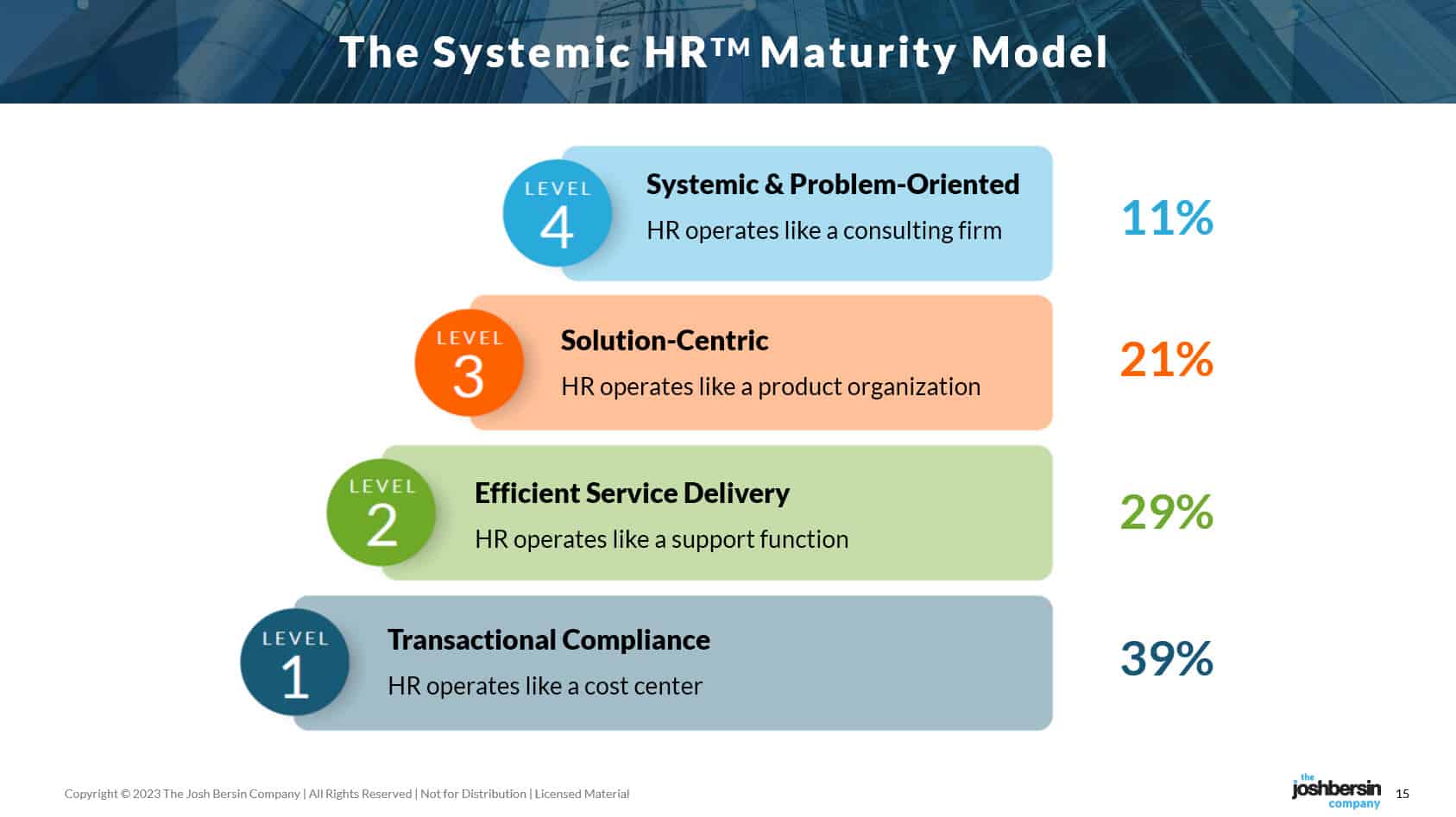
So here’s my point. HR, like other functional areas in our companies, is going to have a real-life identity crisis. If you can’t figure out how to move your HR function up the maturity level quickly (check out our Systemic HR maturity model) someone’s just going to cut your headcount (the Elon Musk approach). Then you’ll be figuring out AI in a hurry.
(Galileo can assess your HR maturity with its “consulting mode,” by the way.)
I’m not saying this is easy. The AI products we need barely exist yet. But the pressure is on.
You shouldn’t wait for the CFO to point his “productivity gun” in your face, you have to get ahead of this wave. Start pushing yourself to fix plumbing, check out the new tools in the market, get your IT team involved, and redesign your work using your own expertise. Many surprisingly good things will happen.
Let me give you an example.
A few years ago Chipotle adopted an AI-based agent system for recruiting, effectively automating a complex workflow for hiring. Not only did it save millions of dollars, the “speed and quality” of hiring went up so high the CEO talked about it as their top “revenue driver” with Jim Cramer on CNBC.
In other words this “identity crisis” in HR is a good thing.
Our recruiting, training, and employee services groups are too big. AI can automate enormous amounts of this work. So my advice is this. As the AI wave sweeps across your company, get out your old “org design” book and start redesigning how your HR team operates right now. Then you can go to the AI vendors and tell them what you want. That’s the secret to keeping HR in tip-top shape.
Will HR go away? Well a lot of the process, data management, and support roles will absolutely change. And yes, employees and job candidates will happily use intelligent bots instead of calling their favorite HR manager.
But as a Superworker, you, as an HR professional will do more interesting things. You’ll become a consultant; you’ll manage and train AI systems; and you’ll have much more real-time information about the strength and weaknesses of your company. We’re just going to have to lean into this AI wave to get there.
As AI agents arrive, it’s time to seriously re-engineer HR. And this time it’s not a transformation, it’s a reinvention.
Bottom line is this. Don’t wait for Workday, SAP, or some other vendor to “invent” a tool that changes your HR operation. You should do it yourself first and bring your IT people with you. That way you’ll buy and build the AI systems you need, and the result will be a new career, an even better HR function, and the opportunity to help your company move from “hiring” to “productivity” in the future.
我刚刚在伦敦与数十家企业进行了为期一周的交流,大部分讨论都围绕着AI展开。绝大多数对话的主题是:公司在应对AI带来的影响时,感到焦虑、推动、甚至焦躁不安,这种焦虑不仅体现在HR部门,也体现在各业务团队中。
在CEO和CFO的压力下,HR团队正被要求加速自动化、优化服务、并通过AI实现人员精简。虽然我们都知道AI是一种能够促进增长和规模化的技术,但当前传递出的主要信息是:“赶紧推动生产力项目。”
而所谓的“生产力”,实际上就是“裁员”的委婉说法。
先谈谈裁员
几乎我们接触的每一家企业,都的确存在人员过剩的问题。这是为什么呢?
因为我们的招聘、资源配置和工作管理方式本身就非常低效。我们将“编制名额”下放给各级管理者,而他们则倾向于尽可能多地招聘人员。
我们并没有真正教导或激励管理者如何构建高效的生产力,反而往往奖励他们“扩大团队规模”。结果就是,像我最近在一家大型广告公司看到的那样,组织中充满了各种各样的职位,但缺乏统一性和结构性。这家公司有约10万名员工,却设有超过6万个不同的岗位头衔——几乎每个职位都是为某个人量身定制的,这种做法显然荒谬。
企业存在的根本目的,是为了实现规模化。如果每个部门经理都各自为战,自行搭建团队架构,那无异于将低效深植于企业之中。
虽然我们有一些基本的组织效率模型,比如呼叫中心、全球服务中心、共享服务、能力中心等,但这些传统设计在当下正逐渐过时。在高性能多功能AI代理全面普及的时代,我们必须走得更远。
从“第一性原理”重构组织?
Elon Musk 推崇“第一性原理”方法——即解散现有团队,只从零开始招聘最核心、最迫切需要的人员。这种方法在小型公司或许奏效,但在大型企业中,由于存在大量“支持服务”,简单地“砍掉重建”并不可行。
现实中,很多公司在各个角落散布着项目经理、程序经理、分析师等职位,因为核心员工缺乏管理项目、推进计划、或进行数据分析的能力。由于招聘过程中缺乏严格的标准和规划,各部门纷纷自行扩编,导致组织臃肿、效率低下。
组织设计本来就是一门古老且被严重忽视的学问,多数公司对此缺乏系统化思考。IBM 曾表示,他们的组织设计策略是“聘请一位高绩效高管,让他/她自己摸索出解决方案”——这实际上是行业普遍现象。
AI真正改变的,是“工作设计”
如果我们希望从AI工具和代理中获得真正的投资回报率,就必须彻底重新思考“工作设计”——不仅仅是画组织结构图,而是要厘清工作流程、标准化与非标准化的业务环节,并找出可以自动化的领域。
尽管大多数企业已经部署了大量的生产力系统(如ServiceNow、Salesforce、Workday等),但由于缺乏使用这些系统的能力或纪律,反而持续地通过“增加人手”来解决问题。
作为一名工程师,我对此体会尤深。将问题推给某个人远比优化底层“管道”来得容易。然而,管理工作流程就像修建城市水管系统——如果基础设施不合理,再先进的AI工具也无济于事。
正如渣打银行Tanuj Kapilashrami所说:“必须先修好管道,才能合理应用AI。”
这意味着,我们不能指望微软Copilot之类的工具神奇地提升员工生产力。我们必须从根本上重新审视业务流程与员工技能,并围绕AI重新设计整个企业运作模式。
员工技能,未来的关键
企业之所以聘请大量“分析师”和“项目经理”,往往是因为普通员工和管理者缺乏项目管理、时间安排、数据分析等基本技能。未来,所有人都需要掌握这些能力,而不再依赖大量辅助人员。高阶专业人才应当专注于重大事务,而不是出席会议做会议记录(AI记录工具早已能胜任此事)。
(顺便提一句,我预测很快就会出现AI项目经理、AI程序经理、AI数据分析师——这些岗位也将逐步被自动化!)
那么HR会怎样?
回到HR领域,当企业致力于重塑流程、导入AI时,HR的角色至关重要。
HR的本质任务是构建并管理围绕“人”的各项流程:招聘、培养、管理、薪酬、激励与支持等。这项使命极为庞大,当公司将焦点转向“提升生产力”时,HR必须积极参与。
一般认为,一个运作良好的HR团队与公司整体人数的理想比例是1:100。也就是说,一家拥有1万名员工的公司,大约需要100名HR人员。而优秀的HR团队不仅自己高效运作,更会采购、搭建技术系统,以实现规模化管理。
举例来说,如果CEO要求你招聘50名顶尖AI工程师,你不能只是随便打几个电话,而是要设计一套高效、可扩展的方法。这可能包括外包、引进人才情报系统、招聘高端猎头,等等。总之,HR自身也必须成为高效运作的样板。
因此,HR团队必须迅速引入AI代理,取代大量重复性事务,尤其是那些依赖工作流、流程管理和行政性处理的工作。比如,我们的Galileo系统已经可以自动评估候选人的面试表现,并将其技能映射到Lightcast、SHL和Heidrick的领导力模型。
未来,HR工作会消失吗?
某种程度上,答案是肯定的。
凭借出色的数据整合和生成能力,AI可以完成50%-75%的HR工作。目前这些AI系统尚未完全成熟,但趋势已经非常明显。
我们刚刚与一家大型制药企业交流,他们已经基本实现了“全AI化管理”,以仅10人规模的学习与发展团队,服务6000多名科学家和制造专家。他们通过AI自动完成了培训、合规追踪、入职辅导、领导力支持等任务。对于大多数公司来说,这种效率简直是难以想象的。
HR将迎来身份危机
未来,HR必须迅速向更高的成熟度迈进(可以参考我们提出的Systemic HR Maturity Model)。否则,就会像Elon Musk那样,被大规模裁员,并被迫在短时间内仓促上马AI项目。
我并不是说这条路轻松易行。事实上,市面上真正成熟的AI HR产品还非常有限。但压力已经到来。
HR不能等着CFO拿着“生产力枪”指着自己,必须主动出击,修好内部“管道”,试用新工具,联合IT团队,重新设计工作模式。这样,你将能主动选择适合自己公司的AI系统,并构建一个全新的、充满机遇的职业未来。
结语:HR的重塑与再创造
让我们看看Chipotle的案例。他们通过部署基于AI的招聘代理,成功自动化了复杂的招聘流程,不仅节省了数百万美元,还大幅提升了招聘速度和质量。甚至在接受CNBC采访时,CEO将这一成果称为公司的“主要营收驱动因素”。
这场HR身份危机,其实是一个难得的机遇。
我们今天的招聘、培训、员工服务团队规模普遍过大。AI将能够自动化其中大量工作。我的建议是:在AI浪潮席卷而来之前,立即拿起你尘封已久的组织设计手册,重新设计HR团队的运作方式。这样,当面对AI供应商时,你可以主动提出自己的需求,而不是被动接受他们的产品。
未来HR不会消失,但大量传统流程、数据管理与支持岗位将发生剧变。员工与候选人也会越来越习惯通过智能机器人,而非人力HR来解决问题。
不过,真正优秀的HR专业人士,将会变成超能型人才(Superworker)——你将成为企业战略顾问、AI系统训练师,并且能够实时掌握公司人才与流程的整体健康状况。
这次,不再是简单的“转型”,而是真正意义上的“再创造”。

 员工体验
员工体验
 员工体验
员工体验
 员工体验
员工体验
 员工体验
员工体验
 员工体验
员工体验
 员工体验
员工体验
 员工体验
员工体验
 员工体验
员工体验
 员工体验
员工体验
 员工体验
员工体验



 扫一扫
添加客服
扫一扫
添加客服


