• talent strategy
    CHRO 的新战略机遇:生成式 AI 如何重塑组织的未来 概要:74% 的 CEO 认为团队已准备好迎接 AI,但只有 29% 的 C-suite 同意。这一巨大认知差距既是风险,也是 CHRO 最关键的机会窗口。预计到 2025 年,77% 的初级岗位与超过 25% 的高管岗位都将因 AI 发生改变。未来三年,CHRO 必须从支持角色转变为组织未来的设计者,围绕三项任务展开:构建 AI 人才战略、重塑组织运营模式、建立 AI 治理框架。AI 时代的核心竞争力不再是技术本身,而是 CHRO 如何重塑组织能力与文化。抓住这个窗口期,组织才能真正迈向未来。 引言:迎接组织变革的“AI 时刻” 生成式 AI 与以往任何技术都截然不同,它正以前所未有的速度颠覆商业与社会,迫使领导者实时反思并重塑其核心战略。这场变革的核心并非技术本身,而是它对“人”与“工作方式”的根本性重塑。正如深度研究所指出的,“生成式 AI 的一切都与人有关——关乎工作如何完成”。 懂得如何用生成式 AI 赋能人才的领导者,将对业务产生“倍增效应”。在未来三年,首席人力资源官(CHRO)将迎来一个决定性的转折点,从传统的支持角色转变为驱动这一倍增效应的核心战略制定者。然而,当前仍有高达 60% 的高管将人力资源视为纯粹的行政职能,这一认知错位不仅是巨大的风险,更预示着一个前所未有的战略机遇。CHRO 必须抓住此刻,引领组织迎接未来。 -------------------------------------------------------------------------------- 一、趋势洞察:生成式 AI 正在重塑工作的本质 1. AI 放大人类能力,而非取代人类 生成式 AI 的核心价值在于放大人类的专业能力。它通过自动化市场研究、内容创建、数据分析和代码开发等重复性任务,让员工得以专注于更高价值的创造性工作。例如,客服人员可以将常规问答交给 AI,从而专注于销售赋能;程序员可以摆脱繁琐的编程,聚焦于提升代码质量与安全性;HR 专家则能从日常流程中解放出来,全力投入于真正重要的人才发展。 企业的竞争优势不再仅仅来源于技术本身,而是来源于规模化员工的专业知识和扩展组织的能力。这催生了“AI 增强型劳动力”的概念。一个清晰的现实是:生成式 AI 不会取代人类,但使用生成式 AI 的人将会取代不使用它的人。 2. CEO 与组织间存在显著的“AI 准备度差距” 高管层对组织 AI 准备度的认知存在显著脱节,这种乐观情绪背后潜藏着巨大风险。数据显示: 74% 的 CEO 认为他们的团队已经为生成式 AI做好了技能准备。 然而,仅有 29% 的 C-suite 高管 同意这一观点。 这一巨大的认知鸿沟,代表了 CHRO 最为紧迫的行动指令。更值得警惕的是,AI 的影响是普遍的:到 2025 年,77% 的初级员工的岗位将发生转变,同时超过四分之一的高管也无法幸免。这使得 CEO 的盲目乐观尤为危险。CHRO 的核心机会在于,识别并弥合组织内部的人才与能力错配,确保组织具备驾驭变革的真实能力。 3. 未来关键能力:创造力与协作力超越技术力 在一个看似由技术驱动的变革时代,一个反直觉的真相浮出水面:人类独有的软性能力正变得空前重要。一项核心洞察指出: 高管们认为,到 2025 年,对组织最有价值的技能将是创造力。 当技术性工作可以被 AI 高效辅助时,企业的核心竞争力将从技术熟练度转向那些机器无法复制的能力。高管们认为,团队建设和协作能力与软件开发和编码同等重要,甚至领先于分析和数据科学。创造力,将成为引领未来的关键。 -------------------------------------------------------------------------------- 二、CHRO 的三大新使命:未来 36 个月的行动框架 为应对挑战,CHRO 需要一个清晰、可执行的战略框架,围绕以下三大新使命展开行动。 1. AI 人才战略 (Talent Strategy for AI) 目标:重新设计人才的“选、育、用、留”体系,构建一支 AI 增强型团队。 行动建议: 重塑岗位与技能图谱:推动对现有岗位职责的重新定义,将工作重心从执行重复性任务,转向利用 AI 进行分析、创造和战略决策。 推动全员技能再培训:将 AI 技能提升视为员工重大的职业发展机遇。尤其要重点投资于高绩效员工,因为 AI 无法放大平庸的绩效,它带来的是一场革命而非演进,其真正价值在于将优秀人才的能力提升到全新高度。 将人力资源部作为战略试点:要让全员拥抱 AI,首先要从人力资源部开始。CHRO 应将 HR 部门打造为组织内 AI 转型的战略试点项目,率先对 HR 专业人员进行再培训,使其成为组织内 AI 应用的实践者、引领者和赋能者。 2. 组织运营模式重构 (Operating Model Redesign) 目标:打造更敏捷、更智能、更具创造力的组织模式,以释放 AI 的全部潜力。 行动建议: 聚焦高价值应用场景:避免被海量的可能性分散精力。集中资源投资于三到五个最具商业影响力的 AI 应用场景(“Focus on the top five. Or three.”),以点带面,实现价值最大化。 建立快速迭代与试错文化:鼓励团队以“快速失败”(fail fast)的方式进行小范围实验。建立跨部门的反馈循环机制,系统性地分享成功案例、失败教训和实践经验。 利用 AI 优化工作流程:应用 AI 增强的流程挖掘技术,深入分析现有工作流程,精准识别瓶颈与低效环节,并通过智能化改造加速决策效率。 3. AI 治理与伦理 (AI Governance) 目标:建立负责任的 AI 使用框架,确保技术向善,规避潜在风险。 行动建议: 建立明确的道德准则:制定并推行一套清晰的 AI 道德使用框架,其中包含明确的标准、指南和行为期望。 保障数据安全与隐私:在鼓励全员实验的同时,必须围绕数据保护和道德规范设立明确的护栏,确保创新在安全可控的范围内进行。 确保透明与公平:在招聘、绩效评估等关键人力资源环节应用 AI 时,必须建立有效的机制来管理算法偏见,确保决策过程的透明度与公平性。 -------------------------------------------------------------------------------- 三、从战略伙伴到未来设计师:CHRO 的新定位 生成式 AI 正在推动 CHRO 的角色发生根本性演进。CHRO 必须从被 60% 高管视为被动的行政支持者,进化为主动的战略引擎,成为组织未来工作模式的总设计师和 AI 时代人力资本的管理者。CHRO 的新角色是通过前瞻性地引导 AI 在人才与组织层面的落地,主动重塑组织文化、决策模式和业务节奏。 在最高管理层中,CHRO 的新定位是连接技术、人才与业务战略的关键枢纽。AI 的成功绝非单一部门的责任,而需要建立一个由业务、IT 和人力资源负责人共同负责的问责模式。在这个领导力“三驾马车”中,CHRO 作为平等的战略伙伴,确保技术投资能够真正转化为组织能力和商业价值。 -------------------------------------------------------------------------------- 决胜未来,重在组织能力的设计 生成式 AI 时代已经到来,领先的企业正在迅速采取行动。最终的成功者,将是那些能够围绕人才与技能建立灵活、深思熟虑的战略,并积极克服组织焦虑、奖励热情、拥抱包容与乐观的组织。 在生成式 AI 时代,决定企业未来竞争力的不是技术本身,而是 CHRO 对组织与人才能力的重新设计能力。
    talent strategy
    2025年11月24日
  • talent strategy
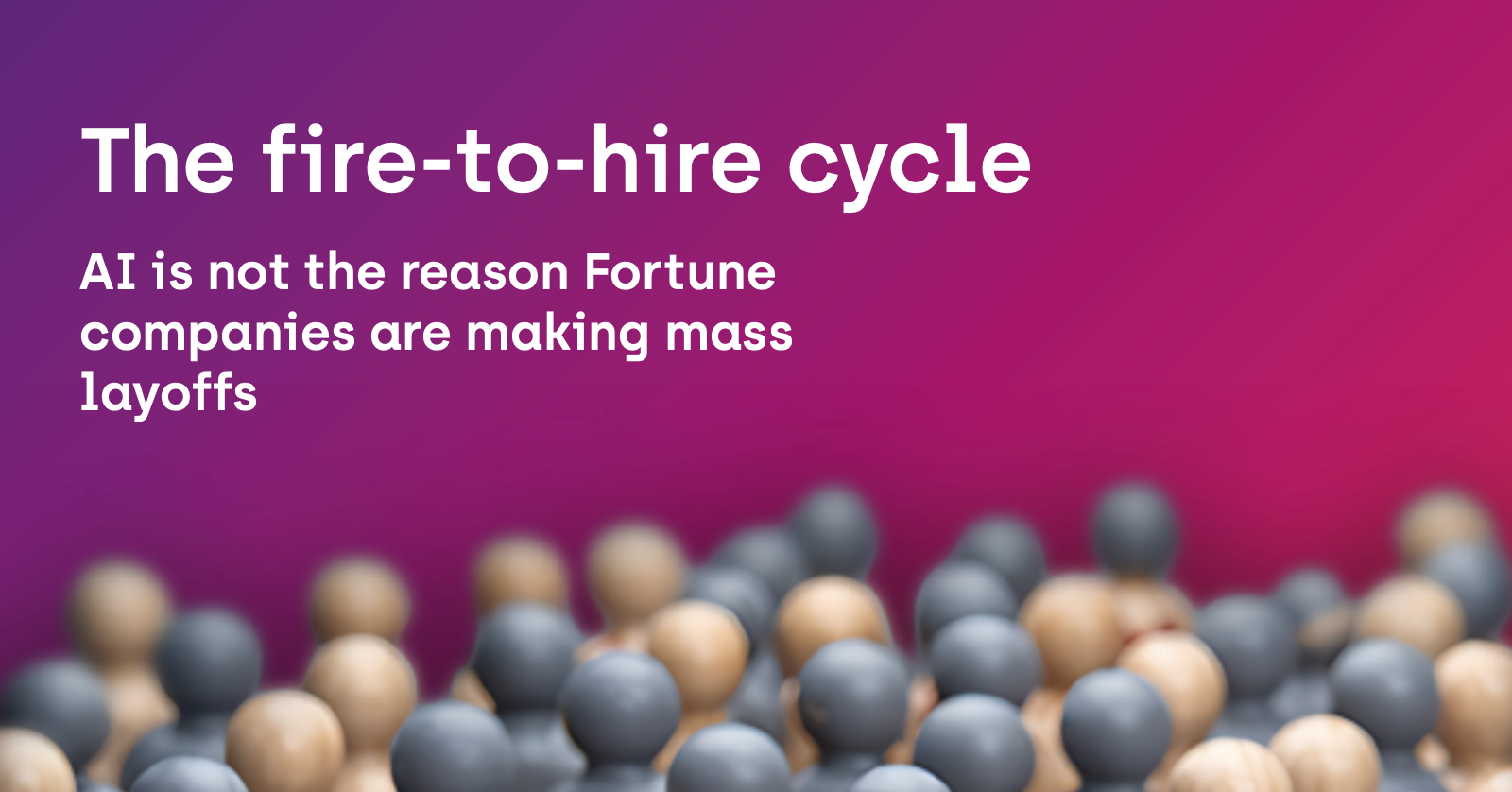
    AI并非裁员元凶:财富100强陷入“解雇—再招聘”循环,250亿美元换不来AI转型 美国财富100强的裁员潮与AI关系不大。报告分析了超过一万条招聘信息,发现仅有11%的岗位提及AI,6%要求具体技能。过去一年,这些企业共裁员8.6万人,但又在2025年7月新增5.8万个职位。所谓的“解雇—再招聘”循环让企业仅在2024年就支付了250亿美元的遣散费,平均每节省1美元,实际支出却高达1.27美元。 在AI热潮席卷全球的当下,企业大规模裁员似乎成了数字化转型的必经之路。但来自 Orgvue 的最新研究却揭示了一个令人意外的事实:AI并不是驱动裁员的核心力量,美国财富100强企业正陷入一场高成本、低回报的“Fire-to-Hire(解雇—再招聘)”循环。 一、AI“高声量、低落地”:仅一成岗位提及AI Orgvue 对财富100强企业最新招聘信息的分析显示,在所有岗位中,仅有 11% 提及AI,其中仅 6% 明确要求具体AI技能或平台经验。换句话说,大多数企业在招聘层面并未显现出对AI能力的迫切需求。 行业差异同样显著: 科技行业的AI需求最高,占比 26%; 金融与医疗行业分别仅为 9% 和 8%; 非管理岗位仅 8% 要求AI技能,而总监级以上职位则高达 18%。 这一结果揭示出一个趋势:AI素养正成为决策层的“战略语言”,而非一线员工的“执行工具”。 Orgvue 首席产品官 Jessica Modrall 指出: “AI 技能的真实需求远低于市场想象。企业似乎尚未明确AI究竟能在哪些岗位、哪些场景中真正创造价值。” 她补充说,AI 投资在实践中“屡屡令人失望”,暴露出雄心与落地之间的巨大断层。 二、裁员不是AI的结果,而是效率幻觉的代价 过去一年,48家财富100强企业共裁员86,000人,但其中 46家又在2025年重新招聘。仅2025年7月,这些企业就新增了 58,000个职位。 Orgvue 将此现象定义为“Fire-to-Hire Cycle”——一种表面上削减成本、实则代价高昂的循环。报告显示: 2024年财富100强企业仅遣散费支出就达 250亿美元; 扩展至财富500强,总额高达 430亿美元; 平均而言,企业每节省1美元人力成本,反而要额外支出 1.27美元 的隐性成本(包括招聘、培训与生产力损失)。 这意味着所谓“AI驱动的精简”并未带来效率提升,反而使企业在重组中不断失血。 Jessica Modrall 评论道: “AI经常被用作裁员的理由,但缺乏对岗位、技能与工作内容的数据洞察,企业实际上是在丢失宝贵的组织记忆与知识资产。” 三、“AI取代人类”是误解,企业更倾向招募年轻可塑性人才 研究还发现,64% 的新招聘岗位面向工作经验不足5年的候选人,其中近一半为基层岗位。这意味着AI并未消灭初级职位,反而让企业更青睐“灵活、学习能力强”的新生代劳动力。 然而,只有 24% 的招聘信息提及职业发展机会,18% 未公开薪资区间,显示企业更关注“短期补位”而非“长期培养”。这种策略虽然能降低薪资支出,却可能削弱企业的知识沉淀与文化连续性。 四、行业画像:AI需求冷热不均,文化与灵活性成关键差异点 科技行业(Tech):处于AI与文化双重引领地位。92% 的招聘岗位提到企业文化,70% 提供股权激励。 医疗行业(Healthcare):以灵活工作模式和职业发展机会领先,42% 岗位支持远程或混合办公。 金融行业(Finance):高层招聘比例最高(39%),但AI应用仍处早期,仅9% 岗位提及AI技能。 五、解读:AI不是“裁员导火索”,而是“转型信号灯” Orgvue 的研究为当前“AI导致大规模裁员”的论调泼下冷水。AI并未直接带来岗位消失,而是暴露出企业在组织规划与技能转型上的盲区。 真正的挑战不在于“AI取代人”,而在于“如何用AI重塑人”。企业若持续依赖短期的“裁员—补员”循环,而不建立系统性的人才与技能规划能力,将在AI浪潮中失去竞争力。 Modrall 总结道: “未来的关键,不是是否转型,而是你是否基于数据、有计划地转型。那些依赖直觉裁员、盲目重组的企业,正在为短期利益牺牲长期韧性。” AI并非洪水猛兽,也不是万能解药。真正的竞争优势来自于企业能否以数据为基础进行劳动力洞察,找到“技术—人—组织”三者的最优平衡点。在AI时代,管理者的任务不再是裁掉人,而是设计出让“人+AI”协同创造价值的新工作体系。
    talent strategy
    2025年10月30日
  • talent strategy
    The best HR & People Analytics articles of March 2025 2025年3月的《Data Driven HR Monthly》由人力分析专家David Green主编,汇集了全球最新的HR与人力分析领域的重要洞察。文章聚焦于“技能驱动型组织”、“CHRO领导力崛起”与“生成式AI在HR中的落地应用”等核心主题。Insight222最新研究指出,若CHRO和高管团队以身作则地使用数据,HR人员在日常工作中应用人力分析的可能性将提高三倍。Mercer报告显示,高技能效能企业中有73%建立了系统的技能目录。此外,Deloitte《2025全球人力资本趋势》强调,应在“组织文化”“员工个人成长”“企业社会价值”三者之间平衡张力。McKinsey指出,25%的企业通过应用生成式AI,HR成本下降超过10%。Josh Bersin研究则揭示,13%的CHRO已跻身企业前五高薪高管,展现出其日益增强的战略地位。本期还涵盖了关于员工体验设计、DEI策略调整、混合办公模式下的设计思维、HR技术成熟度评估、员工聆听模型等多项实务建议,是HR从业者和决策者必读的专业内容合集。 I was reflecting this weekend that I have now been in the people analytics field for over a decade. Much has changed during that time, but three constants have been the Wharton People Analytics Conference, People Analytics World and UNLEASH. All have acted as a source of inspiration to me and an unmissable opportunity to connect with others in our field. As such, I am looking forward to attending and speaking at all three events in the coming weeks. First, I’m excited to be speaking for the first time at the Wharton People Analytics Conference in Philadelphia on April 10 and 11 on Unlocking the Power of Data: The Case for Analytics Democratization. Other speakers include: Amy Edmondson, Ravin Jesuthasan, Ben Waber, Jennifer Kurkoski, Guru Sethupathy, Siri Chilazi, and Michael Fraccaro. Next up, I’ll be co-chair and opening keynote speaker at People Analytics World in London on April 29 and 30, where I’ll be sharing some of the research and work we do at Insight222. Other speakers include: Dawn Klinghoffer, Alexis Saussinan, and Cole Nussbaumer. The week after, I’ll be heading back to the US for Unleash America, which takes place in Las Vegas, and where I’ll be moderating the Unleash Talent Summit on May 6, and the AI Track on May 7 and 8. Other speakers include; Adam Holton, Anshul Sheopuri, Sue Lam, Avani Prabhakar, Christy Pambianchi, and Amy Coleman. I hope to see some of you in Philadelphia, London and/or Las Vegas. This edition of the Data Driven HR Monthly is sponsored by our friends at Mercer Putting skills to work: Benchmarking skills-powered success The scale of skills gaps poses an existential threat to businesses’ ability to get work done. The velocity and volatility of change associated with these gaps stems from compounding trends across geopolitics, climate, demographics and the AI revolution. How can organizations keep pace when supply fails to meet shifting demand? Accelerating agility is one answer. By connecting the dots between skills and the specific tasks that are changing, employers can unlock new ways to connect people to work (beyond moving them from one job to another). A skills taxonomy lays the groundwork: Mercer’s 2024-2025 Skills Snapshot Survey Report shows that 73% of companies with high skills effectiveness have a skills catalog. While technology makes skills mapping easier, the overall journey can feel overwhelming. HR capacity concerns often stop teams from taking the first step to becoming skills-powered. To put skills to work in a manageable way, think big but start small with a pilot program. This may be for a specific talent process like internal mobility or talent acquisition in the context of a fast-changing business area. Find more strategic skills insights in Mercer’s 2024-2025 Skills Snapshot Survey report, including: Building the path to a skills-powered organization Mapping skills to employees Linking skills with rewards Overcoming obstacles Get the Snapshot Enterprises who realize the full potential of Skills-Powered Organization practices use skills to revolutionize how they work, modernize talent deployment, and rethink development and rewards. Their journeys are underpinned by a shared vision and a strong data foundation. To sponsor an edition of the Data Driven HR Monthly, and share your brand with more than 140,000 Data Driven HR Monthly subscribers, send an email to dgreen@zandel.org. MARCH ROAD REPORT March turned into a month of highs and lows. Focusing on the former, the first week of March witnessed the most successful and well-attended Peer Meeting yet for member companies of the Insight222 People Analytics Program®, hosted by NBC Universal at their iconic global headquarters at the Rockefeller Center in New York. A huge thank you to Jamie Nevshehir and Jennifer Mandelson for hosting as well as our speakers at the event: Dawn Klinghoffer, Lynette Carlson, Olga Dobromyrova, Geetanjali Gamel, Anshul Sheopuri and Jeremy Shapiro. March also saw me deliver two conference keynotes in my home city of London. First up, I had the privilege of delivering the closing keynote at HiBob’s Heartcore HR event in London (see here) – thanks to Emily Hanssen Arent for inviting me and Toby Hough for hosting. The following week, I had the pleasure of delivering another closing keynote – this time at the Workhuman Forum Live – on how data-driven storytelling can elevate HR’s impact and role in shaping the future (see here) – thanks to Maya Lane and Kathryn Santora for inviting me. Join me for an Insight222 webinar on April 2 on building data literacy in HR at scale. In our research at Insight222, we have found that when both the CHRO and the HR leadership team role-model the use of people data and analytics, HR practitioners are three times more likely to use those insights in their day-to-day work. That’s the kind of cultural shift that unlocks business impact, strategic alignment, and organisational capability. If you’re interested in learning more about why data literacy is central to the success of both the HR function and the wider business—please join Naomi Verghese along with Shannon Rutledge, Director of People Analytics & Data Solutions at T. Rowe Price, and me on 2 April 2025 at 4:00 PM BST for our upcoming webinar, “Upskilling the HR Profession – Building Data Literacy at Scale”. Share the love! Enjoy reading the collection of resources for March and, if you do, please share some data driven HR love with your colleagues and networks. Thanks to the many of you who liked, shared and/or commented on February’s compendium. If you enjoy a weekly dose of curated learning (and the Digital HR Leaders podcast), the Insight222 newsletter: Digital HR Leaders newsletter is usually published every other Tuesday – subscribe here – and read the latest edition. HYBRID, GENERATIVE AI AND THE FUTURE OF WORK HELEN POITEVIN - AI in HR: Hits, Misses and Growing Pains Skills-based talent management cannot scale or be sustainable long-term without AI-enabled skills management. Writing for Gartner, Helen Poitevin presents a AI use-case prism for human capital management (see FIG 1) before providing detailed insights on AI in HR across three key areas: recruiting, virtual assistants and skills in terms of what’s working and what isn’t as well as areas requiring more focus (growing pains) and what to expect next. For example, with AI-enabled skills management, AI is helping organisations to scale and personalise but is still struggling to incorporate unstructured skills data. Helen recommends starting with the teams that are most ready for using skills data alongside creating a long-term skills vision and ambition. She also highlights that growth in the use of AI based skills management tools is set to rise: “Gartner predicts that by 2028, 40% of large organizations will have invested in two or more AI-enabled skills management solutions with the aim of delivering business agility.” Thanks to Brian Heger for highlighting in his excellent Talent Edge Weekly newsletter. FIG 1: AI use-case prism for human capital management (Source: Gartner) McKINSEY - The state of AI: How organizations are rewiring to capture value The latest McKinsey Global Survey on AI finds that the use of AI (both generative and analytical) is increasing with three-quarters of organisations using AI in at least one business function. From a people and HR perspective there are a number of takeaways from the report including these five: (1) Just over 20% of companies have created a comprehensive approach to foster trust among employees in the use of GenAI. (2) 31% of large and 17% of small organisations have established capability-based training courses designed to help employees use GenAI appropriately. (3) AI is shifting the skills organisations need with roles on risk and ethics on the rise and those in data-visualisation reducing. (4) There is an increased focus on reskilling with companies expecting this to further increase in the next three years (see FIG 2). (5) Across industries 13% of companies report they are using GenAI regularly in HR with the media and telecom sector highest at 22%. (6) 25% of companies report cost reductions in HR of more than 10% in the second half of 2025. Kudos to the authors: Alex Singla, Alexander Sukharevsky, Lareina Yee, and Michael Chui, with Bryce Hall. FIG 2: Employee reskilling due to AI use (Source: McKinsey) DELOITTE - 2025 Global Human Capital Trends: Navigating complex tensions and choices in the worker-organization relationship Organizations that successfully increase the capacity of workers to grow personally, use their imagination, and think deeply are: 1.8 times more likely to report better financial results, 1.4 times more likely to say they are creating broad value for customers, community, and society, and 1.6 times more likely to say they provide workers with meaningful work. Deloitte’s annual Global Human Capital Trends report is always insightful, thought-provoking and forward-looking, and the 2025 edition does not disappoint. The introduction sets the scene and highlights the need for organisations and leaders to find a balance between competing tensions (see FIG 3). The report has eight chapters organised around three themes of work, workforce, and organisation and culture, and what it means to navigate the tensions in them. As ever, the report is packed full of insights, visualisations and data – I particularly found the analysis on AI’s potential silent impacts interesting (see FIG 4). Kudos to the authors who include: Susan Cantrell, David Mallon, Kevin Moss, Nicole Scoble-Williams GAICD, and Yves Van Durme. FIG 3: Navigating the tensions (Source: Deloitte) FIG 4: AI’s potential silent impacts (Source: Deloitte) PEOPLE ANALYTICS NAOMI VERGHESE - The Importance of Data Literacy Skills for HR Professionals By embracing people data and analytics, HR can move beyond traditional administrative functions and become a key driver of business success. Insight222’s most recent People Analytics Trends survey confirms that scaling data literacy is a strategic priority for CHROs, with 85% of companies confirming that the CHRO has emphasised people data and analytics as an essential component of the HR strategy. However, only 58% of companies report that they have a data-driven culture for people data and analytics today, and only 51% of companies report that HR Practitioners are actively developing their data literacy skills to become more data driven. In her article, Naomi Verghese provides examples of data literacy in practice (see FIG 5), and highlights five skills for HR professionals to develop data literacy (including being able to tell stories with data) FIG 5: Examples of data literacy in HR in practice (Source: Naomi Verghese, Insight222) MARTHA CURIONI - Analytical AI vs Gen AI – What’s the Difference? | PRABHAKAR PANDEY - Understanding the European Union's Pay Transparency Directive | ALEXIS FINK - The Power of Responding instead of Reacting | RICHARD ROSENOW - An (updated) interview with an unusual People Analytics Expert - ChatGPT 4.5 | SCOTT REIDA - Evaluating Talent Hubs: A Data-Driven Approach using GenAI w/Tableau In each edition of the Data Driven HR Monthly, I feature a collection of articles by current and recent people analytics leaders. These are intended to act as a spur and inspiration to the field. Five are highlighted in this month’s edition. (1) Martha Curioni provides a helpful primer on the differences between analytical AI and generative AI in a HR setting (see FIG 6).  (2) Prabhakar Pandey provides a detailed examination on the background, objectives, key provisions, and potential impacts of the EU’s Pay Transparency Directive on employers, employees, and the broader European economy. (3) Alexis Fink provides a timely guide on the power of responding instead of reacting. (4) Richard Rosenow fires a series of questions related to people analytics at ChatGPT 4.5, and gets a pretty good set of answers. (5) Scott Reida walks through a structured, GenAI-powered methodology for evaluating talent hubs using ChatGPT, which explains how to define clear objectives, select job families and locations, weight decision factors, and visualise results for smarter, faster insights. Thanks to Hung Lee and Toby Culshaw for highlighting Scott’s article. FIG 6: The differences between analytical and generative AI (Source: Martha Curioni) THE EVOLUTION OF HR, LEARNING, AND DATA DRIVEN CULTURE DAVE ULRICH - Six Actions for HR to Create More Stakeholder Value How can HR create more value for all stakeholders? That’s the question posed by Dave Ulrich at the start of his article. As he explains, answering this pivotal question enables HR leaders to make informed choices about where to prioritise their work and then intentionally share what they are doing and its business impact. In the article, Dave outlines HR’s key stakeholders and the outcomes they require, a human capability framework that integrates 38 initiatives into four pathways, how to focus on outcomes as opposed to activities, and how we can get more precise when it comes to prioritising our work. FIG 7: Six actions, questions, next steps to create stakeholder value from human capability KATE BRAVERY, JOANA SILVA, AND JENS PETERSON | MERCER - Workforce 2.0: Unlocking human potential in a machine-augmented world - Global Talent Trends 2024-25 The world of work is in full metamorphosis, forever changed by the seismic shifts of recent years and accelerated by the imminent human-machine teaming revolution. The rise of generative AI has been met with equal measures of unease and excitement, changing not only how people work but the work experience itself…Unlocking the potential of this new world of work means keeping people at the heart of the transformation agenda. These are an abridged version of the opening words from the Mercer Global Talent Trends report for 2024-25, which has recently been published. As ever, the study, which is based on a survey of 14,400 executives, HR leaders, employees, and investors, and is authored by Kate Bravery Joana Silva and Jens Peterson – with contributions from the likes of Jason Averbook, Ilya Bonic, Lewis Garrad, Ravin Jesuthasan, CFA, FRSA, Jean Martin and JESS VON BANK is an absolute must-read. As in previous years, the study highlights a disconnect between what HR is prioritising for the 2025 people agenda and the initiatives that executives believe will have the most impact on business growth (see FIG 8). The analysis also highlights that improving people managers’ skills (up from 9th in 2024 to 1st in 2025) and designing talent processes around skills (up from 8th to 3rd) are high on HR’s agenda. The study identifies and breaks down four priorities that firms that outpace their competitors are focusing on: (1) Driving human-centric productivity. (2) Anchoring to trust and equity. (3) Boosting the corporate immune system (including highlighting the importance of insights and analytics – see FIG 9). (4) Cultivating a digital-first culture. My tip to enjoy the study: find a couple of hours, make yourself a cup of tea and have a pen and paper to hand. FIG 8: HR priorities for the 2025 people agenda (Source: Mercer Global Talent Trends 2024-25) FIG 9: What gets measured gets managed (Source: Mercer Global Talent Trends 2024-25) JOSH BERSIN AND KATHI ENDERES - Secrets Of The High Performing CHRO The CHRO role is critical for business success, with CHROs serving as C-suite leaders first, and HR function leaders second. In his article previewing his new paper with Kathi Enderes, Understanding the Path to CHRO, Josh Bersin cites a recent study by Nick Bloom and Mert Akan (see here), which finds that 13% of CHROs are among the top five highest-paid executives in their organisations, a sharp rise from just 0.5% thirty years ago. The paper outlines the role of the CHRO, career trajectories, education, experiences, and high-level success drivers, along with the implications for leaders. Findings include: (1) More than 75% of CHRO appointments come from the outside, indicating a lack of CEO confidence in HR and/or a lack of succession planning for this job. (2) There are four major archetypes of CHRO (see FIG 10): Career CHRO (who change companies regularly), Company CHRO (who grow up inside the company), Business CHRO (who are rotated into the job from non-HR roles), and Operations CHRO (who come from legal, finance, or operations background). (3) Business CHROs drive the greatest change and impact. FIG 10: Four paths to the CHRO (Source: The Josh Bersin Company) WORKFORCE PLANNING, ORG DESIGN, AND SKILLS-BASED ORGANISATIONS MCKINSEY - The critical role of strategic workforce planning in the age of AI S&P 500 companies that excel at maximizing their return on talent generate an astonishing 300 percent more revenue per employee compared with the median firm In many cases, these top performing firms are using strategic workforce planning to stay ahead of their competitors in the talent race, treating talent with the same rigour as managing their financial capital. In their article, Neel Gandhi, Sandra Durth, Vincent Bérubé, Charlotte Seiler, Kritvi Kedia and Randy Lim, highlight how the emergence of generative AI is making strategic workforce planning even more important (see FIG 11), and discuss five best practices for building a holistic talent plan through SWP: (1) Prioritise talent investments as much as financial investments. (2) Consider both capacity and capabilities. (3) Plan for multiple business scenarios. (4) Take an innovative approach to filling talent gaps – by refocusing from hiring to reskilling and upskilling. (5) Embed SWP into business as usual: Strategic workforce planning should become a business-as-usual process, not just a one-off exercise in the face of a single threat to an organization’s talent pipeline or business goals. FIG 11: The impact of GenAI on tasks that previously had low potential for automation  (Source: McKinsey) JOSH TARR - Key Skills-Based Strategies for Building a More Agile and Resilient Workforce | WORKDAY – The Global State of Skills Skills-based strategies are transforming the workplace into a more dynamic, adaptable, and equitable environment. Josh Tarr shares key findings from Workday’s recently published The Global State of Skills report, which finds that 51% of business leaders are concerned about a looming talent shortage, with only 32% in agreement that their organisation possesses the skills needed for future success. The article examines three key skills-based strategies: (1) Skill Identification: Building an Accurate Picture of Workforce Capabilities. (2) Skills-Based Hiring: Focusing on What People Can Do, not Their Credentials. (3) Upskilling and Reskilling: Elevating the Workforce. Thanks to Sophie Barnes for highlighting. FIG 12: Top drivers and anticipated outcomes for becoming a skills-based organisation (Source: Workday) EMPLOYEE LISTENING, EMPLOYEE EXPERIENCE, AND EMPLOYEE WELLBEING PATRICK COOLEN AND SANDER DE BRUIJN - 7 Golden Rules For Improving Employee Experience Effective EX solutions are built on an iterative and evidence-based approach while co-creating with employees. In their article, Patrick Coolen and Sander de Bruijn of KennedyFitch share their experience and insights on how to do continuous employee listening and improve employee experience. They share seven ‘Golden Rules’ for improving employee experience including: (1) Applying the ‘Triple Diamond Model’ (see FIG 13) in order to capture, understand and act on your employees' needs and ambitions. (2) Ensuring strategic positioning (“EX is a strategic capability, so the responsible team should be positioned in HR accordingly”). (3) Aiming for hyper-personalisation (“By understanding employee differences, organisations can tailor experiences to be more personalised and meaningful”). Read the article to learn about the other golden rules as well as letting Patrick and Sander know what rules eight, nine and ten should be. FIG 13: The ‘Triple Diamond Model’ to drive employee experience (Source: Patrick Coolen and Sander De Brujin) DANIEL WENTZEL, ALICE MINET, STEFAN RAFF-HEINEN, AND JANINA GARBAS - How Remote Work Changes Design Thinking A key advantage of the design-thinking process over other innovation methods is its emphasis on the user experience. Design thinking and user centred design are critical tools in building an exceptional employee experience – and HR practitioners can learn much from how these tools are applied to customer experience. In their article for MIT Sloan Management Review, Daniel Wentzel, Alice Minet, Dr. Stefan Raff-Heinen, and Dr. Janina Garbas share advice for leaders on structuring the design-thinking process to exploit the best features of both physical and virtual environments for more effective ideation, customer experience research, and other design-thinking steps. As outlined in FIG 14, effectively combining physical and virtual formats throughout the design-thinking process allows innovation leaders to harness the distinct advantages of each setting. FIG 14: How to set up hybrid design thinking processes (Source: Wentzel et al) LEADERSHIP, CULTURE, AND LEARNING STUART L. HART - How to Embed Purpose at Every Level In his article, drawn from his book, Beyond Shareholder Primacy: Remaking Capitalism for a Sustainable Future, Stuart L. Hart presents a practical framework and approach for truly embedding societal purpose, drawing upon the experience of several innovative companies. This framework imagines the company as a house of transformational sustainability – see FIG 15 – where the shared values are the foundation, the roof is the company purpose, the middle floor is the core elements of strategy. The article examines of the elements of the corporate architecture in more depth, along with examples from the 15 companies Hart and his team studied as part of their work: (1) What We Believe: Values (“The transformational companies we examined established a strong foundation built on their organizations’ values”). (2) Why We Exist: Purpose. (3) What We Solve: Aspirations and Quests: (“Together, aspirations and quests serve as the fulcrum for change in leading-edge companies, translating purpose and intention into strategy and operating reality”). (4) How We Win: Strategies and Initiatives. (5) What We Track and How We Accelerate: Goals and Metrics, Rewards and Incentives. FIG 15: The House of Transformational Sustainability (Source: Stuart L. Hart) DIVERSITY, EQUITY, INCLUSION AND BELONGING DANIEL ZHAO – DEI Data Points on Glassdoor | JOELLE EMERSON – Analysis on EEOC Assessment of Unlawful DEI Initiatives | MEG A. WARREN – Amid DEI Rollbacks, Champion Allyship | JEREMIE BRECHEISEN, TERESA ALMEIDA AND NIKITA - When Does a Regional Approach to DEI Make Sense for Multinational Companies? | BRANDON DENON - In the US, DEI is under attack. But under a different name, it might live on With the continuing uncertainty around Diversity, Equity and Inclusion, as with the February edition of Data Driven HR Monthly, I wanted to share some of the resources I’ve consumed on this topic with readers: (1) Daniel Zhao shares a number of DEI related data points from Glassdoor, which perhaps not surprisingly has seen that conservations on DEI have surged on Glassdoor’s community platform (see FIG 16). (2) DEI expert Joelle Emerson provides an initial assessment of the EEOC’s recent guidance on unlawful DEI initiatives. (3) Meg Warren, Ph.D. presents research that finds that abandoning DEI initiatives can harm both performance and workplace culture – with inclusive workplaces being better for workers and our businesses. (4) Jeremie K Brecheisen, Teresa Almeida, and Nikita present findings from a study by Gallup and the London School of Economics that found that 77% of companies had centralised DEI operations, but that the companies with decentralised regional operations reported greater business impact. (5) Finally, in a BBC InDepth article, Brandon Drenon writes on how companies in the US are adopting different stances to Trump’s Executive Orders. FIG 16: The rise of DEI conversations on Glassdoor (Source: Glassdoor) HR TECH VOICES Much of the innovation in the field continues to be driven by the vendor and analyst community, and I’ve picked out a few resources from March that I recommend readers delve into: EMILY KILLHAM | PERCEPTYX - The State of Employee Listening 2025 – Perceptyx's annual analysis of employee listening, authored by Emily Killham, is always a compulsory read. The 2025 edition continues the high standard with highlights including (1) How the top barriers to listening and action have changed in the last 12 months. (2) The critical risks associated with increasing burnout of HR leaders. (3) An update to Perceptyx’s 4-stage maturity model that describes the progression of an employee listening and action program from its most fundamental to its most robust. FIG 17: Employee listening maturity model (Source: Perceptyx) PHILIP ARKCOLL - The AI Maturity Curve: Measuring AI Adoption in your Organization – Philip Arkcoll, CEO at Worklytics , sets out a compelling framework for measuring the impact of AI on your organisation – the AI Maturity Curve (see FIG 18), which is comprised of three stages: Adoption (focused on uptake), Proficiency (focused on impact), and Leverage (focused on productivity gains). FIG 18: Measuring the impact of AI on your organisation (Source: Worklytics) DIRK JONKER AND RALF BOVERS - How common are people analytics teams? – In a recent edition of Crunchr’s newsletter, The HR Crunch, Dirk Jonker and Ralf Bovers provide some illuminating insights into the size and location of companies that have people analytics teams (see FIG 19) with the US and larger companies leading the way. FIG 19: Companies with people analytics teams (Source: Crunchr) ERNEST NG - AI Holds the Potential to Lead Organizations Into an Era of Abundance – Workday’s Ernest Ng, PhD discusses how AI agents will impact how we think about the organisation and challenge common HR orthodoxies. His article outlines how we can reimagine the organisation with a ‘beginners mind’ if we were not bound by the limitations of time and human attention, why AI is potentially transformational, and where to go from here. FRANCISCO MARIN - Measuring the Impact of Organizational Network Analysis (ONA): From Insights to Tangible ROI - Francisco Marin and the Cognitive Talent Solutions team share a helpful primer on how to measure the ROI of organisational network analysis (ONA), which includes a table (see FIG 20) with example use cases and ROI estimates. FIG 20: ONA Use Cases & Hard Savings Estimations (Source: Cognitive Talent Solutions) PODCASTS OF THE MONTH In another month of high-quality podcasts, I’ve selected five gems for your aural pleasure: (you can also check out the latest episodes of the Digital HR Leaders Podcast – see ‘From My Desk’ below): DR. HOLLY LAM - Bridging the Chasm Between People Analytics & the Business – Holly Lam, PhD joins hosts Cole Napper and Scott Hines, PhD on the Directionally Correct podcast to discuss what it’s like to be decision maker in the business and move back to people analytics. BRENDA KOWSKE - Strategic Workforce Planning in the Age of AI – In an episode of Workplace Stories, hosts Stacia Sherman Garr and Dani Johnson speak with Brenda Kowske about how her people analytics and workforce planning team is breaking down traditional HR silos, integrating workforce planning into business decisions, and staying ahead of the curve with AI and skills-based planning at Boston Scientific. ARNE-CHRISTIAN VAN DER TANG – CHRO Insights – Arne-Christian Van Der Tang, CHRO at TomTom, joins Kathi Enderes on the What Works podcast to explain why the CHRO is no longer an HR leader, but now a business transformation executive. IAN WILSON - How Amazon Builds High-Performing Teams – Ian Wilson, VP HR at Amazon, speaks to Christopher Rainey on the HR Leaders podcast about how Amazon builds high-performing teams, the role of psychological safety, and HR’s role in driving business impact. BRYAN HANCOCK AND BROOKE WEDDLE - How to get return to office right - In this episode of McKinsey Talks Talent, Bryan Hancock and Brooke Weddle speak with host Lucia Rahilly about their recent research on the opportunities and challenges of RTO—and how leaders can drive productivity, collaboration, and innovation successfully. VIDEO OF THE MONTH AMIT MOHINDRA AND HEATHER WHITEMAN – People Analytics Career Skills Live! Two giants of people analytics – Amit Mohindra and Heather Whiteman, Ph.D., who both featured on the recent list of Top 20 People Analytics Influencers join forces as Amit shares his career journey, the key skills for success in people analytics, and a wealth of invaluable advice. The webinar includes a demonstration of how to leverage basic descriptive analytics to perform predictive analytics. BOOK OF THE MONTH KWEILIN ELLINGRUD, LAREINA YEE, AND MARÍA DEL MAR MARTÍNEZ – The Broken Rung: When the Career Ladder Breaks for Women and How They Can Succeed in Spite of It For every 100 men who are promoted to manager, only 81 women get promoted. This causes women to fall behind men early on – far below the ‘glass ceiling’. This is what Kweilin Ellingrud, Lareina Yee, and Maria del Mar Martinez have coined “the broken rung”. Their book is based on a decade of research, their own experiences as the first three chief diversity and inclusion officers for McKinsey, interviews with 50 leaders, and is a guide to help women accelerate their career growth. For a preview of the book, I recommend reading a recent article by the authors: How Women Can Win in the Workplace. RESEARCH REPORT OF THE MONTH FABRIZIO DELL’ACQUA ET AL - The Cybernetic Teammate: A Field Experiment on Generative AI Reshaping Teamwork and Expertise Our results suggest that AI adoption at scale in knowledge work reshapes not only performance but also how expertise and social connectivity manifest within teams, compelling organizations to rethink the very structure of collaborative work. This new paper summarises the findings from a study of how AI transforms the core pillars of collaboration – namely performance, expertise sharing, and social engagement – through a field experiment with 776 workers at Procter & Gamble. The findings include: (1) AI significantly enhances performance, (2) AL breaks down functional silos. (3) AI’s language-based interface prompted more positive self-reported emotional responses among participants (see FIG 21). The paper is a collaboration between Fabrizio Dell'Acqua, Charles Ayoubi and Karim Lakhani from the Digital Data Design Institute at Harvard along with Hila Lifshitz, Raffaella Sadun, Ethan Mollick, and Lilach M., and Yi Han, Jeff Goldman, Hari Nair, and Stewart Taub from Procter & Gamble. You can also read Ethan Mollick’s article on the research: The Cybernetic Teammate. FIG 21: Working with AI leads to better emotional experiences (Source: Ethan Mollick) BONUS RESOURCES Some bonus resources to consume this month feature articles from five of my favourite newsletters: Lars Schmidt ’s personal and compelling Confessions of a Reluctant Thought Leader explains why he has shifted back from being an influencer to an operator. Much of this really resonates. In AI’s battle of the skills: upskilling vs deskilling, Laetitia Vitaud asks and then answers the question: “Does generative AI mostly amplify the skills of experienced workers, or does it level the playing field by enabling less experienced, less qualified workers to perform at higher levels?” Andrew Spence’s Workforce Futurist is consistently one of the most insightful newsletters out there – his latest: Seven Ways Technology is Making Us More Human, Not Less is a must-read. Serena H. Huang, Ph.D.’s From Data to Action has close to 10,000 subscribers, and it’s easy to see why as the latest edition: The Future of Work is Wellbeing—And It’s Broken Without Inclusion, tackles an important and timely topic in her typically insightful and personal style. Not many understand the world of HR Tech better than Thomas Otter as his excellent Work in Progress substack consistently testifies. In Explaining M&A through the lens of Income Statement v Balance Sheet analyses two very different recent acquisitions: ServiceNow and Moveworks. and Deel and the global payroll business of Safeguard. As an additional bonus, I also want to highlight the inaugural edition of Phil Kirschner’s The Workline, which features an exclusive interview with Annie Dean of Atlassian on their “Cost Per Visit” metric. See: Exclusive Case Study: Atlassian Humanized the Office with One New Metric. FROM MY DESK March saw the final four episodes of series 45 the Digital HR Leaders podcast, sponsored by our friends at Amazing Workplace, Inc. KATHERINE MACNAUGHTON - How Manulife Improved Employee Experience Through Transforming Its Organisational Culture - In this episode I talk to Katherine Macnaughton, CHRL, Vice President of Global Talent Management and Development at Manulife, about how Manulife is embedding purpose into every stage of the employee journey. SHON HOLYFIELD - Why Measuring Happiness Matters Just as Much as Engagement - Shon Holyfield, Founder and CEO of Amazing Workplace, Inc., joins me to explore how focusing on employee happiness can transform business outcomes. LUCY ADAMS - How HR Can Lead Successful Digital Transformation Initiatives – Lucy Adams, CEO of Disruptive HR and former CHRO at the BBC and Eversheds, joins me to discuss how HR can lead digital transformation and enable business leaders to be change champions. ANNA TAVIS - How to Drive Workforce Experience and Learning with Digital Coaching - Anna A. Tavis, PhD, Chair of the Human Capital Management Department at New York University and co-author (with Dr. Woody Woodward, PhD, PCC) of The Digital Coaching Revolution, joins me to explore how organisations can move from traditional coaching methods to scalable AI-powered solutions. LOOKING FOR A NEW ROLE IN PEOPLE ANALYTICS OR HR TECH? I’d like to highlight once again the wonderful resource created by Richard Rosenow and the One Model team of open roles in people analytics and HR technology, which – as Richard’s latest newsletter reveals - now numbers over 525 roles. Look out too for Richard's latest newsletter analysing the current job market. THANK YOU The Economic Times for including Excellence in People Analytics in their Top 20 books HR professionals should consider reading in 2025 Joachim Rotzinger for featuring me in the inaugural issue of his #OrgPeople series, which highlights individuals who are shaping the way we think about organisations and analytics: you can read Joachim’s post here. Chrishtica Sivakumar for including me in her list of 11 HR Professionals to follow and learn from. Similarly, K Nair for including me in his 25 Must-Follow LinkedIn Accounts for HR in 2025. Congratulations to Sukumaran Mariappan on 25 years of growth and gratitude – and thanks for including me as one of 20 people you highlight for having helped you on your journey. Marc Voi Chiuli. (MSc. HRM. Assoc CIPD. MIHRM.) for referencing Excellence in People Analytics in his recent article: HR Analytics Is Here! Are HR Practitioners Ready to Adopt this New Trend and Take Their Businesses to the Next Level? I always enjoy reading posts from listeners of the Digital HR Leaders podcast summarising their key takeaways and learnings from individual episodes. Two great examples (the first from the recent episode with Lucy Adams on HR’s role in transformation and the second with Anna Tavis on digital coaching come from Shrez Ghelani (here) and Olimpiusz Papiez (here). Finally, a huge thank you to the following people who either shared the February edition of Data Driven HR Monthly and/or posted about the Digital HR Leaders podcast, conferences or other content. It's much appreciated: Sam Streak, Anja Leschly, Thomas Kohler, Raja Sengupta, Brandon Merritt Johnson, Galo Lopez Noriega, Mike Madelin FCIPD, Megan Reif, Johann Cheminelle, Gerard Kiely, Charlotte Copeman, Clodagh Scannell, Matthew Phelan, Catriona Lindsay, Aurélie Crégut, Keji Fakeye, MS, CSM, Jose Luis Chavez Vasquez, Kouros Behzad, Jarret O., Callum MacRae, Dan George, Francesca Gabetti, Susana Pires, Felipe Jara, Laurent Reich, Bob Pulver, Megan Sherman, Ph.D., Diego Miranda ??, Amardeep Singh, MBA, Viktoriia Kriukova (Вікторія Крюкова), Krista V., David Simmonds FCIPD, Danielle Farrell, MA, CSM, Ian OKeefe, Sanja Licina, Ph.D., Deborah M. Weiss, Dean Carter, Dan Riley, Sibusiso Mkhize, Nitish Kumar, Aravind Warrier, Sarajit Poddar, Preetha Ghatak Mukharjee, Lewis Garrad, Greg Pryor , Kris Saling, Nick Lynn, Shirley Mariole, MPNGHRI, Richard Bretzger, Till Alexander Leopold, Kyle Forrest, Erik Samdahl, Ralf Buechsenschuss, David Boyle, Ben Berry, Amanda Nolen, Andrew Pitts, Swechha Mohapatra (IHRP-SP, SHRM-SCP, CIPD), Linpei Zhang, Moïra Taillefer, Sonia Mooney, Kathleen Kruse, Timo Tischer, Volodymyr Shevchenko Rebecca Ray, Anyuta Dhir, Tobias W. Goers ツ, John Guy, Kristin Saboe, Ph.D., Caitie Jacobson Mikulis, Hesham Ahmed, Daisy Grewal, Ph.D., Brian Elliott, Paola Alfaro Alpízar, Mila Pascual-Nodusso, John Golden, Ph.D., Heather Muir, Dan Lapporte, Tina Peeters, PhD, Frankie Close, Tonille Miller, Narelle Burke, Ying Li, Raquel Mitie Harano, Saumya Singh, Joseph Frank, PhD CCP GWCCM, John Perrian, Jill Larsen, Kelly Cartwright, Paul Boyle, Paulo Henrique Bolgar, Federico Bechini, Phil Inskip, Tammy Arnaud, Anushree Kabra Tatu Westling, Brad Hubbard, Marie-Hélène Gélinas, MBA (Cand.), Aimee Shirreffs, Delia Majarín, Jo Thackray FCIPD, Gishan Nissanka, Ali Nawab, Pedro Pereira, Natasha Ouslis, PhD, David Balls (FCIPD), Nikita D'Souza, Tanya Jain, Angela LE MATHON, Graham Tollit, Mino Thomas, Dave Millner, Ingi Finnsson ?, Maria Ursu, Craig Starbuck, PhD, Stela Lupushor, Dave Fineman, Monika Manova, Hanne Hoberg, Jacob Nielsen, James McKay, Morgan Baldwin, Mattijs Mol, Sebastian Knepper, Maria Alice Jovinski, Mariami Lolashvili, Shuang Yueh Pui, PhD, Ken Clar, Andrés García Ayala, Dr Philip Gibbs, Elizabeth Esarove, Higor Gomes, Olivier Bougarel, Ron Ben Oz, Louis Gordon, Jeff Wellstead, Agnes Garaba, Erik Otteson, Stephen Hickey UNLOCK THE POTENTIAL OF YOUR PEOPLE ANALYTICS FUNCTION THROUGH THE INSIGHT222 PEOPLE ANALYTICS PROGRAM At Insight222, our mission is to make organisations better by putting people analytics at the centre of business and upskilling the HR profession The Insight222 People Analytics Program® is your gateway to a world of knowledge, networking, and growth. Developed exclusively for people analytics leaders and their teams, the program equips you with the frameworks, guidance, learnings, and connections you need to create greater impact. As the landscape of people analytics becomes increasingly complex, with data, technology, and ethical considerations at the forefront, our program brings together over one hundred organisations to collectively address these shared challenges. Insight222 Peer Meetings are a core component of the Insight222 People Analytics Program®. They allow participants to learn, network and co-create solutions together with the purpose of ultimately growing the business value that people analytics can deliver to their organisations. If you would like to learn more, contact us today. ABOUT THE AUTHOR David Green ?? is a globally respected author, speaker, conference chair, and executive consultant on people analytics, data-driven HR and the future of work. As Managing Partner and Executive Director at Insight222, he has overall responsibility for the delivery of the Insight222 People Analytics Program, which supports the advancement of people analytics in over 100 global organisations. Prior to co-founding Insight222, David accumulated over 20 years experience in the human resources and people analytics fields, including as Global Director of People Analytics Solutions at IBM. As such, David has extensive experience in helping organisations increase value, impact and focus from the wise and ethical use of people analytics. David also hosts the Digital HR Leaders Podcast and is an instructor for Insight222's myHRfuture Academy. His book, co-authored with Jonathan Ferrar, Excellence in People Analytics: How to use Workforce Data to Create Business Value was published in the summer of 2021. MEET ME AT THESE EVENTS I'll be speaking about people analytics, the future of work, and data driven HR at a number of upcoming events in early 2025: April 10-11 - Wharton People Analytics Conference, Philadelphia April 16 - Delegation Rewired: What HR Can Stop Doing, Thanks To Agentic AI, Webinar organised by People Matters April 29-30 - People Analytics World, London May 6-8 - UNLEASH America, Las Vegas June 4-6 - TALREOS (Talent Analytics Leadership Roundtable Economic Mobility Summit), Chicago June 10-11 - Insight222 Q2 North American Peer Meeting, Toronto, (hosted by Royal Bank of Canada, and exclusive to the people analytics leader in member companies of the Insight222 People Analytics Program®) June 25-26 - Insight222 Q2 European Peer Meeting, London, (hosted by BT, and exclusive to the people analytics leader in member companies of the Insight222 People Analytics Program®) July 31 - August 1 - People Matters TechHR India 2025, Delhi October 7-9 - Insight222 Global Executive Retreat, Atlanta (exclusive to the people analytics leader in member companies of the Insight222 People Analytics Program®) October 15-16 - People Analytics World, New York October 21-22 - UNLEASH World, Paris More events will be added as they are confirmed.
    talent strategy
    2025年04月14日
  • talent strategy
    David Green: The best HR & People Analytics articles of February 2025 2025年2月的 Data Driven HR Monthly 深入探讨了影响未来HR战略的关键趋势,涵盖了混合办公、AI驱动的技能管理、组织设计以及人力资源分析的最新发展。 麦肯锡提出了一种全新的HR运营模式,强调**“人力资源战略家、数据科学家和技术专家”** 的三位一体架构,以增强HR的战略影响力。同时,世界经济论坛(WEF)发布了**《全球技能分类法工具包》**,推动企业采用通用的技能语言,以提升人才管理能力。 另一个重要议题是任务智能(Task Intelligence),TechWolf的研究表明,企业应关注员工实际执行的任务,而不仅仅是他们具备的技能。这种方法有助于精准规划人才需求、优化招聘和培训,并挖掘自动化机会,以提升企业效能。 此外,混合办公和多样性、公平性、包容性(DEI)等议题正日益被政治化。美国最新数据表明,2025年1月仍有29%的工作日为远程办公,但企业对重返办公室(RTO)的讨论持续升温。随着AI的发展,HR部门如何平衡企业需求与员工期望,将成为未来几年最重要的挑战之一。 本期还关注了HR科技市场的发展,例如Gartner对2025年首席人力官(CHRO)的三大战略优先事项,以及AI在HR转型中的应用案例。对于希望在人力资源管理中充分利用数据和科技的HR领导者来说,本期内容不容错过! February is supposed to be the shortest month but the 2025 version felt conspicuously long. We may be living in a post-truth world but it is an irrefutable fact that it was Ukraine that was invaded just over three years ago by 150,000 Russian troops. The Ukrainian people - and Volodymyr Zelenskyy - need to be supported not disparaged. Compiling this month’s edition of the Data Driven HR Monthly proved to be a welcome distraction from geopolitics, even if two hitherto work topics that are increasingly being politicised - hybrid work and diversity, equity and inclusion - feature prominently. Other selections include a fresh take on the HR operating model from McKinsey, which is founded upon a strategic triumvirate of people strategists, people scientists, and people technologists. Look out also for a Global Skills Taxonomy toolkit from the World Economic Forum, as well a list of 20 global people analytics influencers, which was compiled using active ONA data. Enjoy! This edition of the Data Driven HR Monthly is sponsored by our friends at TechWolf Are we looking at skills the wrong way? AI and automation are reshaping work. By 2028, one-third of enterprise software will automate tasks and decisions (Gartner), and McKinsey estimates this could add 1.2% to annual GDP growth. Yet, 92% of HR leaders say (Gartner) they don’t have reliable data on the skills of their workforce. The challenge is clear: How do we ensure skills evolve as fast as work itself? Which skills actually drive business value? How can companies align business and talent strategies with real work? Most organizations track skills through self-reports, manager assessments, and outdated frameworks. An AI data layer like TechWolf revolutionizes that issue. But skills alone don’t tell the full story—tasks do. "Skills tell us what someone càn do, tasks tell us what they actually do" says Jeroen Van Hautte ?, TechWolf’s CTO & Co-Founder, "They explain why those skills are needed and what value they bring." So to understand skills, we need to understand work itself. That’s where Task Intelligence comes in. By analyzing real work data—from projects, collaboration tools, and enterprise systems—Task Intelligence connects skills to actual work, giving companies a real-time, unbiased view of workforce capabilities. Organizations using task intelligence to gain insights in the skills of their workforce can: Plan workforce needs with confidence Target learning & development where it matters Improve hiring by focusing on real skills Identify automation opportunities to free up time for high-value work Curious to see how task intelligence and AI-powered skills insights are shaping the future of work? Dive into our latest insights: ? How TechWolf Bridges Skills and Work ? Exploring the Task-Skill Connection TechWolf helps large enterprises understand the skills they have, the skills they need, and how to manage the gap in between—powered by AI. To explore how TechWolf’s AI can help your organization, reach out at hello@techwolf.ai or visit techwolf.ai. To sponsor an edition of the Data Driven HR Monthly, and share your brand with more than 140,000 Data Driven HR Monthly subscribers, send an email to dgreen@zandel.org. FEBRUARY ROAD REPORT In the last week of February, I had the privilege of chairing the second People Analytics World event in Zürich, which Ralf Buechsenschuss perfectly captures in his key takeaways and learnings.  Thanks to Barry Swales and his team for organising a great two days. From Zürich, I am now heading to New York where Jamie Nevshehir and his team at NBC Universal are hosting a peer meeting for members of the Insight222 People Analytics Program®. It promises to be an enthralling two days with more than 70 people analytics professionals attending and a line-up of speakers including: Dawn Klinghoffer, Geetanjali Gamel, Anshul Sheopuri and Jeremy Shapiro. Also in March, I’m looking forward to delivering keynotes at HiBob’s Heartcore HR Live event in London on March 13, as well as the Workhuman Live Forum, also in London on March 19. I hope to see some of you there. February also saw the acquisition of eqtble by Paradox - congrats to Adam Godson, Gabe Horwitz, Joseph Ifiegbu and all concerned. Share the love! Enjoy reading the collection of resources for February and, if you do, please share some data driven HR love with your colleagues and networks. Thanks to the many of you who liked, shared and/or commented on January’s compendium. If you enjoy a dose of curated learning (and the Digital HR Leaders podcast), the Insight222 newsletter: Digital HR Leaders newsletter is usually published every other Tuesday – subscribe here – and read the latest edition. HYBRID, GENERATIVE AI AND THE FUTURE OF WORK PHIL KIRSCHNER - McKinsey On Return To Office: Leaders Are Focused On The Wrong Thing | AARON DE SMET, BROOKE WEDDLE, BRYAN HANCOCK, MARIN MUGAYAR-BALDOCCHI, AND TAYLOR LAURICELLA - Returning to the office? Focus more on practices and less on the policy | NICK BLOOM - There are lies, damned lies and statistics | NICK BLOOM - The Future of Working from Home Leaders must stop obsessing over where work gets done and start improving how it gets done. February’s edition of the Data Driven HR Monthly has to start with this debate on RTO and hybrid. As Phil Kirschner’s article in Forbes explains, McKinsey has been publishing the findings of its ‘talent trends’ research through six studies since 2021. He observes that one clear trend has emerged: “The tension between where employees work and how effectively work gets done has been growing.” The latest McKinsey study finds that there was a surge in RTO from 2023 to 2024, with the proportion of mostly in-person workers (those working in person at least four days a week) doubling to 68 percent, from 34 percent in 2023. In his LinkedIn post citing Mark Twain’s infamous quote, Nick Bloom, who tracks work arrangements and attitudes monthly – see wfhresearch.com – questions the McKinsey data, explaining why he believes it is flawed and has both recall and sample biases. Bloom provides alternative data sources, which find that in January 2025, 29% of paid days in the US were work-from-home days (see FIG 1). Bloom’s supposition is that McKinsey may have felt pressurised by clients that want the narrative that work from home is failing in the media. One hopes that’s not the case, particularly as the main message the authors of the McKinsey article (Aaron De Smet, Brooke Weddle, Bryan Hancock, Marino Mugayar-Baldocchi and Taylor Lauricella) appear to be making is that: “The working model is far less important than the work environment leaders create.” They highlight five core practices to help firms implement a policy that fits their culture: collaboration, connectivity, innovation, mentorship, and skill development (see FIG 2). With the increasing politicisation – and even weaponisation by the new US Administration - of work topics such as flexible working and DEI, expect more debates like this as the year continues to unfurl. FIG 1: About 29% of Paid Days in the US in January 2025 Were Work-From-Home Days (Source: WFH Research) FIG 2: Employees’ ratings of their organization’s maturity in five practices by working model (Source: McKinsey) CALLUM MCRAE AND SAMUEL BAMIDELE - Redefining workplace flexibility: Harmonizing corporate culture and employee satisfaction | KIM PARKER - Many remote workers say they’d be likely to leave their job if they could no longer work from home | BRIAN ELLIOTT, ANNIE DEAN, AND KEVIN OAKES – Navigating the Return-to-Office, Hybrid and Remote Landscape Three more resources to help readers of the Data Driven HR Monthly navigate the latest research, challenges and discussions on flexible working. (1) Callum McRae and Samuel BAMIDELE present the key findings from WTW’s 2024 Workplace Flexibility Pulse Survey. One finding is that while 50% of 1,200 companies who participated in the study have policies in place requiring employees to be in the office for two to four days per week, the actual number of in-person days per week is lower (see FIG 3). (2) Similar to the WTW study, which also highlights the risk of employee attrition if companies fail to balance employer and employee needs, Kim Parker presents data from the Pew Research Center, which finds that nearly half of workers who currently work from home some of the time would likely leave if they were no longer able to do so (see FIG 4). (3) Finally, I highly recommend tuning into a recent The Institute for Corporate Productivity (i4cp) webinar, which saw Brian Elliott, Annie Dean, Kevin Oakes, and host Tom Stone get into the complexities of RTO, hybrid and remote work strategies. Topics covered included workplace design, how AI can augment human potential, and how blanket RTO mandates erode trust and engagement. FIG 3: In-office-days required vs. actual by country (Source: WTW) FIG 4: Source: Pew Research Center HANNAH MAYER, LAREINA YEE, MICHAEL CHUI, AND ROGER ROBERTS - Superagency in the workplace: Empowering people to unlock AI’s full potential Almost all companies invest in AI, but just 1 percent believe they are at maturity. The biggest barrier to scaling is not employees—who are ready—but leaders, who are not steering fast enough. Inspired by Reid Hoffman’s book Superagency, this new report from McKinsey asks a similar question: How can companies harness AI to amplify human agency and unlock new levels of creativity and productivity in the workplace? Perhaps the standout conclusion is that employees are ready for AI but that the biggest barrier to success is leadership. The report is presented in five chapters. (1) An analysis of the rapid advancement of technology over the past two years and its implications for business adoption of AI. (2) The attitudes and perceptions of employees and leaders, with the former three times more likely than leaders realise to believe that AI will replace 30 percent of their work in the next year. (3) An examination of the need for speed and safety in AI deployment, with half of employees worrying about AI inaccuracy and cybersecurity risks. (4) A look at how companies risk losing ground in the AI race if leaders do not set bold goals. (5) Guidance on what is required for leaders to set their teams up for success with AI: “The challenge of AI in the workplace is not a technology challenge. It is a business challenge that calls upon leaders to align teams, address AI headwinds, and rewire their companies for change.” Finally, the article poses three questions each for leaders and employees to meet their AI future (see FIG 5). If you enjoy the article, I also recommend diving into AI in Action, an interactive four-part learning journey featuring Reid Hoffman and Lareina Yee, one of the authors of the McKinsey report. (Authors: Hannah M. Mayer, Lareina Yee, Michael Chui, and Roger Roberts). FIG 5: Questions to shape a company’s AI future (Adapted from McKinsey) FELIPE JARA - The Reality Check: Making AI in HR Actually Work While 75% of organisations are still in early stages of AI adoption, those taking a systematic, process-led approach will see remarkable results - from 40% efficiency gains to fundamental transformations in how HR operates. In his comprehensive and illuminating article, Felipe Jara analyses AI transformation in HR, breaking it down into four sections: (1) The Reality Check, which examines some of the barriers holding HR back: capability, financial constraints, delivery limitations, and technology. (2) The Process Revolution, examining the promise. With cases studies from the likes of Mastercard, IBM and Stanford Health Care, and how AI can augment the employee lifecycle (see FIG 6). (3) The Maturity Journey, which presents a maturity model from Deloitte and provides guidance on how to move forward. (4) The Implementation Framework, presenting a four-step approach to enabling AI in HR. FIG 6: The AI-Augmented Talent Lifecycle (Source: Felipe Jara) PEOPLE ANALYTICS ANDREW PITTS, MATTHEW DIABES, RICHARD ROSENOW AND STEPHANIE MURPHY - Top 20 People Analytics Influencers and more from the PANC Whilst I always appreciate being included on ‘influencer’ lists, most are wholly subjective and compiled using little or no data. This makes the People Analytics Network Census (PANC), all the more interesting. The initiative, which is the brainchild of Andrew Pitts, Matthew Diabes, PhD, Richard Rosenow and Stephanie Murphy, Ph.D., uses active organisational network analysis to map the global people analytics network. The results, which are based on more than 450 participants, are presented in five groups: (1) Top 20 Overall People Analytics Influencers, (2) Top 3 Networking Influencers, (3) Top 3 Mentorship Influencers, (4) Top 3 Technical Influencers (5) Top 10 Influencers from Outside of the United States. It’s a real honour to be included in the first list. Congrats to all those selected – many of whom I count as friends, colleagues and inspirations: Al Adamsen, Alexis Fink, Amit Mohindra, Andrew Pitts, Cole Napper, Dave Ulrich, Dawn Klinghoffer, Heather Whiteman, Ph.D., Ian OKeefe, John Boudreau, Josh Bersin, Mark H. Hanson, Michael Arena, Michael M. Moon, PhD, Patrick Coolen, Richard Rosenow, Rob Cross, Stacia Sherman Garr, Stephanie Murphy, Ph.D., Annika Schultz, Barry Swales, Greg Pryor, Lexy Martin, Michelle Deneau, Kevin Erikson, Kevin S., Michael Walsh, PhD, Adam McKinnon, PhD., David Shontz, Jaap Veldkamp, Kinsey Li, Leopoldo Torres, Ludek Stehlik, Ph.D., Martha Curioni, Rafael Uribe, Sanja Licina, Ph.D. MCKINSEY - What makes product teams effective? In episodes of the Digital HR Leaders podcast with leaders such as Ian OKeefe (here) and Aashish Sharma (here), we’ve talked about the importance of productisation in people analytics. Moreover, Insight222’s 2024 People Analytics Ecosystem study found that ‘analytics at scale’ teams (those teams that turn an insight, prediction, or algorithm into a product) have emerged as a core capability in the people analytics function of Leading Companies. As such, this article by Santiago Comella-Dorda, Vik Sohoni, Arun Sunderraj, Dan Gardner, and Lauren Gingerich McCoy for McKinsey is required reading for people analytics leaders. They analysed data from 1,700 teams, to measure how five capabilities (strategy, structure, people, process, and technology) impact four main outcomes (effectiveness, speed, productivity, and quality). This article focuses on the key capabilities required for three sub-outcomes of effectiveness: (1) Delivery predictability, (2) Value realisation (see FIG 7), and (3) Team engagement. FIG 7: The ten key capabilities of value realisation in product teams (Source: McKinsey) HELEN FRIEDMAN - Early Trends Influencing People Analytics Agendas In 2025 | BEN BERRY - The Rise of External Talent Intelligence as a Strategic Priority | DAVID BOYLE - Beyond Build-Buy-Borrow: "Blend" Emerges as a Pillar of Workforce Strategy | HESHAM AHMED - The three pillars of competitive advantage in data & analytics In each edition of the Data Driven HR Monthly, I feature a collection of articles by current and recent people analytics leaders. These are intended to act as a spur and inspiration to the field. Four are highlighted in this month’s edition. (1) Helen Friedman walks through three topics shaping many current people analytics agendas: workforce planning, AI in relation to skills and pay equity, and using data to drive decisions around turnover, pay and managing uncertainty. (2) Ben Berry explains why the use of external talent intelligence data by organisation is rising sharply, how they’re using this data and what we can expect to see in the future. (3) David Boyle writes on the emergence of ‘blend’ as a fourth pillar of workforce planning: “Workforce strategy and AI strategy have the potential to trip over each other if they are not synchronized.” (4) Hesham Ahmed outlines three ways data and analytics can drive competitive advantage: superiority of information, insight and action (see FIG 8): “Superiority of action: it is not sufficient to know something that others don’t. It is the ability to act on that information or insight that leads to an advantage or edge.” FIG 8: Three pillars of competitive advantage in data and analytics (Source: Hesham Ahmed) THE EVOLUTION OF HR, LEARNING, AND DATA DRIVEN CULTURE ASMUS KOMM, FERNANDA MAYOL, NEEL GANDHI, SANDRA DURTH, AND JASMIN KIEFER - A new operating model for people management: More personal, more tech, more human Organizations that excel in both people development and financial performance are four times as likely as peers to outperform financially and one and a half times as likely as peers to remain top tier year on year. In the last three years, the most popular resource I have shared on LinkedIn, with over 1m views is McKinsey’s 2022 article, HR’s new Operating Model. The sequel is likely to drive just as much interest. In this article, which I was grateful to be invited to contribute to, the McKinsey team of Asmus Komm, Fernanda Mayol, Neel Gandhi, Sandra Durth, and Jasmin Kiefer explore a new vision of people management, centred on hyper-personalising the employee experience. Their findings conclude that that only about 20 percent of the most strategic activities in today’s HR portfolios will remain with two-thirds of current HR tasks being automated to a large degree (see FIG 9). They also outline the core elements of the operating system required to turn their vision into reality encompassing (1) Establishing a strategic triumvirate of people strategists, people scientists, and people technologists, (2) Streamlining the people operating model: more strategic, more fluid, and more tech-enabled (see FIG 10), and (3) Mastering complexity with technology. The authors also set out concrete steps organisations can take to implement a new people operating system. These steps include the need to experiment, a focus on continuous improvement and an onus on scaling what works. FIG 9: Two-thirds of today’s people management processes can be largely automated (Source: McKinsey) FIG 10: The future operating model for people management will be more strategic, fluid and tech-enabled (Source: McKinsey) GARTNER - Top 3 Strategic Priorities for Chief HR Officers CHROs are navigating a complex landscape shaped by several key trends. CEOs prioritizing growth through transformation, AI deployment challenges and shifting labor market pressures on talent strategies are influencing how the best organizations are leading HR to achieve business goals. New research from Gartner identifying the three top CHRO focus areas for 2025: (1) Elevating HR’s impact on the organisation’s growth strategy. (2) Building a deep bench of change leaders. (3) Creating a future-ready workforce. The report provides a deep-dive on the three priorities with guidance and methodologies on how to drive success in each, such as the Talent Risk Assessment Heat Map (see FIG 11). The report also contains a powerful section on the new capabilities required by chief people officers (see FIG 12) and HR professionals. A must-read. FIG 11: Example Talent Risk Assessment Heat Map (Source: Gartner) FIG 12: Model of a World-Class CHRO (Source: Gartner) DAVE ULRICH AND ROBERT DAVID - How HR Can Help Deliver Both Market Share and Customer Share through Human Capability The evidence shows that when HR engages customers in talent, organization, leadership, and HR department initiatives, both market share and customer share improve. What role can chief human resources officers play in helping their organisations to increase customer share while building market share? In their article, Dave Ulrich and Robert David outline five specific steps CHROs can take, which together demonstrate how HR can move from its traditional support role to help drive customer relationships and business growth: (1) Identify targeted customers – focus human capability investments on these. (2) Track customer share. (3) Define customer connection. (4) Engage with target customers (see FIG 13), and (5) Change HR conversations. For more on why and how HR professionals can increase their engagement with customers, do listen to Dave in discussion with Stacia Garr and me on this episode pf the Digital HR Leaders podcast: How HR Can Create Stakeholder Value and Drive Organisational Growth. FIG 13: Ways to connect and engage with customers (Source: Dave Ulrich and Robert David) WORKFORCE PLANNING, ORG DESIGN, AND SKILLS-BASED ORGANISATIONS WORLD ECONOMIC FORUM - Global Skills Taxonomy Adoption Toolkit: Defining a Common Skills Language for a Future-Ready Workforce Skills and talent shortages are critical challenges hindering economic growth, limiting business opportunities, and curbing individual potential. As technology rapidly advances and economic landscapes continue to shift, a common skills language is urgently needed to bridge gaps and enable workforce transformation. The World Economic Forum is spoiling us thus far in 2025. Not content with publishing the barnstorming Future of Jobs 2025 report, they have also released the Global Skills Taxonomy Adoption Toolkit, which will be a boon for workforce planners and people analysts everywhere. The toolkit is designed to equip leaders with actionable steps, evidence-based insights, and real-world case studies to adopt a common skills language and embed skills-first approaches into talent management strategies. Contents include (1) reasons for adopting a common skills taxonomy, (2) a Global Skills Taxonomy roadmap comprised of three phases (see FIG 14), and (3) key insights and methodologies for implementing each phase. Kudos to the authors - Neil Allison, Ximena Játiva, and Aarushi Singhania along with a stellar cast of contributors including Peter Brown MBE, Simon Brown ??, Shannon Custard, Soon Joo Gog, Kelli Jordan, and Jan Meyer. FIG 14: Global Skills Taxonomy adoption roadmap (Source: World Economic Forum) EMPLOYEE LISTENING, EMPLOYEE EXPERIENCE, AND EMPLOYEE WELLBEING IT SURVEY GROUP - The Future of Feedback: Trends Shaping Employee Listening in 2025 AI and technology advancement are game changers for the listening and survey space. They will allow us to synthesize and interpret data – particularly qualitative data – with unprecedented speed and complexity What are the key trends shaping the evolution of employee listening? Who better to ask than practitioners at the forefront of this important work. In their article, members of the IT Survey Group – including Megan Sherman, Ph.D., Kristin Saboe, Ph.D., Sophie Horneber, Anthony Ariano, Caitie Jacobson Mikulis, David Koch, Kellie Roberts, M.A., Stephanie Andel, PhD, and Robyn Petree-Guzman, Ph.D. present five trends shaping employee listening in 2025 (see FIG 15): (1) Supercharging sentiment, (2) “Silent” signaling, (3) Synergising surveys, (4) Guiding greatness, and (5) Refining the rhythm. FIG 15: Top five trends for employee listening (Source: IT Survey Group) NICK LYNN - Proactive Accountability: Turning Employee Insights into Action Proactive accountability is more than just a practice — it’s a cultural commitment to transforming insights into meaningful action. It thrives on clear ownership, well-defined goals, and unwavering transparency. Nick Lynn uses the concept of ‘proactive accountability’, which is commonplace in health and safety work, to solve the habitual challenge of turning insights gathered from employee listening work into meaningful actions (see FIG 16). Nick examines some of the common challenges from moving from insight to action such as the lack of a framework to prioritise feedback, slow decision-making, and poo communication. He explains why proactive accountability matters and how to foster it including developing a structured framework, assigning clear ownership, setting measurable goals, leveraging technology, building a community of change leaders, and celebrating success. FIG 16: Proactive accountability (Source: Nick Lynn) LEADERSHIP, CULTURE, AND LEARNING DARRELL RIGBY AND ZACH FIRST – The Power of Strategic Fit Companies that excel at creating stakeholder value attract and retain the most valuable stakeholders, gaining a competitive advantage. In their article for Harvard Business Review, Bain partners Darrell Rigby and Zach First how to create a cohesive strategy that unleashes the power of ‘strategic fit’, which they define as: “Strategic fit is the degree of alignment and amount of synergy in a company’s business system.” They identify seven strategic factors: (1) the mental model, (2) purpose and ambitions, (3) stakeholder value creation, (4) macro forces, (5) markets and products, (6) competitive advantages, and (7) the operating model. They explain how aligning them generates beneficial multiplier effects, and – especially relevant for HR and people analytics professionals – demonstrate how creating value for employees and other stakeholders leads to higher returns (see FIG 17). FIG 17: Strategic Fit Leads to Higher Returns (Source: Bain) ANNE MCSILVER | LINKEDIN – Workplace Learning Report 2025: The rise of career champions Learning combined with career development — leadership training, coaching, internal mobility, and more — accelerates the flow of critical skills to keep pace with business needs The key theme of LinkedIn’s Workplace Learning Report 2025 is that the 36% of companies categorised as ‘career development champions’ (those companies with robust programs that yield business results) enjoy positive correlations with profitability outlook, confidence to attract and retain talent, and increased adoption of GAI. The report, with lead author Anne McSilver, features contributions from a host of talent leaders including: Vidya Krishnan (“The companies that outlearn other companies will outperform them.”), Chris Louie, Chris Foltz, Jennifer Shappley, Al Dea and Amanda Nolen (“You must be able to answer at least one of these three questions: How will this initiative help you to make money, save money, or mitigate risk for the company.”). The report also presents five talent foundations designed to accelerate career-driven learning: (1) Build the right skills, faster (see FIG 18). (2) Help people – and skills – move more easily. (3) Measure business impact. (4) Empower managers to support employee careers. (5) Inspire individual career growth. Thanks to Jennifer Gronski for making me aware of the report. FIG 18: Skills-based talent and career development champions (Source: LinkedIn) DIVERSITY, EQUITY, INCLUSION AND BELONGING STACIA GARR - Understanding the Impact of Recent DEI Executive Orders | KENJI YOSHINO, DAVID GLASGOW, AND CHRISTINA JOSEPH - The Legal Landscape Around DEI Is Shifting. Your Messaging Should, Too | JOSH BERSIN - Despite Political Firestorm, Diversity Investments Are Alive And Well | JOELLE EMERSON - Continuing the Work of DEI, No Matter What Your Company Calls It | While DEI the acronym may be on the decline, the work itself will remain vital for organizations that want to thrive today and in the future. President Trump’s two executive orders (EOs) to “end radical and wasteful” Diversity, Equity, Inclusion and Accessibility initiatives, and litigate up to nine private companies as examples have set off a hailstorm of amazement and uncertainty. From what I’ve come across to date, here are some resources I recommend consuming: (1) Stacia Sherman Garr of RedThread Research was one of the first out of the blocks with a very helpful summary of the EOs and their implications. (2) Kenji Yoshino, David Glasgow, and Christina Joseph from the NYU School of Law’s Meltzer Center for Diversity, Inclusion, and Belonging, set out best practices on communicating about DEI, offer some sample language to avoid legal risk, and share strategies to disseminate these best practices throughout your organisation. (3) Josh Bersin offers a glimmer of hope in his article, first by highlighting organisations like Apple, Microsoft and JP Morgan that have all come out publicly against anti-DEI initiatives, and second by emphasising that rather than turning away from DEI, many companies are instead “embedding DEI into the disciplines of leadership, recruitment, performance management, and rewards.” (4) Joelle Emerson presents findings from a study by Paradigm, The State of Culture and Inclusion: 2024 Trends and a Look Ahead at 2025, which outlines three ways companies should consider shifting their approach to DEI: resetting the narrative, using data more effectively, and moving from siloed efforts to an embedded company-wide focus on creating cultures that work for everyone. HR TECH VOICES Much of the innovation in the field continues to be driven by the vendor community, and I’ve picked out a few resources from February that I recommend readers delve into. In a slight change-up this month, I’ll start with a couple of pieces that analyse the people analytics and wider HR technology market: FRANZ GILBERT AND MATTHEW SHANNON - How agentic AI is changing HR dynamics in 2025 – Deloitte's Human Capital Forward team of Franz Gilbert and Matthew Shannon unveil six trends that will likely change how humans and technology work together in the year ahead. Their first prediction is that: “Improved macroeconomic factors will drive increased investment and transactions in the HR technology market.” MERCER - The 2024/2025 Skills Snapshot Survey report – The Mercer team of Brian Fisher, Melba Gant, Katie Jenkins, ?Heather Ryan, and Peter Stevenson unveil the findings from their skills snapshot survey. One of the main findings is that the number of organisations attaining a high or very high level in skills maturity has increased significantly compared to 2023 (see FIG 19). FIG 19: Skills maturity across organisations in talent practices, 2024 vs 2023 (Source: Mercer) PHILIP ARKCOLL - How to get people to care about your insights – Philip Arkcoll, CEO at Worklytics, provides a five-step guide to help organisations turn insights from people data into meaningful outcomes. JOHN GUY AND GARETH FLYNN - Simply Skills Chat: SWP, Tasks, AI, Skills and HR – John Guy and Gareth Flynn explore how HR can take advantage of the latest data, toolsets and mindsets to advance the field and drive business value. LOUJAINA ABDELWAHED - Remote Companies Grow Twice as Fast – Loujaina Abdelwahed, PhD presents analysis by Revelio Labs, which finds that workforce growth in companies offering remote and hybrid work arrangements has outpaced that of in-person firms (see FIG 20). FIG 20: Remote and hybrid companies have grown twice as fast as in-person companies (Source: Revelio Labs) PODCASTS OF THE MONTH In another month of high-quality podcasts, I’ve selected five gems for your aural pleasure: (you can also check out the latest episodes of the Digital HR Leaders Podcast – see ‘From My Desk’ below): HEATHER BUSSING – Navigating Trump’s DE&I Executive Orders: Clarity – In a must-listen episode of Workplace Stories, Heather Bussing joins Stacia Sherman Garr and Dani Johnson to unpick the recent executive orders on DE&I, what they mean for businesses, and how employers can navigate this complex landscape without overreacting. JEFFREY PFEFFER – Is Work Killing Us? – “An employer can be a good steward of the human beings whose lives have been entrusted to them — or not,” explains Jeffrey Pfeffer, author of Dying for a Paycheck, to host Kevin Cool, in this powerful episode of the if/then podcast from Stanford Business School. MARC EFFRON - The Science of Talent, 8 Steps to High Performance – Marc Effron joins Cole Napper and Scott Hines, PhD of the Directionally Correct podcast for an absorbing discussion covering topics such as why top I/O psychology Ph.D. programs aren’t more practitioner focused, as well as Marc’s two recent articles: “It’s not the mortar, it’s the bricks” and “Is the juice worth the squeeze”. RICHARD ROSENOW – Reimagining HR: Leveraging AI and Data for Better Outcomes – Richard Rosenow guests on the Capital H podcast with Kyle Forrest to discuss the role of data quality, governance, and AI in enabling HR teams to focus on strategic insights and drive business outcomes. DEBORAH PERRY PISCIONE - Employment Is Changing Forever – Sharing insights from her new book with Josh Drean, Employment is Dead: How Disruptive Technologies are Revolutionizing the Way We Work, Deborah Perry Piscione joins host Alison Beard on HBR IdeaCast to explain why we’re at a pivot point where old models of employment will be replaced by entirely new ones, and how mindset shifts and upskilling can help us prepare. VIDEO OF THE MONTH NAOMI VERGHESE, MADHURA CHAKRABARTI, AND DAVID GREEN | INSIGHT22 – People Analytics Trends Webinar Hopefully, I’ll be excused the mild dose of self-indulgence here, but this month’s ‘Video of the Month’ is the recent webinar I hosted with Naomi Verghese and Madhura Chakrabarti, PhD on the key findings of fifth annual Insight222 People Analytics Trends report. The webinar includes a deep dive on the four main findings of the study, which include insights on the impact of AI on people analytics, how leading companies measure the value of their work, and what we’ve identified as the adoption gap in people analytics. BOOK OF THE MONTH SERENA HUANG - The Inclusion Equation: Leveraging Data & AI For Organizational Diversity and Well-being Serena H. Huang, Ph.D.’s debut book is incredibly well-timed given the current assault on diversity, equity and inclusion. The Inclusion Equation provides a compelling guide to merging DEI and wellbeing initiatives with people analytics and AI to deliver outcomes for employees – and the business. As I wrote in my endorsement of the book: “The Inclusion Equation acts as a guide for chief people officers to harness data, analytics and technology to create a truly inclusive and healthy environment where workers can thrive.” RESEARCH REPORT OF THE MONTH KYLE LAGUNAS - Unlocking AI’s Potential in HR: A Practical Guide for Leaders This new report from Kyle Lagunas and the team at Aptitude Research is certainly worth a read. It features insights from seasoned HR thinkers and executives like Bob Pulver, Manjuri Sinha, Dustin Cann, and Meghan Rhatigan as well as a practical framework – impact, complexity, and risk - for assessing AI use cases, helping HR and operations professionals cut through the hype and so making smarter technology decisions. FIG 21: Adoption of AI in HR is slowing, but interest isn’t (Source: Aptitude Research) BONUS RESOURCES Some bonus resources to also consume this month: I don't anyone is writing with more quality or consistency on the impact of AI on work and on HR than Jason Averbook read one of his latest pieces, Thriving, Not Just Surviving, in an AI-First World, and then - if you haven't already - subscribe to his Now to Next Substack. Adam Bryant’s Strategic CHRO newsletter is always required reading as his recent interviews with Ellyn Shook (CHROs Must Never Forget That They Are The Voice Of The People On The C-Suite Team) and Peter Fasolo, Ph.D. (You Have To Be Curious About How All The Levers Work In Large-Scale Social Systems) ably demonstrate. Dr Tomas Chamorro-Premuzic asks Can AI Fix Succession Planning? and highlights how passive data can be used to help predict leadership success: “The work of David Stillwell, Sandra Matz and Michal Kosinski demonstrates how AI can infer personality traits and leadership potential from digital footprints, as well as internal company data not historically seen as critical to leadership talent.” In a recent edition of his This Week, In Recruiting newsletter, Hung Lee asks is Elon Musk an existential threat to HR, and presents six compelling arguments to suggest he might be. After reading Hung’s piece, readers may wish that Musk is handed a one-way ticket to mars. Thomas Otter is one of my favourite writers, and in The difficult second album: Advice for HR TECH vendors on launching a second product uses The Stone Roses sophomore album, The Second Coming (actually, a very good album) as a warning for HR Tech vendors intent on launching a second product. Tom Redman and Donna Burbank explain how by mixing together some training, providing an opportunity to speak up, and having better KPIs, leaders can hone a data driven culture: How to Make Everyone Great at Data. In his article, Laurent Reich provides five learnings to make the Corporate Sustainability Reporting Directive (CSRD) and opportunity for HR: CSRD: HR's Burden or Breakthrough? Turning Compliance into Opportunity: 5 learnings. FROM MY DESK February saw the final two episodes of series 44 the Digital HR Leaders podcast, sponsored by our friends at TalentNeuron (thanks to John Lynch, David Wilkins, Maureen McGinness, and the TalentNeuron team). It also saw a special bonus episode featuring my colleagues from Insight222, and the first episode of series 45, sponsored by our friends at Amazing Workplace, Inc. (thanks to Shon Holyfield). HENRIK HÅKANSSON - What People Analytics Leaders Need to Know About Scaling Their Function – Henrik Håkansson, who has built people analytics functions at three companies: Sony, Delivery Hero, and now Volvo Cars, joins me to share practical insights from his journey—what worked, what didn’t, and the lessons he’s learned on scaling people analytics along the way. TOBIAS BARTHOLOMÉ – How Lufthansa Group Combines Operational and Strategic Workforce Planning - Dr. Tobias Bartholomé, Project Lead for Strategic Workforce Planning at Lufthansa Group, joins me to explore why—after nearly a decade—Lufthansa has taken a bold step back to reimagine how it plans for the future of work. JONATHAN FERRAR AND NAOMI VERGHESE - How Leading Companies Turn People Analytics Into Business Value – In a special bonus episode of the Digital HR Leaders podcast, I was joined by my Insight222 colleagues Jonathan Ferrar and Naomi Verghese to uncover what truly differentiates leading companies in people analytics, and what research tells us about the evolution of the field over the last five years. ERIN MEYER - How to Bridge Cultures and Lead Global Teams for Success – Erin Meyer, Professor at INSEAD and author of The Culture Map: Breaking Through the Invisible Boundaries of Global Business joins me for a conversation exploring how cultural differences shape the way we work, lead, and collaborate. DAVID GREEN - How do you leverage People Analytics to inform Strategic Workforce Planning initiatives? – A wrap up of series 44 of the Digital HR Leaders podcast, which featured conversations with Stacia Sherman Garr, Dave Ulrich, Prasad Setty, David Wilkins, Henrik Håkansson, and Dr. Tobias Bartholomé, and featured the common question: How do you leverage People Analytics to inform Strategic Workforce Planning initiatives? LOOKING FOR A NEW ROLE IN PEOPLE ANALYTICS OR HR TECH? I’d like to highlight once again the wonderful resource created by Richard Rosenow and the One Model team of open roles in people analytics and HR technology, which – as Richard’s latest newsletter reveals - now numbers over 500 roles. Look out too for Richard’s People Analytics Talent Book. THANK YOU The team at 365Talents for including me in their Top 50 HR influencers to follow in 2025 Mila Pascual-Nodusso for including the Digital HR Leaders podcast in her list of the Top 6 Spotify Podcasts on Human Resources, Talent Management, and Leadership Development. Neeru Monga for also including the Digital HR Leaders podcast on a list of her seven favourite podcasts. Steve Hunt for concluding after running a ChatGPT summary of the January edition of the Data Driven HR Monthly, that my version “is far more informative, interesting, and enjoyable even if it does take more time to read.” I won’t hang up my cap, just yet then ;-) Hirex for including me as one of 10+ influential experts you need to follow in 2025 Thinkers360 for including me in their list of Top 100 B2B Thought Leaders, Analysts & Influencers You Should Work With In 2025 (EMEA). Finally, a huge thank you to the following people who either shared the January edition of Data Driven HR Monthly and/or posted about the Digital HR Leaders podcast, conferences or other content. It's much appreciated: Thomas Kohler, Steve Sands, Christian Vetter ??, Ashish Pant, Stela Lupushor, Jo Thackray, Elin Thomasian, Guusje Brummer, Russell Flint, Kevin Le Vaillant, RJ Milnor, Ben Berry, Sewmini Amanda, Malinda Perera, Terri Horton, EdD, MBA, MA, SHRM-CP, PHR, Nesimi Akgul, Charlotte Copeman, Amardeep Singh, MBA, Diego Miranda, Jeff Wellstead, Dr Philip Gibbs, Amber O'Mahony, David Simmonds FCIPD, Sachin Sangade, Thiago Pimentel Pinto, Robin Haag, Susan Podlogar (she/her), Torin Ellis, Scott Reida, Catriona Lindsay, Kris Saling, Graham Tollit, Aravind Warrier, Jacob Nielsen, Swechha Mohapatra (IHRP-SP, SHRM-SCP, CIPD), Lewis Garrad, Viktoriia Kriukova (Вікторія Крюкова), Ying Li, Marc Steven Ramos, Danielle Farrell, MA, Greg Pryor, Jose Luis Chavez Vasquez, Michel Ciampi, Jacqui Brassey, PhD, MA, MAfN ?️ (née Schouten), Till Alexander Leopold, Richard Bretzger, José Valdivieso, John Golden, Ph.D., Kathleen Kruse, Kyle Forrest, Matthew Hamilton, Asaf Jackoby, David McLean, Dave Millner, Ben Waber, Ravin Jesuthasan, CFA, FRSA, Federico Bechini, Rebecca Ray, Aizhan Tursunbayeva, PhD, GRP, Tobias W. Goers ツ, Andrew Spence, Michelle Lee ?, Alex Franco, MHRM, Destin Cacioppo, Anisha Aulbach, Megan Reif, Dolapo (Dolly) Oyenuga, Kirsten Edwards, Kimberly Rose, Amanda dos Reis Garcia, Paola Alfaro Alpízar, Anna Kjellberg, Lucie Vottova, Kouros Behzad, Alexis Vergani, Francesca Gabetti, Brandon Roberts, Delia Majarín, Peter Ryan, John Gunawan, Sergio Garcia Mora, Dan George, Gal Mozes, PhD, Chris Long, Ohad Geron, Ryan Wong, Raja Sengupta, Pedro Pereira, Nikita D'Souza, Timo Tischer, Dave Fineman, Monika Manova, Shuang Yueh Pui, PhD, Holly Kortright (she-her), Hanne Hoberg, Andrés García Ayala, Arne-Christian Van Der Tang, Daisy Grewal, Ph.D., Nicolas Quadrelli, Erik Otteson, Bejoy Mathew, Stephen Hickey, Agnes Garaba, Gawain Wang, Emanuele Magrone, Maria Ursu, Marc Caslani, Dan Lapporte, Patrick Coolen, Ian Grant FCIPD, Joonghak Lee, Jaejin Lee, David Balls (FCIPD), Craig Starbuck, PhD, Mariami Lolashvili, Mattijs Mol, David Elkjær, Marie-Hélène Gélinas, MBA (Cand.), Aurélie Crégut, Nick Hudgell, Teodora Staneva, Sonia Mooney, Elizabeth Esarove, Søren Kold, Moïra Taillefer, Monika Mardaus, Tina Peeters, PhD, Ken Clar, Maria Alice Jovinski, Marcela Mury, Toon van der Veer, Madeline Cedeno, Marc Voi Chiuli. (MSc. HRM. Assoc CIPD. MIHRM.), Herbert Burri, Alexander S. Locher, Ava Dossi, Anna Kuzmenko ABOUT THE AUTHOR David Green ?? is a globally respected author, speaker, conference chair, and executive consultant on people analytics, data-driven HR and the future of work. As Managing Partner and Executive Director at Insight222, he has overall responsibility for the delivery of the Insight222 People Analytics Program, which supports the advancement of people analytics in over 100 global organisations. Prior to co-founding Insight222, David accumulated over 20 years experience in the human resources and people analytics fields, including as Global Director of People Analytics Solutions at IBM. As such, David has extensive experience in helping organisations increase value, impact and focus from the wise and ethical use of people analytics. David also hosts the Digital HR Leaders Podcast and is an instructor for Insight222's myHRfuture Academy. His book, co-authored with Jonathan Ferrar, Excellence in People Analytics: How to use Workforce Data to Create Business Value was published in the summer of 2021. MEET ME AT THESE EVENTS I'll be speaking about people analytics, the future of work, and data driven HR at a number of upcoming events in early 2025: March 13 - HiBob Heartcore HR LIVE, London March 19 - Workhuman Live Forum, London April 10-11 - Wharton People Analytics Conference, Philadelphia April 29-30 - People Analytics World, London May 6-8 - UNLEASH America, Las Vegas June 4-6 - TALREOS (Talent Analytics Leadership Roundtable Economic Mobility Summit), Chicago July 31 - August 1 - People Matters TechHR India 2025, Delhi October 21-22 - UNLEASH World, Paris More events will be added as they are confirmed.
    talent strategy
    2025年03月02日
  • talent strategy
    首席人力官2030:从后勤专家到企业变革推手 越来越多企业发现,首席人力官(CPO)正从纯粹的“后台运营”升级为“核心战略伙伴”。他们不仅要管理薪酬、福利与合规,更要在组织变革、领导力培养和AI应用等方面发挥关键作用。报告特别强调了领导力流动性和多元文化的重要性,在快速变化的商业环境中,这些因素为企业增强韧性和创造力提供有力支持。 想要在人才竞争中领先,就必须以开放思维和前瞻眼光重新审视人力资源战略,让CPO真正成为企业变革与创新的驱动者。 在企业环境瞬息万变的今天,传统的人力资源部门正经历从“后台运营”向“战略伙伴”转型的巨大变革。面对人工智能崛起、新一代员工价值观迭代以及全球经济政治形势的波动,首席人力官(Chief People Officer, CPO)的地位和职能正变得前所未有地关键。 报告指出,CPO需要在以下几个方面进一步进化: 1. 从业务支持到业务引领新时期的CPO不仅要确保员工薪资、劳动合规、人员福利等基础工作能够稳定运转,更要深度参与组织设计、领导力培养和战略性人才布局。在企业长期增长的目标指引下,CPO的“业务敏锐度”成为衡量其价值的关键指标,必须与CEO及其他高管组成紧密的“智囊团队”。 2. 动态用工与领导力梯队快速变化的外部环境需要更灵活的用工模式。报告提出“领导力流动性”概念,一方面培养管理者的多元能力与跨部门学习力,另一方面通过短期专家与项目型人才的配置,实现企业人力资源的动态调度。此外,打造深层次的继任计划与领导力储备库,将吸纳、培养、留用和晋升等人才环节打通,从而持续为企业输送新鲜血液。 3. AI驱动的人力资源升级随着AI、数据和数字化技术的普及,人力资源管理者需要更好地利用这些工具来进行人才评估、绩效管理和招聘筛选。报告强调,CPO应积极发挥带头作用,不仅要在HR内部尝试更多自动化与智能化应用,也要引导其他业务部门正确使用AI技术,将“重复性工作”交给自动化,将“创造性与战略性工作”留给人力团队,不断提升企业整体效率。 4. 包容与韧性的文化塑造在地缘政治和经济不确定性凸显的时代,企业需要一种更具弹性与凝聚力的文化。CPO应协助管理层在全公司范围内推动多元、健康、包容的工作氛围,强化员工心理支持和沟通渠道。通过惠及不同年龄、不同背景员工的个性化政策,帮助组织在“高速变化”与“人才多元化”之间找到平衡点,激发个人与组织的双向潜能。 5. 全新“工具包”助力未来从制定接班人计划到探索混合办公模式,从部署AI到建设全球化团队,CPO需要一套兼具系统思考和实践落地的“工具包”,才能在愈加复杂的商业环境中为企业提供持续的战略价值。 总结而言,CPO正脱离单纯的后勤管理角色,晋升为企业的“变革推手”和“战略护航者”。这一角色转变不仅关乎人力资源部门的精细化运营,更决定着企业能否在新的竞争时代中保持活力与创新力。 **内容来源:**本文基于 Heidrick & Struggles 的《Chief People Officer of 2030: Building a tool kit to get from here to there》报告撰写。
    talent strategy
    2025年02月24日
  • talent strategy
    2025洛杉矶华人HR新年论坛—2025北美华人人力资源洛杉矶论坛1月4日举办,欢迎参加 北美华人人力资源洛杉矶论坛将于2025年1月4日在洛杉矶隆重举行,这是一场为在美华人HR专业人士量身打造的盛会。论坛将聚焦人力资源管理的多个核心话题,从人才招聘、组织发展、薪酬福利,到多元化与包容性、HR科技等,全面探讨华人HR在职场中面临的独特挑战和机遇。 积极响应南加华人HR的呼声,特别举办本次洛杉矶论坛,诚邀南加的HR童鞋们积极参与! 作为华人HR社群的一员,您将有机会在这里与来自各领域的优秀同行直接交流,拓展专业人脉,为职业发展带来新思路。此外,论坛还特别欢迎HR服务机构、法律、猎头等等领域的专业合作伙伴加入,与参会者深入互动,共同探讨华人HR市场的最新动态与前沿解决方案。 期待您的参与,与我们共同打造一个推动北美华人HR领域发展的高质量交流平台! Stay Together Stay Powerful 立即报名,锁定席位,探索人力资源的无限可能! 2025北美华人人力资源洛杉矶论坛 2025 North American Chinese HR Forum - Los Angeles 时间:2025年1月4日周六 9:30-17:00   (8点30分开始签到) 地点:Residence Inn By Marriott Anaheim Brea  (180 S State College Blvd , Brea, California, USA, 92821) 报名地址:https://www.nacshr.org/Survey/D1098614-EA75-67CF-6B55-7DEA34FC1C4F 会议费用:150美元/人 12月25日前 现场门票200美元/人 会议期间提供咖啡和茶等 注:午餐需自理,届时各小组自行组队 (不含会议午餐) 你为什么不能错过NACSHR峰会: 聆听行业大咖的精心分享: 演讲嘉宾包括成功的企业家、重量级的行业内大咖、优秀的人才战略专家。 他们精通中国以及北美的人力资源市场,乐于分享他们的观点和经验。 确保您能听到行业内最专业成功人士的分享。 学习新知识,掌握新动态: 不论您是职场老将还是新兵,更新知识库是一个永恒的课题。 峰会设置了多种会议形式,各种方式获取行业动态和职场经验。 有行业内大咖的独家分享,帮助您打开新视野,更具竞争力。 职业发展新机遇,更广泛的选择: NACSHR设置了北美地区HR岗位需求,现场更有机会面对面沟通交流。 非正式的会议交流,更有益深入交流,为您的职场铺就成功之路。 南加地区最大的华人HR行业盛会: 聚焦南加华人人力资源行业精英,汇聚南加职场华人力量。 汇集首屈一指的企业家、创业家和行业先锋,打造北美唯一、最大的华人HR盛会。 交流新资讯,结交新伙伴: 探讨行业热点话题,激发创新思维,共同推动HR行业的发展。 利用大会机会结识北美地区的华人HR同仁,拓展个人交际圈。 启发职场新思维,实现职业新突破: 探讨华人管理者如何实现职场发展目标。 设有职场人讨论环节,与嘉宾、行业专家和同行伙伴一起探讨如何在美国职场实现自我价值。 如何可以参与NACSHR峰会? 作为人力资源服务机构,有多种方式可以参与共襄盛举。你可以选择各种赞助形式,如钻石赞助、演讲赞助、设置展位、Demo展示,年度合作等多种方式,具体可以联系我们。 另外如果贵司还没有加入北美华人人力资源服务图谱,点击这里可以加入: https://www.nacshr.org/map/Register/join 参展赞助与合作: nacshr818@gmail.com 或者点击这里:https://www.nacshr.org/Survey/CDBE9324-6291-EB0E-3E50-91532A2A70BB 同时2025年NACSHR 活动计划和NACSHR年度合作伙伴计划也已经推出,欢迎索取加强合作 参与分享演讲:(仅限 inhouse HR) Gavin nacshr818@gmail.com 嘉宾申请链接: https://www.nacshr.org/1732.html The North American Chinese HR Forum will be held in Los Angeles on January 4, 2025, tailored specifically for Chinese HR professionals in the U.S. This forum will focus on multiple core topics in human resource management, ranging from talent acquisition, organizational development, and compensation & benefits to diversity and inclusion, HR technology, and more. It will comprehensively explore the unique challenges and opportunities faced by Chinese HR professionals in the workplace. In response to the strong demand from Chinese HR professionals in Southern California, this Los Angeles forum is specially organized, inviting HR peers from SoCal to participate actively! As a member of the Chinese HR community, you will have the opportunity to engage directly with top professionals from various fields, expand your network, and bring fresh perspectives to your career development. Additionally, the forum warmly welcomes partnerships from HR service providers, legal advisors, recruitment firms, and other specialized partners to interact with attendees and discuss the latest trends and innovative solutions in the Chinese HR market. We look forward to your participation as we work together to build a high-quality exchange platform for advancing the Chinese HR field in North America! Stay Together Stay Powerful Register now to secure your spot and explore the endless possibilities in human resources! 2025 North American Chinese HR Forum - Los Angeles Date: Saturday, January 4, 2025, 9:30 AM - 4:30 PM Location: Residence Inn By Marriott Anaheim Brea (180 S State College Blvd , Brea, California, USA, 92821) Registration Link: https://www.nacshr.org/Survey/D1098614-EA75-67CF-6B55-7DEA34FC1C4F Registration Fees:$150 per person if paid by December 25th, $200 per person for on-site tickets Note: Coffee and tea will be provided during the forum. Lunch is self-arranged, with groups forming to organize meals. Lunch is not included in the event.  
    talent strategy
    2024年12月04日
  • talent strategy
    Josh Bersin: With Thoughtful Design And Culture, Dropbox Proves Remote Work Is A Winner Dropbox, a company with a $7 billion market cap and over $2.5 billion in revenue, has adopted a "Virtual First" strategy in response to the pandemic, transforming its work model from lavish San Francisco offices to a remote-first approach. This shift was led by CEO Drew Houston and Chief People Officer Melanie Rosenwasser, moving away from an office-centric culture to enhance productivity and teamwork through remote work. The strategy includes home office stipends, Dropbox Studios for face-to-face interactions, and innovative meeting management services. Despite initial challenges, this approach has led to high employee satisfaction and a strong talent strategy, allowing Dropbox to thrive in a competitive tech landscape. One of the most interesting tech companies we’ve studied is Dropbox, a $7 billion market cap rocket ship generating more than $2.5 billion in revenue. This kind of company, which sells a platform that competes with Microsoft, Google, and other major players, lives in a world of brutal competition: competition for product leadership, sales deals, and talent. And today, as AI engineers are in short supply, Dropbox has to attract the best and brightest to continue its growth. In its early days, Dropbox was a typical San Francisco-based tech company with gourmet food, gorgeous offices, and a culture of lavish benefits. In the pre-pandemic 2010s this was the rage, and Dropbox became a hot place to work. The pandemic upset that applecart. Not only did “work at home” obsolete the company’s real estate and gourmet investments, it forced the company to rethink its culture. The Chief People Officer, Melanie Rosenwasser, told me that the first few months of the pandemic were traumatic. Employees were upset by working at home and weren’t sure what the company stood for. She and Drew Houston, the CEO, had to rethink the whole operating model. As Melanie described it to me, they took a risky, irreversible move. They decided to totally shift their operating model from that of “San Francisco gourmet offices” to “energized, empowered, team-based, remote work.” Not an easy decision. Note that just this week Eric Schmidt, the ex-CEO and board member at Google, blamed Sundar Pichai for “remote work laziness” as cause for Google’s “falling behind in AI.” So the debate about remote work continues, and some of the most successful leaders still haven’t figured it out. Well Drew, Melanie, and the Dropbox team placed a bet. Knowing that the pandemic had interrupted their campus investments, they dramatically shifted to a “Virtual First” strategy. And they told the company “we are moving away from an office-centric culture” and going to a model of remote-first work. And this included converting offices to Dropbox Studios as well as a carefully architected approach to teamwork, collaboration, and periodic face-to-face activity. Rather than ask people to “come in 3 days a week” (this kind of policy bugs people because they drag themselves into the office just to zoom with others at home), they designed one of the most sophisticated approaches I’ve seen. Employees receive a generous stipend for home office improvements and the company now offers a series of programs, services, and tools to make team and personal productivity thrive. While it seemed risky it worked exceedingly well. By holistically thinking about culture, management, teamwork, and productivity, the company developed a set of innovations that empower people to work at their best, meet with their teams at least one week per quarter, and come together when and where it makes sense. And this model, which looks like an HR innovation, became a business innovation that helps the company thrive. While Dropbox lost a significant number of employees at first, now the company has one of the highest Glassdoor ratings in its industry (4.3, 85% recommend CEO, higher than Google). Dropbox wins awards for employment brand. And not only does Virtual First create productive operations, it helps the company build “tools for the new world of work,” which is where every company is going. Work at home is complicated. In between dogs, kids, gardeners and delivery people we’re futzing with MS Teams, Zoom, Webex, Google Docs, and dozens of other tools. Most of them work well but they’re each different and inconsistent. Dropbox, as a “system designed for remote work” simplifies this enormously. Virtual First helps Dropbox test its products on itself. Why has Virtual First succeeded? As Melanie and the team explains, the shift turbo-charged its talent strategy. Now Dropbox can hire people from any geography in the world (reducing labor cost) and they look for high-energy, passionate, high-performers (not employees who like the offices). Teamwork is stronger than ever. I know, from our company, that this works well. We have 40+ people in our organization and we rely on frequent face-to-face meetings, an open culture, and tremendous amounts of training and communication to grow. Back when I ran our company in an office we hardly talked with each other unless we had a meeting. Things are much more collaborative and productive now. Dropbox has proven this at scale. You can read about Virtual First on the Dropbox website, but one of the innovations I want to point out is the company’s “concierge service” for meetings. (The Offsite Planning Team.) When you as a leader want to have a meeting, this team helps you decide your objectives, reviews the outcomes you want to achieve, and then puts together a detailed plan (location, logistics, agenda, tools) to help you make it work. This removes enormous amounts of wasted time from managers and helps the company operate productively. I cannot tell you how much time I’ve wasted “managing offsite meetings.” To have a seasoned, professional group that helps with this entire strategy in process is a godsend. For Dropbox, this team now knows precisely how the teams work and can continuously improve its consulting services to make sure face-to-face meetings are impactful. A “new manager introduction” meeting, for example, is different from a “get product ready for launch meeting” as you can imagine. How does this apply to your company? Regardless of industry, I guarantee you have remote work teams. Many companies have front line workers (healthcare, retail, manufacturing, transportation) who have to locate with customers. But think about finance teams, IT teams, scientific teams, and HR. We all need productive remote work practices, and Dropbox has proven that a strategic focus on this area will pay off. Melanie and I will be doing a webcast in the near future and she is joining us at our Irresistible 2025 Conference as well. Dropbox has taken the lead in this new world, and they want to share their learnings with all of us.
    talent strategy
    2024年08月30日
  • talent strategy
    推荐阅读:关于成为技能型组织的问题 https://talentstrategygroup.com/is-the-juice-worth-the-squeeze/ 本文深入探讨了基于技能的组织架构的概念,这一趋势由咨询和技术供应商所推广。报告从多个角度审视了将组织转型为基于技能的模式的必要性、优势以及所面临的挑战。通过对Deloitte、Korn Ferry、PwC、McKinsey和Accenture等知名咨询公司发布的报告进行批判性分析,本文揭示了在推进技能为中心的组织结构转型过程中存在的一系列问题和疑问。 首先,报告指出了对于“技能”定义的普遍缺乏共识,这种模糊不清的定义为组织实施基于技能的转型带来了困难。 其次,尽管咨询和技术公司对于基于技能的组织转型充满热情,但他们通常未能提供足够的证据来支持这一做法能够带来的具体好处,特别是在组织效率和员工满意度方面。 此外,报告还质疑了基于技能的转型对于组织结构、人员配置、培训、薪酬等方面的深远影响,指出这种大规模转型的成本和风险可能远远超过其潜在的好处。 同时,报告强调了现有简单有效的解决方案,如调整职位描述,以减少对大规模组织重组的需求。 通过提出17个关于基于技能组织的问题并给出回答,报告为读者提供了一个全面、客观的视角,帮助他们在面对每天涌现的关于可能帮助企业发展的产品和服务信息时,能够做出更为谨慎的选择。 总之,本报告建议在考虑向基于技能的组织转型之前,组织应更加深入地分析和评估这一做法的实际效益和潜在风险,确保决策基于充分的信息和理性的考量。在追求创新和改革的同时,保持对传统组织结构和管理方式的适当尊重和利用,可能是更为稳妥和高效的道路。 推荐给大家!    
    talent strategy
    2024年02月18日