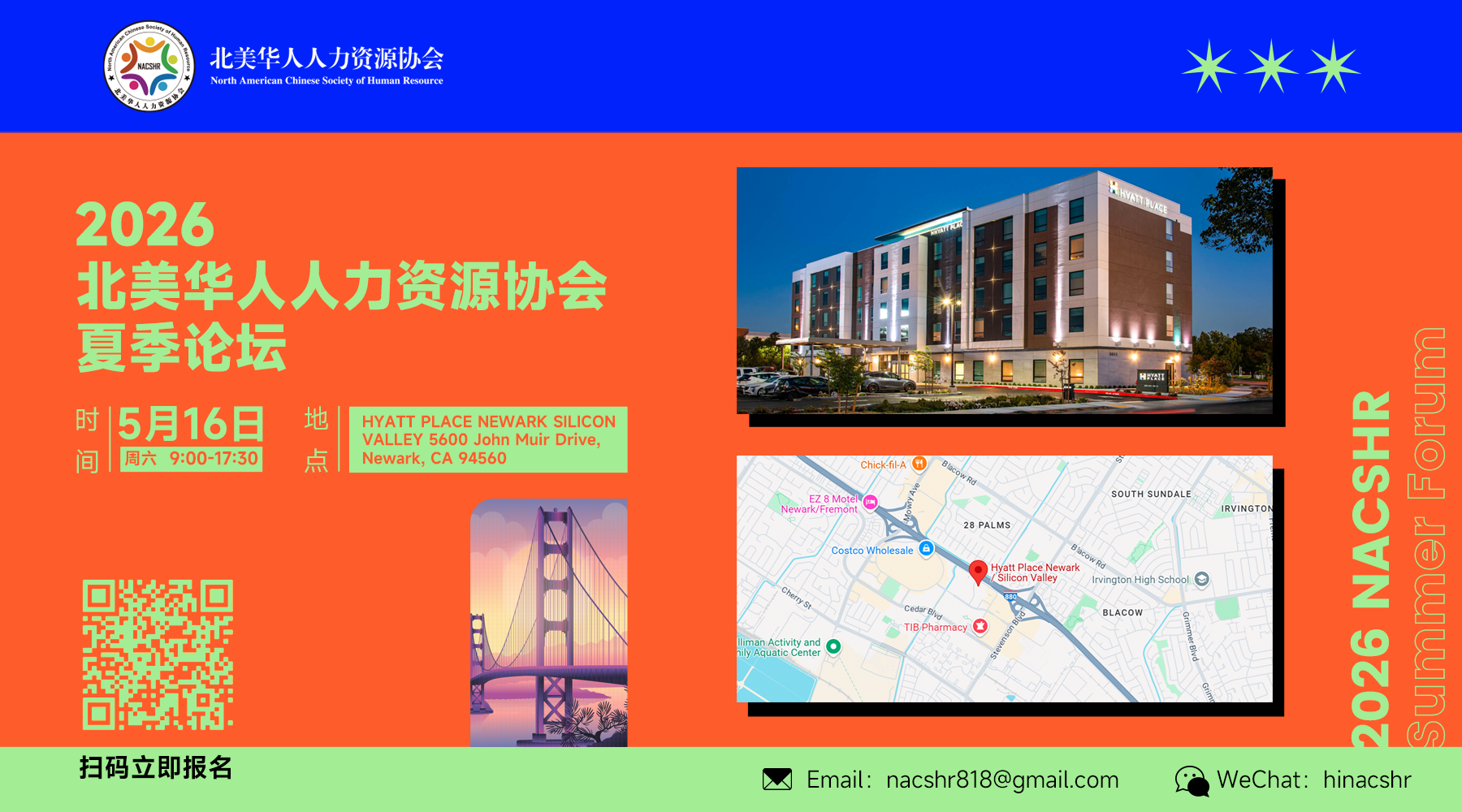
【重磅】2026北美华人人力资源夏季论坛5月16日在硅谷举办,诚邀参加
在快速变化的环境中,很多 HR 并不缺信息, 真正稀缺的,是判断、位置感,以及可以继续对话的高质量同行关系。
2026 NACSHR 北美华人人力资源夏季论坛 将于 5 月 16 日(周六)在硅谷举办。 这是一次刻意回归“高密度、深讨论、强链接”的专业聚会,也是 NACSHR 在多年实践基础上的一次重要升级。
自 2016 年成立以来,北美华人人力资源协会(NACSHR)持续构建一个面向华人 HR 及相关从业者的专业交流平台。随着行业与环境的变化,我们也不断反思: 什么样的会议,才真正值得你相聚在NACSHR?
2026 年,我们给出的答案是: 用一天时间,完成最重要的讨论; 用一个场域,连接真正值得继续对话的人。
这不只是一场用来学习的会议,而是一个让专业关系自然发生的场域。
与传统以内容输出为核心的会议不同,2026 NACSHR 夏季论坛更关注:
你是否在一天之内,校准了几个关键判断
你是否更清楚自己所处的位置与下一步方向
你是否遇见了未来可以继续对话的同行
这里没有标准答案,也不追求共识。我们相信,真正有价值的收获,往往发生在讨论之间、对照之中,以及会后持续的交流里。
一天高密度主场,留白延展思考
2026 年夏季论坛采用 1 天高密度核心论坛 + 会前会后非正式延展交流 的结构设计。
所有核心讨论、分享与互动,均集中在 5 月 16 日(周六) 完成,确保内容与参与的专注度。同时,也为提前抵达或愿意多停留的参会者,保留自由交流与个性化延展的空间。
这不是把会议“缩短”, 而是把真正重要的事情放在最清晰的位置上。
聚焦硅谷语境,也连接更广阔的华人 HR 世界
2026 NACSHR 夏季论坛将立足硅谷,围绕企业 HR 一号位、组织与人才战略、华人 HR 的职业路径、AI 时代的判断与选择等核心议题展开讨论。这里既高度贴合硅谷的专业深度与前沿语境,也足够吸引来自北美各地、甚至海外的华人 HR 与相关从业者参与。
一个可以被记住的专业场域
我们希望,每一位离开会场的参会者,都能带走一些属于自己的东西——可能是一个尚未成形但重要的想法,可能是一次关键的对话,也可能是对自己下一阶段更清晰的判断。
这不是一场把时间填满的会议,而是一场为未来关系与思考预留空间的专业聚会。
Stay Together · Stay Powerful
诚挚邀请北美及全球华人 HR、企业管理者及相关从业者共同参与 2026 NACSHR 北美华人人力资源夏季论坛,在硅谷,完成一次值得回看的专业相聚。
为确保会议质量与讨论深度,2026 NACSHR 北美华人人力资源夏季论坛 参考之前参会嘉宾的建议,采用 1 天高密度核心论坛 + 会前会后非正式延展交流 的结构设计。
NACSHR 2026 · 北美华人HR夏季论坛
2026 North American Chinese HR Summer Forum
时间:5月16日 周六全天 Saturday, May 16, 2026(9:00-17:00)VIP及特邀晚宴18:30-20:30 对外名额有限
地点:HYATT PLACE NEWARK SILICON VALLEY (5600 John Muir Drive, Newark, CA 94560 )
报名:https://nacshr.org/Survey/204F7A10-CA16-BD5E-57CE-0B95C3C2B760
门票分为:HR Pass 仅限InhouseHR和HR学生 和 General Pass 如HR服务机构、顾问等非InhouseHR均适合此类门票)
HR Pass 仅限InhouseHR和HR学生等企业内部相关岗位同仁 General Pass 如HR服务机构、顾问、创始人、创业者等其他非InhouseHR的均适合此类门票
夏季论坛超级早鸟票价格:
· HR Pass早鸟票: 200美元/人 仅限4月1日前或名额用完 (原价400美元)
· General Pass优惠票:400美元/人 仅限4月1日前或名额用完(原价600美元)且对外名额有限 额满为止
· HR Pass门票三人同行,享受8.5折优惠
· 周六晚宴门票(不单独销售)150美元/人 (原价200美元) 对外名额有限 额满为止
· Pitch Show 含现场资料发放和10分钟展示机会,含会议通票一张 3000美元 仅剩一个名额
· 论坛赞助(演讲、展位、Panel 、晚宴赞助等诸多形式),具体请联系工作人员,多种模式对论坛支持!
· 同时预定9月26日 年度论坛超级早鸟票(参考目前价格)
HP 早鸟票 200美元 4月1日前 250美元 5月1日前 300 美元 5月15日前 门票原价400美元
GP 早鸟票 400美元 4月1日前 500美元 5月1日前 550 美元 5月15日前 门票原价 600美元
(会议期间提供咖啡和茶等 注:但午餐需自理,因酒店午餐成本非常高,所以不含会议午餐)为了确保所有参会者的最佳体验,NACSHR论坛管理团队将定期审核注册名单,并可能根据需要调整注册类别。如果您的注册类型被调整,您需补缴相应的费用差额。本政策旨在维护公平性,并提升所有与会者的参会体验。优惠门票价格以付费为准 付费指南:https://www.nacshr.org/3016/
NACSHR夏季论坛日程纲要(详细信息不断更新)
08:30 – 09:00 会议签到和会前交流
09:00 – 12:00 上午高密度全体会议
12:00 – 13:30 午间休息与集体合影留念
13:30 – 17:30 下午高密度全体会议
18:30 – 20:30 特邀嘉宾及 VIP 深度交流晚宴
同时为增加更多交流机会和个性化需求,特别设立了可选的非正式交流的时间和安排
会前交流:5月15日(周五)19:00 – 21:00 为方便提前抵达硅谷的参会者 地点:酒店 Bar
会后交流:5月17日周日,可以自行安排深度交流、硅谷探索、Hiking等活动,不设官方统一活动,方便大家自由安排。
更多会议相关内容,我们会不断更新,并通过NACSHR官网和社交媒体发布。
会议参展及赞助演讲合作
联系人:Annie(nacshr818@gmail.com)或 点击申请 : https://www.nacshr.org/Survey/CDBE9324-6291-EB0E-3E50-91532A2A70BB
如何可以参与NACSHR论坛的合作?
我们欢迎各界同仁一起共襄盛会,各种合作形式可以参与其中:
· 作为人力资源服务机构,有多种方式可以参与共襄盛举。
你可以选择各种赞助形式,如钻石赞助、演讲赞助、展位、Demo展示,对话合作、年度合作、晚宴赞助等多种方式,具体可以联系我们。
名额有限,机会难得。
赞助合作详情:https://nacshr.org/3792.html
今年赞助一定级别以上,将获得类似(供参考)
2026 北美华人人力资源夏季论坛|独家合作猎头与人才服务机构
2026 北美华人人力资源夏季论坛|指定合作移民与签证法律事务所
。。。。
2026 NACSHR 夏季论坛 · 私享交流晚宴
作为 2026 NACSHR 北美华人人力资源夏季论坛 的重要组成部分,私享交流晚宴将于 2026 年 5 月 16 日(周六)18:30-20:30,在加州硅谷 · NACSHR 夏季论坛会场举行。
本次晚宴将汇聚论坛分享嘉宾与VIP 特邀 HR 专业人士,在更加轻松、私密的环境中,延续白天的专业讨论,围绕职业发展、组织管理与行业趋势展开深入交流。
这是一次刻意控制规模的高质量聚会,不以人数取胜,而以真实对话、深度连接与长期信任为核心。
晚宴还有少量席位仅面向论坛参会者开放,马上预定吧优先面向希望建立高质量人脉、参与长期专业对话的 HR 同行与合作伙伴。
A limited number of seats are available by invitation only.
你为什么不能错过NACSHR峰会:
聆听行业大咖的精心分享:
演讲嘉宾包括成功的企业家、重量级的行业内大咖、优秀的人才战略专家。
他们精通中国以及北美的人力资源市场,乐于分享他们的观点和经验。
确保您能听到行业内最专业成功人士的分享。
学习新知识,掌握新动态:
不论您是职场老将还是新兵,更新知识库是一个永恒的课题。
峰会设置了多种会议形式,各种方式获取行业动态和职场经验。
有行业内大咖的独家分享,帮助您打开新视野,更具竞争力。
职业发展新机遇,更广泛的选择:
NACSHR设置了北美地区HR岗位需求,现场更有机会面对面沟通交流。
非正式的会议交流,更有益深入交流,为您的职场铺就成功之路。
北美地区最大的华人HR行业盛会:
聚焦北美华人人力资源行业精英,汇聚北美职场华人力量。
汇集首屈一指的企业家、创业家和行业先锋,打造北美唯一、最大的华人HR盛会。
交流新资讯,结交新伙伴:
探讨行业热点话题,激发创新思维,共同推动HR行业的发展。
利用大会机会结识北美地区的华人HR同仁,拓展个人交际圈。
启发职场新思维,实现职业新突破:
探讨华人管理者如何实现职场发展目标。
设有职场人讨论环节,与嘉宾、行业专家和同行伙伴一起探讨如何在美国职场实现自我价值。
往届回顾:
2026洛杉矶:https://nacshr.org/3702.html
2025年度论坛:https://nacshr.org/3396.html
2024夏季论坛:https://nacshr.org/1991.html
2023年度论坛:https://www.nacshr.org/762.html
2019年度论坛:https://nacshr.org/678.html
2018年度论坛:https://nacshr.org/566.html
2018芝加哥交流:https://nacshr.org/382.html
2026 North American Chinese HR Summer Forum
May 16, 2026 · Silicon Valley
In a fast-changing world, HR professionals are not short of information.What is truly scarce are sound judgment, a clear sense of position, and high-quality peer relationships that can sustain meaningful dialogue over time.
The 2026 North American Chinese HR Summer Forum, hosted by North American Chinese Society of Human Resources (NACSHR), will take place on Saturday, May 16, 2026, in Silicon Valley.
This year’s forum marks a deliberate return to what matters most:high-density discussions, depth over breadth, and genuine professional connections.It also represents an important evolution of NACSHR’s long-standing mission.
A Forum Designed for Meaningful Connection — Not Just Learning
Founded in 2016, NACSHR has long been dedicated to building a trusted platform for Chinese HR professionals and related practitioners across North America.As the industry and external environment continue to evolve, we have repeatedly asked ourselves:
What kind of forum is truly worth gathering for?
Our answer for 2026 is clear:
Use one focused day to complete the most important discussions.Create a shared professional space where relationships worth continuing can naturally emerge.
This is not merely a conference to learn from,but a professional setting where meaningful connections take shape.
What This Forum Focuses On
Unlike traditional content-heavy conferences, the 2026 NACSHR Summer Forum centers on what participants take away when they leave:
Have you recalibrated a few key judgments within a single day?
Are you clearer about your current position and your next professional direction?
Have you met peers with whom future conversations genuinely matter?
There are no standard answers, and consensus is not the goal.We believe that the most valuable insights often arise between sessions, through comparison, dialogue, and continued interaction after the event.
One High-Density Core Day, With Space for Reflection
The 2026 forum adopts a 1-day high-density core forum, complemented by optional, informal pre- and post-event interactions.
All essential discussions, exchanges, and interactions will take place on Saturday, May 16, ensuring focus and depth.At the same time, participants who arrive early or choose to stay longer will have room for informal conversations and personalized extensions of the experience.
This is not about shortening the forum,but about placing what truly matters in the clearest possible focus.
Rooted in Silicon Valley, Connected to the Global Chinese HR Community
The 2026 NACSHR Summer Forum is firmly grounded in the Silicon Valley context, while remaining open to a broader Chinese HR community across North America and beyond.
Key discussion themes include:
The role and responsibility of CHROs and senior HR leaders
Organizational and talent strategy
Career paths and positioning for Chinese HR professionals
Judgment and decision-making in the AI era
The forum reflects both the depth and forward-looking mindset of Silicon Valley, and the diverse realities of Chinese HR professionals worldwide.
A Professional Space Worth Remembering
We hope that every participant leaves with something personal and lasting —a still-forming but important idea,a pivotal conversation,or a clearer sense of judgment for the next stage ahead.
This is not a conference designed to fill every minute,but a professional gathering that leaves room for future thinking and long-term relationships.
Stay Together · Stay Thoughtful · Stay Connected
We sincerely invite Chinese HR professionals, business leaders, founders, and HR-related practitioners from North America and around the world to join us in Silicon Valley for a professional gathering worth revisiting.
Event Details
Event NameNACSHR 2026 · North American Chinese HR Summer Forum2026 North American Chinese HR Summer Forum
Date & TimeSaturday, May 16, 2026Main Forum: 9:00 AM – 5:00 PMVIP & Invited Dinner: 6:30 PM – 8:30 PM (limited availability)
LocationSilicon Valley, CaliforniaConvenient transportation access
Registrationhttps://nacshr.org/Survey/204F7A10-CA16-BD5E-57CE-0B95C3C2B760
Ticket Types
HR PassFor in-house HR professionals and HR students only
General PassFor HR service providers, consultants, founders, entrepreneurs, and other non-in-house HR professionals
Super Early Bird Pricing (Summer Forum)
HR Pass – Super Early Bird:USD $150 per personAvailable until March 1 or until sold out(Regular price: USD $400)
General Pass – Early Offer:USD $300 per personAvailable until March 1 or until sold out(Regular price: USD $600)Limited external seats
Group Discount:HR Pass — 15% off for groups of three
Saturday VIP Dinner Ticket:USD $150 per person (not sold separately)Regular price: USD $200Limited availability
Additional Participation Options
Pitch ShowIncludes on-site materials distribution and a 10-minute presentation slotIncludes one forum passLimited to 3 slotsUSD $2,000 before March 1 (Regular price: USD $3,000)
Forum Sponsorship OpportunitiesSpeaking slots, demo presence, panels, dinner sponsorship, and other customized formatsPlease contact the organizing team for details
Early Booking for Annual Forum (September 26)Super Early Bird available when booked together(Pricing subject to future announcement)
HR领导力
2026年01月25日
HR领导力
Yes, AI Is Really Impacting The Job Market. Here’s What To Do.Josh Bersin 在 2025 年末指出,美国就业市场正在出现结构性变化。整体失业率上升至 4.6%,其中应届大学毕业生的失业率接近 10%,成为最受冲击的群体。与此同时,不要求大学学历的岗位持续增长,一线员工的重要性正在被重新定义。更值得关注的是信任问题。Edelman 调研显示,70% 的员工不信任企业关于 AI 裁员的说法,只有 27% 信任 CEO。AI 不只是技术工具,而是一场社会与组织层面的转型。Josh Bersin 强调,AI 并非消灭岗位,而是放大能力。真正的挑战在于,企业是否愿意投资年轻人才,是否能用透明沟通化解 AI 焦虑。
详细来看
All year I’ve been studying the employment data and talking with press about the smallish impact of AI on the job market. Most of the slowdown in US jobs, from my data and conversations, has been driven by cost-cutting and general economic uncertainty, not explicit AI job replacement.
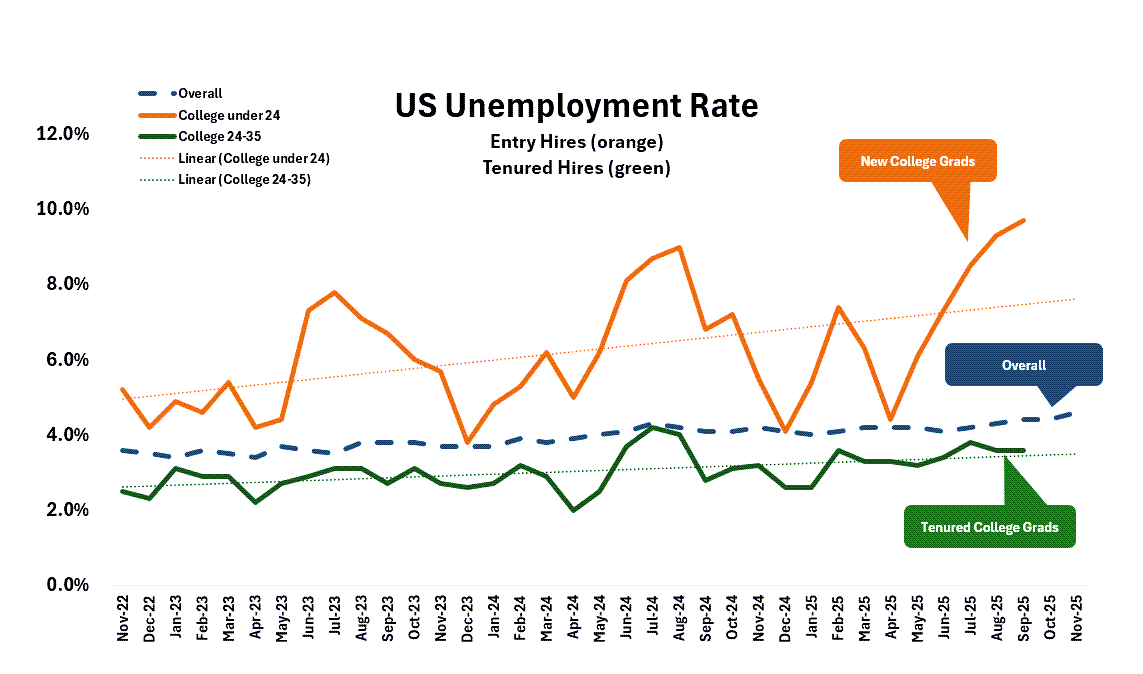
Well going into 2026 the situation is changing. The US unemployment rate is now 4.6%, up from 4.2% one year ago (a 9.5% increase) and 3.7% in November of 2023 (a 24.7% increase in two years). These are significant increases, especially considering that unemployment was 3.6% in November of 2022.
This tells me that the US economy is slowing after the post-pandemic “revenge buying” frenzy of 2021 and 2022. And of course US tariffs, inflation, and relatively high interest rates all contribute.
But now let’s look under the covers and break out unemployment into two sub-groups: new college graduates (24 years and younger), and more seasoned workers (age 25-35). Suddenly you see a divergence.
The green line, tenured college graduates, shows a steady unemployment rate below the average. This makes sense: these are experienced employees with skills, judgement, and seasoned decision-making maturity.
The orange line, new college graduates, is trending upward. In fact right now it’s almost 10%, which is the highest it has been since July 2021, the peak recovery from the pandemic. Looking backwards, the only time young college grad unemployment was this high was in 2011, a period of recovery from the 2008 recession. (St. Louis Fed agrees.)
And by the way, to round this out, jobs that do not require a degree are plentiful, roughly 82% of the workforce (up from 79% five years ago). So AI is not only slowing new college grad hiring, it’s also reducing the total number of jobs that require college.
There are three important things happening here:
First, whether it’s correct or not, employers are slowing down entry level hiring. Companies hire new college grads for many reasons (largely for talent pipeline), and many newly minted grads are far more AI-ready than we are. Despite this, it appears to economists that it’s harder than ever for these young folks to compete, so they need to “sell” their AI readiness and learning capacity.
Second, the frontline workforce is becoming much more important. The general automation of white collar work (it’s still early days) and the explosion of jobs in healthcare, social services, retail, repair, entertainment and distribution are making the “college grad” part of the workforce relatively smaller. That’s not to say the money isn’t good, but as a CEO or leader more and more of your energy has to go into supporting these frontline workers. (Read our Frontline-First research for more.)
Third, employees don’t trust CEO talk about jobs. A new study by Edelman shows a massive lack of people’s trust in business leaders (and AI scientists) around AI. This 5,000+ worker survey found that 70% of US workers do not trust statements about AI job reductions. When asked “who you do trust” only 27% of US workers trust the CEO. So we, as leaders, have a trust problem.
Here’s the trust data, and this is all about “Trust in AI’s Value” not “trust in the AI platform.”
AI Is a Socio-Technological Innovation
As I talked about in this week’s podcast, AI is “socio-technological.” It has many societal and sociological impacts.
If only half your employees believe what leaders are telling them, they’re going to hold back, grumble, and resist change. This is why economic insecurity is high: people are concerned about their jobs, careers, and future earnings.
(So AI anxiety could actually lower economic productivity!)
The solution to this is not to ignore the topic, but rather to discuss it openly.
None of us really know how much impact AI will have (I do know most platforms over-sell its value right now), and AI is a little scary.
We have to get comfortable with phones that talk back to us, creepy emails that know our name, avatar-based job interviews, AI-driven career advice, and AI-informed performance reviews. And in 2026 we’re going to see digital twins, robots, and more real-life animations of people at work. (Galileo Learn uses a “Josh Agent” to coach and challenge you as you learn.)
Here’s my advice. If you’re holding back on entry-level hiring you may be making a mistake. Younger staff, who have lived with this technology for more of their lives, are likely to be the ones to most quickly use AI, build with AI, and innovate with its new applications.
People who are tenured tend to see new tools as a way to “speed up what they know how to do.” New employees might just say “why not do it this way?” and bring you the reinvention you need.
Everyone Has The Opportunity To Be A Superworker Now
AI is not a job killer, it’s a big job-leveler.
You, as a younger worker, have access to information and research which was often hoarded by experts. If you’re willing to roll up your sleeves, you can move from “apprentice” to “newly minted expert” quickly. And if you’re looking for a job there’s no excuse for not becoming an expert on the company before you talk with a recruiter.
For senior, more tenured people the same applies. You can’t rely on your experience alone any more: you, too, should be digging in and learning about new technologies, tools, and advancements in your domain.
Employers: Be Careful How You Think
For hiring managers and executives, beware of the “tenure trap” above. Just because a senior person knows your business better, you may find that the young “AI-Guru” right out of college catches up fast. Remember, tenured people may see AI as a way to “do things the old way faster” rather than “rethink the way we work.”
For HR leaders and recruiters, remember one thing. Younger workers may learn faster and ultimately improve productivity at a faster rate (plus they cost less). If you seek out fast-learning AI pioneers they could be your Superworkers of the future.
And for CEOs and other execs, be honest and thoughtful about your plans. All our research points to AI as a “scaling technology,” not one to “eliminate jobs.” The more honest and supportive you are, the faster your employees will adapt and help your company stay ahead.
HR领导力
2025年12月22日
HR领导力
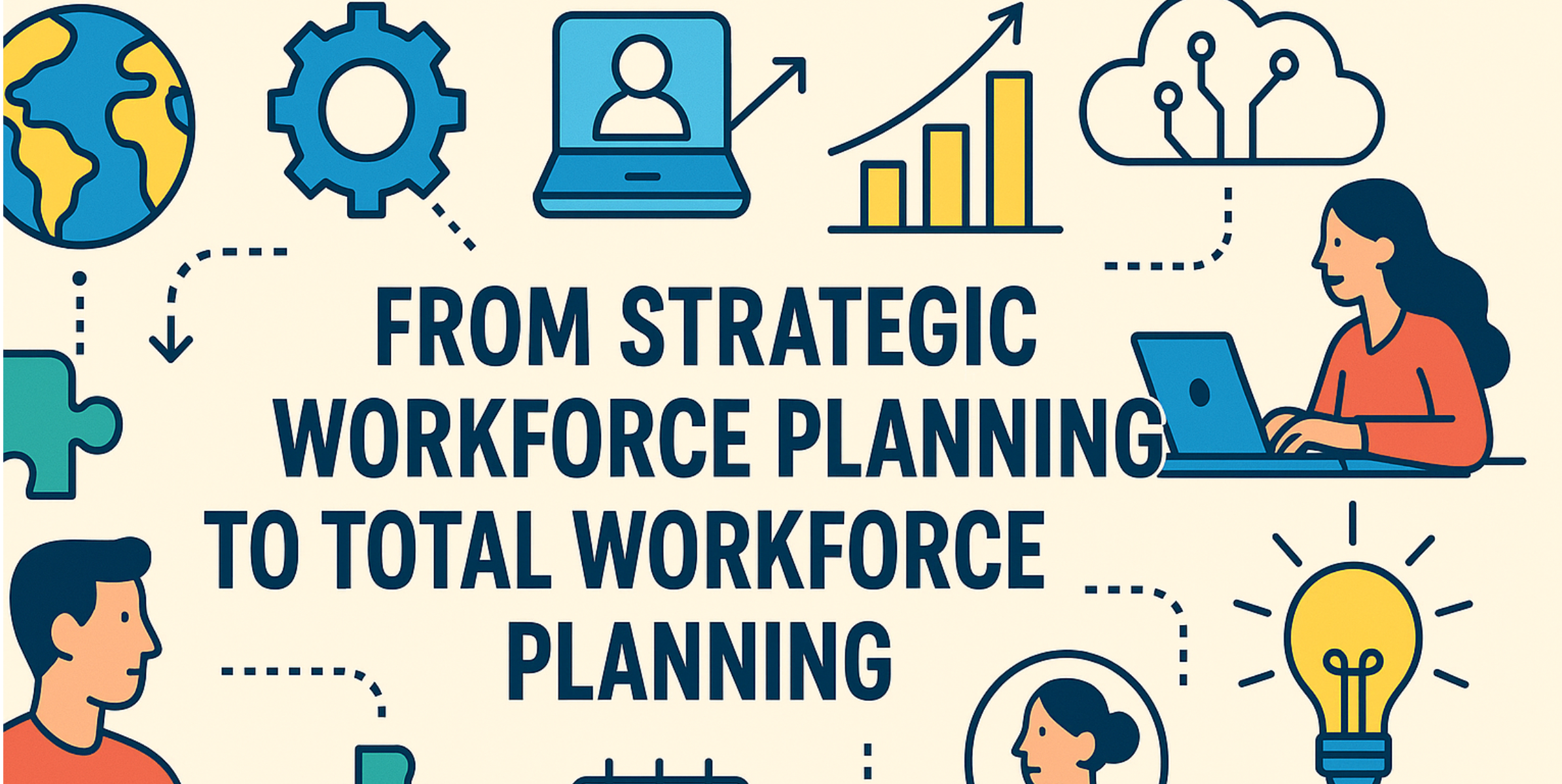
从战略劳动力规划到AI时代的全域劳动力规划Workforce planning has evolved from a headcount-driven exercise into a strategic business function. In the age of AI, organizations must move beyond Strategic Workforce Planning (SWP) toward Total Workforce Planning (TWP) — a model that integrates all types of labor, from full-time employees to contractors, gig workers, and AI-powered automation.Jimmy Zhang emphasizes that AI is reshaping not just how work is done, but who—or what—does the work. Companies that embrace total workforce planning gain agility, visibility, and the ability to optimize talent and technology together. TWP aligns workforce strategy with business outcomes, allowing HR to manage capacity, cost, and capability across the entire ecosystem of work.
作者:Jimmy Zhang(武田制药全球人才招聘负责人)
劳动力规划:从“战略”走向“全域”
在与众多企业与人力资源领导者的交流中,我注意到一个明显趋势:劳动力规划终于成为了战略层面的核心议题。然而,下一个阶段已经到来。
如今,仅仅依靠“战略劳动力规划”已不足够。组织现在需要的是——全域劳动力规划(Total Workforce Planning)。
全域劳动力规划不仅仅是预测人头数或招聘趋势,而是审视整个工作的生态系统。它整合了各种形式的劳动、能力来源与价值创造方式。在一个由人工智能与持续变化主导的环境中,它提出了一个简单但深刻的问题:“我们的工作是如何完成的?”
为什么战略劳动力规划已不再足够
战略劳动力规划帮助企业将人才与业务优先事项对齐,并提前识别能力需求。但在大多数情况下,它仍被传统的组织结构与岗位层级所限制。它依然将“员工”作为分析的主要单位,而如今的工作早已变得分散、灵活,并被技术所增强。
正如Jesuthasan和Boudreau在《Work Without Jobs》中所言:未来的劳动力战略,不是“优化(Optimization)”,而是“统筹(Orchestration)”——设计人、合作伙伴与技术如何共同创造价值。
在我对39项关于AI整合与劳动力转型的研究进行系统性回顾后发现,虽然AI加速了新技能与新结构的需求,但真正完全准备好的组织屈指可数。只有少数企业能被归类为成功的转型者。它们与失败者的区别,不在于技术本身,而在于领导力协同、伦理治理与整合性劳动力规划。
技术决定了“可能性”,而领导力决定了“现实”。
整合业务、财务与劳动力战略
最具前瞻性的组织,都是把劳动力规划直接嵌入到业务与财务战略之中的。
在我研究的最佳实践案例中,劳动力规划被视为全公司共担的职能,而非单纯的HR职责。业务、HR与财务共同拥有关于能力建设、投资与时间节奏的决策权。
这种整合让企业能够模拟多种未来场景,把劳动力能力与业务风险相联系,并将洞察转化为战略执行。
正如Gartner所描述的,这是**“企业整合式劳动力设计(Enterprise-Integrated Workforce Design)”**——一种让能力规划、资本配置与转型管理互为依存、非线性衔接的系统。
当规划真正整合后,讨论的重心就会从“我们需要多少人”转变为——“我们需要怎样的人、合作伙伴与技术组合,才能实现目标?”
从战略到全域:这是一段成熟旅程
从“战略”迈向“全域”并非一跃而就,而是一个成熟曲线(Maturity Journey)。
初期阶段:以人头预测和运营效率为中心;
进阶阶段:转向基于能力的建模和外部市场洞察;
成熟阶段:构建一个“活的劳动力系统”,持续整合内部人才数据、外部趋势与自动化洞察。
在实践中,最可持续的方法是从试点开始:选择一个正在进行转型的业务领域,将其目标与劳动力数据及市场情报相结合。当领导者看到完整图景——包括成本、能力与灵活性——劳动力规划自然会变成一场关于价值创造的战略讨论。
5Bs框架:全域劳动力规划的核心工具
为了指导这些决策,我常使用5Bs框架:Buy、Build、Borrow、Bot、Balance。
该框架帮助企业将战略转化为行动,使能力设计直接连接业务成果。
Buy(购买):通过外部招聘获得稀缺或新兴技能。
Build(培养):通过内部培训与再技能化,构建长期能力。
Borrow(借用):通过合作伙伴与外部人才网络保持灵活性。
Bot(自动化):运用自动化与智能系统扩大人类能力。
Balance(平衡):在成本、能力与员工福祉之间保持动态均衡。
在我的研究中,最成功的企业都强调“平衡”:他们选择再培训而非替代,清晰传达目标,让转型成为一种包容的过程,而非取代。
因此,5Bs不仅是决策工具,更是一种将人类、数字与混合形式的工作整合为一体的战略思维模型。
人的维度
所有劳动力模型的背后,都是人。
研究一再表明,成功的转型往往来自员工的早期参与、透明沟通与持续学习投资。在这样的企业中,员工会将变革视为机遇,而非威胁。
平衡不仅是财务层面的,更是道德与心理层面的平衡——确保商业进步与人类尊严并行发展。当员工在企业未来中看到自己的位置,准备度与信任自然随之而来。
在AI时代的领导力
人工智能扩展了规划的可能性。预测分析能够揭示潜在技能、构建情景模型、展现工作的演化方向。
但AI无法取代领导力。
最有效的领导者展现出Nyberg等人所称的**“适应性智能(Adaptive Intelligence)”:以好奇心、共情力与清晰度应对变革。他们不把劳动力规划当作行政流程,而是当作领导工具**,用于统一人、数据与目标。
全域劳动力规划正是为此而生——它让洞察变成前瞻,前瞻变成方向。
为什么5Bs比以往更重要
5Bs不仅是人才决策模型,更代表了应对复杂性的组织思维模式。
成功的企业会:
Buy with foresight(有远见地招聘);
Build intentionally(有目的地培养);
Borrow strategically(有策略地借力);
Bot responsibly(负责任地自动化);
Balance continuously(持续保持平衡)。
这些选择不仅塑造劳动力规划,更塑造企业文化与组织诚信。
结语:从稳定到适应
未来的工作,不属于那些追求稳定的组织,而属于那些为适应性而规划的组织。
全域劳动力规划不仅是一种流程,更是一种领导哲学——它将商业雄心、人类潜能与技术可能性结合成一个整体系统。
在AI时代,竞争优势不来自“预测未来”,而来自建立平衡、能力与勇气去在变化中蓬勃发展。
参考文献:
Zhang, J. (2025). AI Integration in Workforce Planning: A Systematic Review of 39 Studies.
Jesuthasan, R., & Boudreau, J. (2023). Work Without Jobs.
Bughin, J. (2023). Does Artificial Intelligence Kill Employment Growth?
Nyberg, A. J., et al. (2025). A Brave New World of Human Resources Research: Navigating the GenAI Revolution.
Haipeter, T., et al. (2024). Human-Centered AI Through Employee Participation.
Gartner (2025). Reframing Strategic Workforce Planning for the Modern Enterprise.

 HR领导力
HR领导力
 HR领导力
HR领导力
 HR领导力
HR领导力
 HR领导力
HR领导力





 扫一扫
添加客服
扫一扫
添加客服


