Josh Bersin: When Will The Trillions Invested In AI Pay Off? Sooner Than You Think.近年来,生成式人工智能(GenAI)的投资已达数万亿美元,但围绕其回报问题的争论不断升级。一些分析师,如麻省理工学院教授达隆·阿西莫格鲁(Daron Acemoglu)和纽约大学心理学与神经科学教授加里·马库斯(Gary Marcus),对AI的经济影响持悲观态度,认为其对美国生产力和GDP增长的推动作用有限,甚至可能导致市场崩溃。相反,另一派如高盛的全球经济学家则乐观地认为,AI有望在未来十年内大幅提高生产力。然而,文章指出,生成式AI的真正价值在于其特定领域的应用。例如,Paradox和Galileo等HR技术平台通过高度专业化的解决方案,显著提升了招聘和人才管理的效率。最终,文章强调,AI行业仍处于早期阶段,成功的关键在于找到具有专注性和精确性的创新解决方案。
In the last few weeks there has been a lot of concern that Gen AI is a “bubble” and companies may never see the return on the $Trillion being spent on infrastructure. Let me cite four analyst’s opinions.
Will Today’s Massive AI Investments Pay Off?
MIT professor Daron Acemoglu estimates that over the next ten years AI will impact less than 5% of all tasks, concluding that AI will only increase US productivity by .5% and GDP growth by .9% over the next decade. As he puts it, the impact of AI is not “a law of nature.”
On a similar vein, Gary Marcus, professor emeritus of psychology and neural science at New York University, believes Gen AI is soon to collapse, and the trillions spent will largely result in a loss of privacy, increase in cyber terror, and a lack of differentiation between providers. The result: a market with low profits and big losses.
Goldman Sachs Head of Equity Research Jim Covello is similarly pessimistic, arguing simply that the $1 Trillion spent on AI is focused on tech that cannot truly automate complex tasks, and that vendors’ over-focus on “human-like features” will miss the boat in delivering business productivity. (He studies stocks, not the economy.)
And Goldman Sachs Global Economist, who is a fan, estimates that AI could automate 25% of work tasks and raise US productivity by 9T and GDP by 6.1% over the next decade. He follows the traditional business meme that “AI changes everything” for the better.
What’s going on? Quite simply this new technology is very expensive to build, so we’re all unsure where the payoffs will be.
Buyers Are Looking For A Return Soon
If we discount the work going on at Google, Meta, Perplexity, and Microsoft to build AI-based search businesses, which make money on advertising (Zuckerberg essentially just said that in a few years AI will guarantee your ad spend pays off), corporate IT managers are asking questions.
An article in Business Insider pointed to a large Pharma company that cancelled their Microsoft Copilot licenses because the tool was not adding any significant value (Chevron’s CIO was quoted similarly in The Information).
Another quoted a Chief Marketing Officer who stated Google Gemini’s email marketing tool and the new AI-powered ad-buying tool performed worse than the human workers it was intended to replace (or support).
Given that these tools almost double the “price per user” for the productivity suites, I think it’s fair that CIOs, CMOs, to expect them to pay for themselves fairly quickly.
What’s Going On? The Big Wins Will Be Domain Specific
As with all new technologies that enter the market quickly, “the blush on the rose” is over. We’ve been dazzled by the power of ChatGPT and now we’re searching for real solutions to problems. And unlike the internet, where research was funded by the government, there’s going to be a lag (and some risk) between the trillions we spend and the trillions we save.
Given that ChatGPT is less than two years old and OpenAI has morphed from a research company into a product company, it’s easy to see what’s happening. Every vendor and tool provider is narrowing its AI “strategy” and not just pasting little AI “stars” on their websites, looking for useful things to do. And this process may take a few years.
In the world of HR, I think we can all agree that a “push the button job description generator” is a bit of a commodity. However if the AI analyzes the job title, identifies the skills needed through a large skills engine, and tunes the job description by company size, industry, and role, then it’s a fantastic solution. (Galileo does this, as does SeekOut, SAP, and some other vendors.)
The more “specific” and “narrow” the AI is, the more useful it becomes. Generic LLMs that aren’t highly trained, optimized, and tuned to your company, business, and job are simply not going to command high prices. So while we all thought ChatGPT was Nirvana, we’re now figuring out that highly specialized solutions are the answer.
Let me give you some examples.
The first is the platform built by Paradox, a pioneering company that started work on AI-based recruiting agents in 2016. Paradox, now valued at around $2 Billion, delivers an end-to-end recruitment platform that automates the entire process of candidate marketing, candidate experience, assessment, selection, interview scheduling, hiring, and onboarding. Most people believe its a “Chatbot” but in reality it’s an AI-powered end-to-end system that radically simplifies and speeds the recruitment process in a groundbreaking way. Companies like 7-11, FedEx, GM, and others see massive improvements in operational efficiency and both candidates, managers, and recruiter adore it. It took Paradox eight years to build this level of integrated solution.
The second is our platform Galileo. Galileo, which is now licensed by more than 10,000 HR professionals, is a highly tuned AI agent specifically designed to help HR professionals (leaders, business partners, consultants, recruiters, and other roles) do the “complex work” HR professionals do. It’s not a generic LLM: it’s a highly specialized solution designed specifically for HR professionals, and we’ve added specialized content partners and are building special integrations with other HR platforms. Our clients tell us it’s saving them 1-2 hours a day.
The third is the platform HiredScore, that was recently acquired by Workday. Founded in 2012, the HiredScore team built tools to help identify “fit” between individuals and jobs, and tuned its AI to be highly explainable, unbiased, and very easy to use. It took Athena Karp and the team a few years to nail down the use-cases and user interface but now HiredScore is considered one of the most powerful recruitment “orchestration” tools in the market, and is also used for internal hiring and many other applications. Every customer I talk with tells me it’s essential and saves them months of manual, error-prone effort.
The fourth is the platform Eightfold, which was invented in 2016 as a way to build “Google-scale” matching between job seekers and jobs. Through many years of engineering, product management, and ongoing sales process the company has become the leader in a new space called “Talent Intelligence,” now a billion dollar rapid-growing category. The company is about ten years old and now has some of the world’s largest companies building their hiring, career management, and talent management processes using AI. Companies like EY, Bayer, and Chevron now use it for all their strategic talent programs.
Each of these vendors, including others like Gloat, Sana, Arist, Lightcast, Draup, Uplimit, Firstup, and hundreds of others have patiently taken the power of Generative AI and applied it with laser precision to their solutions. Each of these companies is different, and as we work with them we see lightning bolts of innovation: not in AI itself, but in finding new ways to solve problems and do what I call “crawling up the value curve.”
This is the path for AI in the coming years. As with all new technologies, the “trough of disappointment” is always followed by the “bowling pin” of hitting the nail on the head. Innovators, entrepreneurs, and startup founders are the ones who will take GenAI and apply it in unique ways to solve problems. And soon enough, “AI-powered” will be a phrase we barely even need to say.
The Best Solutions Will Be Narrow Not Wide
GenAI solutions require a large “platform” of data, infrastructure, and software. That alone is not where the value resides. Rather, the big productivity advantages come after years of effort, focusing the data sets and working with customers to find the features, UI designs, and data sets that add enormous value. And we are still in the early stages.
If you want to learn more about HR Technology and AI, join me at the HR Technology Conference on September 24-25 in Vegas, or at Unleash in Paris in October 16-17. While I can’t predict who will win the core AI platform game (Microsoft, OpenAI, Google, Meta, Amazon will fight it out), I can predicts this: Generative AI will deliver massive improvements in business productivity. You just have to shop around a bit and wait for just the right solutions to arrive.
头条
2024年08月10日
头条
Agency Law and the Workday Lawsuit
文章讨论了在Workday诉讼中,代理法的相关法律问题。原告声称,Workday的AI筛选工具因种族、年龄和残疾而对他进行了歧视。这起案件提出了HR技术供应商是否可以对歧视性结果直接负责的问题。法律的复杂性包括AI在招聘决策中的角色、代理责任以及对雇主和AI开发者的潜在影响。此案件提醒雇主在实施AI招聘工具时要谨慎,并确保避免法律风险。AI开发者也必须确保其产品无歧视行为,因为该诉讼可能会树立重要的法律先例。
Editor's Note
Agency Law and the Workday Lawsuit
Agency law is so old that it used to be called master and servant law. (That's different from slavery, where human beings were considered the legal property of other humans based on their race, gender, and age, which is partly why we have discrimination laws.)
Today, agency laws refer to principals and agents. All employees are agents of their employer, who is the principal. And employers can have nonemployee agents too when they hire someone to do things on their behalf. Generally, agents owe principals a fiduciary duty to act in the principal's best interest, even when that isn't the agent's best interest.
Agency laws gets tricky fast because you have to figure out who is in charge, what authority was granted, whether the person acting was inside or outside that authority, what duty applies, and who should be held responsible as a matter of fairness and public policy.
Generally, the principal is liable for the acts of the agent, sometimes even when the agent acts outside their authority. And agents acting within their authority are rarely liable for their actions unless it also involves intentional wrongs, like punching someone in the nose.
Enter discrimination, which is generally a creature of statute that may or may not be consistent with general agency law even when the words used are exactly the same.
Discrimination is generally an intentional wrong, but employees are not usually directly liable for discrimination because making employment decisions is part of the way employment works and the employer is always liable for those decisions.
The big exception is harassment because harassment, particularly sexual harassment, is never part of someone's job duties. So in harassment cases, the individual harasser is liable but the employer may not be unless they knew what was going on and didn't do anything about it.
It's confusing and makes your head hurt. And that's just federal discrimination law. Other employment laws, both state and federal, deal with agent liability differently.
Now, let's move to the Workday lawsuit. In that case, the plaintiff is claiming that Workday was an agent of the employer, but not in the sense of someone the employer was directing. They are claiming that Workday has independent liability as an employer too because they were acting like an employer in screening and rejecting applicants for the employer.
But that's kinda the whole point of HR Technology—to save the employer time and resources by doing some of the work. The software doesn't replace the employer's decision making and the employer is going to be liable for any discrimination regardless of whether and how the employer used their software.
If this were a products liability case, the answer would turn on how the product was designed to be used and how the employer used it. But this is an employment law and discrimination case. So, the legal question here is whether a company that makes HR Technology can also be directly liable for discriminatory outcomes when the employer uses that technology.
We don't have an answer to that yet and won't for a while. That's because this case is just at the pleading stage and hasn't been decided based on the evidence. What's happened so far is Workday filed a motion to dismiss based on the allegations in the complaint. Basically, Workday said, "Hey, we're just a software company. We don't make employment decisions; the employer does. It's the employer who is responsible for using our software in a way that doesn't discriminate. So, please let us out of the case. Then the plaintiff and EEOC said it's too soon to decide that. If all of the allegations in the lawsuit are considered true, then the plaintiff has made viable legal claims against Workday.
Those claims are that Workday's screening function acts like the employer in evaluating applications and rejecting or accepting them for the next level of review. This is similar to what third party recruiters and other employment agencies do and those folks are generally liable for those decisions under discrimination law. In addition, Workday could even be an agent of the employer if the employer has directly delegated that screening function to the software.
We're not to the question of whether a software company is really an agent of the employer or is even acting like an employment agency. And even if it is, whether it's the kind of agency that has direct liability or whether it's just the employer who ends up liable. This will all depend on statutory definitions and actual evidence about how the software is designed, how it works, and how the employer used it.
We also aren't at the point where we look at the contracts between the employer and Workday, how liability is allocated, whether there are indemnity clauses, and whether these type of contractual defenses even apply if Workday meets the statutory definition of an employer or agent who can be liable under Title VII.
Causation will also be a big issue because how the employer sets up the software, it's level of supervision of what happens with the software, and what's really going on in the screening process will all be extremely important.
The only thing that's been decided so far is that the plaintiff filed a viable claim against Workday and the lawsuit can proceed. Here are the details of the case and some good general advice for employers using HR Technology in any employment decision making process.
- Heather Bussing
AI Workplace Screener Faces Bias Lawsuit: 5 Lessons for Employers and 5 Lessons for AI Developers
by Anne Yarovoy Khan, John Polson, and Erica Wilson
at Fisher Phillips
A California federal court just allowed a frustrated job applicant to proceed with an employment discrimination lawsuit against an AI-based vendor after more than 100 employers that use the vendor’s screening tools rejected him. The judge’s July 12 decision allows the class action against Workday to continue based on employment decisions made by Workday’s customers on the theory that Workday served as an “agent” for all of the employers that rejected him and that its algorithmic screening tools were biased against his race, age, and disability status. The lawsuit can teach valuable lessons to employers and AI developers alike. What are five things that employers can learn from this case, and what are five things that AI developers need to know?
AI Job Screening Tool Leads to 100+ Rejections
Here is a quick rundown of the allegations contained in the complaint. It’s important to remember that this case is in the very earliest stages of litigation, and Workday has not yet even provided a direct response to the allegations – so take these points with a grain of salt and recognize that they may even be proven false.
Derek Mobley is a Black man over the age of 40 who self-identifies as having anxiety and depression. He has a degree in finance from Morehouse College and extensive experience in various financial, IT help-desk, and customer service positions.
Between 2017 and 2024, Mobley applied to more than 100 jobs with companies that use Workday’s AI-based hiring tools – and says he was rejected every single time. He would see a job posting on a third-party website (like LinkedIn), click on the job link, and be redirected to the Workday platform.
Thousands of companies use Workday’s AI-based applicant screening tools, which include personality and cognitive tests. They then interpret a candidate’s qualifications through advanced algorithmic methods and can automatically reject them or advance them along the hiring process.
Mobley alleges the AI systems reflect illegal biases and rely on biased training data. He notes the fact that his race could be identified because he graduated from a historically Black college, his age could be determined by his graduation year, and his mental disabilities could be revealed through the personality tests.
He filed a federal lawsuit against Workday alleging race discrimination under Title VII and Section 1981, age discrimination under the ADEA, and disability discrimination under the ADA.
But he didn’t file just any type of lawsuit. He filed a class action claim, seeking to represent all applicants like him who weren’t hired because of the alleged discriminatory screening process.
Workday asked the court to dismiss the claim on the basis that it was not the employer making the employment decision regarding Mobley, but after over a year of procedural wrangling, the judge gave the green light for Mobley to continue his lawsuit.
Judge Gives Green Light to Discrimination Claim Against AI Developer
Direct Participation in Hiring Process is Key – The judge’s July 12 order says that Workday could potentially be held liable as an “agent” of the employers who rejected Mobley. The employers allegedly delegated traditional hiring functions – including automatically rejecting certain applicants at the screening stage – to Workday’s AI-based algorithmic decision-making tools. That means that Workday’s AI product directly participated in the hiring process.
Middle-of-the-Night Email is Critical – One of the allegations Mobley raises to support his claim that Workday’s AI decision-making tool automatically rejected him was an application he submitted to a particular company at 12:55 a.m. He received a rejection email less than an hour later at 1:50 a.m., making it appear unlikely that human oversight was involved.
“Disparate Impact” Theory Can Be Advanced – Once the judge decided that Workday could be a proper defendant as an agent, she then allowed Mobley to proceed against Workday on a “disparate impact” theory. That means the company didn’t necessarily intend to screen out Mobley based on race, age, or disability, but that it could have set up selection criteria that had the effect of screening out applicants based on those protected criteria. In fact, in one instance, Mobley was rejected for a job at a company where he was currently working on a contract basis doing very similar work.
Not All Software Developers On the Hook – This decision doesn’t mean that all software vendors and AI developers could qualify as “agents” subject to a lawsuit. Take, for example, a vendor that develops a spreadsheet system that simply helps employers sort through applicants. That vendor shouldn’t be part of any later discrimination lawsuit, the court said, even if the employer later uses that system to purposefully sort the candidates by age and rejects all those over 40 years old.
5 Tips for Employers
This lawsuit could have just easily been filed against any of the 100+ employers that rejected Mobley, and they still may be added as parties or sued in separate actions. That is a stark reminder that employers need to tread carefully when implementing AI hiring solutions through third parties. A few tips:
Vet Your Vendors – Ensure your AI vendors follow ethical guidelines and have measures in place to prevent bias before you deploy the tool. This includes understanding the data they use to train their models and the algorithms they employ. Regular audits and evaluations of the AI systems can help identify and mitigate potential biases – but it all starts with asking the right questions at the outset of the relationship and along the way.
Work with Counsel on Indemnification Language – It’s not uncommon for contracts between business partners to include language shifting the cost of litigation and resulting damages from employer to vendor. But make sure you work with counsel when developing such language in these instances. Public policy doesn’t often allow you to transfer the cost of discriminatory behavior to someone else. You may want to place limits on any such indemnity as well, like certain dollar amounts or several months of accrued damages. And you’ll want to make sure that your agreements contain specific guidance on what type of vendor behavior falls under whatever agreement you reach.
Consider Legal Options – Should you be targeted in a discrimination action, consider whether you can take action beyond indemnification when it comes to your AI vendors. Breach of contract claims, deceptive business practice lawsuits, or other formal legal actions to draw the third party into the litigation could work to shield you from shouldering the full responsibility.
Implement Ongoing Monitoring – Regularly monitor the outcomes of your AI hiring tools. This includes tracking the demographic data of applicants and hires to identify any patterns that may suggest bias or have a potential disparate impact. This proactive approach can help you catch and address issues before they become legal problems.
Add the Human Touch – Consider where you will insert human decision-making at critical spots along your hiring process to prevent AI bias, or the appearance of bias. While an automated process that simply screens check-the-box requirements such as necessary licenses, years of experience, educational degrees, and similar objective criteria is low risk, completely replacing human judgment when it comes to making subjective decisions stands at the peak of riskiness when it comes to the use of AI. And make sure you train your HR staff and managers on the proper use of AI when it comes to making hiring or employment-related decisions.
5 Tips for Vendors
While not a complete surprise given all the talk from regulators and others in government regarding concerns with bias in automated decision making tools, this lawsuit should grab the attention of any developer of AI-based hiring tools. When taken in conjunction with the recent ACLU action against Aon Consulting for its use of AI screening platforms, it seems the time for government expressing concerns has been replaced with action. While plaintiffs’ attorneys and government enforcement officials have typically focused on employers when it comes to alleged algorithmic bias, it was only a matter of time before they turned their attention to the developers of these products. Here are some practical steps AI vendors can take now to deal with the threat.
Commit to Trustworthy AI – Make sure the design and delivery of your AI solutions are both responsible and transparent. This includes reviewing marketing and product materials.
Review Your Work – Engage in a risk-based review process throughout your product’s lifecycle. This will help mitigate any unintended consequences.
Team With Your Lawyers – Work hand-in-hand with counsel to help ensure compliance with best practices and all relevant workplace laws – and not just law prohibiting intentional discrimination, but also those barring the unintentional “disparate impact” claims as we see in the Workday lawsuit.
Develop Bias Detection Mechanisms – Implement robust testing and validation processes to detect and eliminate bias in your AI systems. This includes using diverse training data and regularly updating your algorithms to address any identified biases.
Lean Into Outside Assistance – Meanwhile, collaborate with external auditors or third-party reviewers to ensure impartiality in your bias detection efforts.
原文来自:https://www.salary.com/newsletters/law-review/agency-law-and-the-workday-lawsuit/
头条
2024年08月10日
头条
David Green: The best HR & People Analytics articles of July 2024这个月的《数据驱动HR月报》由Insight222发布了他们的新研究报告《构建人力分析生态系统:运营模式2.0》。在Insight222庆祝成立七周年之际,团队成员们齐聚一堂,共同回顾过去的成就,规划未来的步骤,并庆祝这一成功。此外,本月的重点还包括我有幸在由Mercer组织的LinkedIn直播中担任主持人,主题是“AI时代的技能驱动组织”,并欢迎在上个月加入的2000多名《数据驱动HR月报》新订阅者。本期由Visier赞助。
在案例研究部分,展示了Experian如何通过Visier将报告时间减少了70%。Experian的数据分析团队曾在Excel和Oracle OBI-EE套件中花费大量时间,限制了战略工作。Visier帮助他们显著提高了效率,使其团队能够专注于发掘劳动力洞察力、赋能数据驱动决策,并建立数据驱动的HR文化。
此外,本期还讨论了SHRM在其DEI(多样性、公平与包容性)计划中移除“公平”一词的决定。这一决定在DEI受到持续攻击、许多知名公司撤回DEI承诺的背景下显得尤为令人震惊。一些评论认为,SHRM此举的动机可能是政治性的,而非其所声明的“通过强调首先包容性,旨在解决DE&I项目的当前不足,减少社会反弹和极化”。
I’m just about to go out on vacation in the South of France for three weeks (hurrah!) and with growing evidence that taking a vacation improves physical and mental wellbeing, I’m looking forward to having time to relax, reflect and recharge. Before I go, I’m looking forward to the release this week of our new Insight222 research study: Building the People Analytics Ecosystem: Operating Model v 2.0 (click on the link to register to receive a copy).
Other highlights in July included:
We marked our seventh anniversary at Insight222 by gathering the team together for a whole week to reflect on our achievements, plan the next steps and celebrate our success.
I had the honour of moderating a LinkedIn Live on Skills-Powered Organisations in the Age of AI, organised by Mercer, with Ravin Jesuthasan, CFA, FRSA and Tanuj Kapilashrami. You can watch the recording here.
Welcome to the more than 2000 new subscribers to the Data Driven HR Monthly newsletter, who joined in the last month.
This edition of the Data Driven HR Monthly is sponsored by our friends at Visier
CASE STUDY: How Experian Cut Reporting Time by 70%
Struggling with manual reporting? Experian, a data analytics giant, did too. Their people analytics team spent hours in Excel and Oracle OBI-EE suite limiting strategic work. Visier slashed their reporting time by 70%. Read the case study.
Now, their People Analytics team focuses on:
Uncovering workforce insights
Empowering data-driven decisions
Building a data-driven HR culture
Visier empowers our people to leverage data for better decisions
Ready to unlock your people data's power? Read the case study.
Visier Inc.: Make data-driven HR decisions. Easier. Faster. On-Demand. At Scale.
To sponsor an edition of the Data Driven HR Monthly, and share your brand with more than 130,000 Data Driven HR Monthly subscribers, send an email to dgreen@zandel.org.
SHRM and the war on DEI
I’m not here to beat up on SHRM, but their flabbergasting decision to drop ‘Equity’ from its approach to ‘Inclusion, Equity and Diversity’ seems to have achieved the notable feat of being universally unpopular. To take this decision at a time when DEI is under sustained attack from politicians and when a growing number of prominent companies are backtracking from previous DEI commitments seems peculiar to say the least. It has led some commentators to conclude that SHRM’s surprise move is politically motivated rather than being driven by their stated objective, which SHRM explained as: “By emphasizing Inclusion-first, we aim to address the current shortcomings of DE&I programs, which have led to societal backlash and increasing polarization.” Whatever SHRM’s motive if, as likely, this decision by such an influential body undermines DEI then it is not only unhelpful but bad for employees, bad for organisations, and bad for society. As Shujaat Ahmad writes in his coruscating analysis:
Equity is one of the most clear, tangible measures for culture change on systemic discrimination. Without it, DEIB is lost in a maze of good intentions and half-baked commitments.
Share the love!
Enjoy reading the collection of resources for July and, if you do, please share some data driven HR love with your colleagues and networks. Thanks to the many of you who liked, shared and/or commented on June’s compendium.
If you enjoy a weekly dose of curated learning (and the Digital HR Leaders podcast), the Insight222 newsletter: Digital HR Leaders is published every Tuesday - subscribe here.
NEW: Insight222 research report on the People Analytics Ecosystem
Access the new Insight222 study here: Building the People Analytics Ecosystem: Operating Model v 2.0 - or by clicking on the image below.
HYBRID, GENERATIVE AI AND THE FUTURE OF WORK
JENS BAIER ET AL - How Work Preferences Are Shifting in the Age of GenAI
When it comes to GenAI’s impact on jobs, talent is aware but unafraid. Although only 5% think that GenAI will replace their jobs, 60% anticipate that they will need to reskill significantly. Most say that they will need help to understand what skills to build.
For the first time since its inception a decade ago, BCG’s Decoding Global Talent study finds that job security is ranked by workers as their number one work preference (see FIG 1). Analysis revealed that workers who expressed concern about the impact of GenAI on their jobs were more likely to prioritise job security. They also recognise the importance of learning, with 60% of workers anticipating they will need to reskill significantly. As the study highlights, to attract and retain talent, organisations will need to solve a complex puzzle. They must anticipate the impact of technology on their workforce and offer robust reskilling programs to help employees stay competitive. (Authors: Jens Stefan Baier Orsolya Kovacs-Ondrejkovic Dr. Tobias Zimmermann Pierre Antebi Dr. Susan Gritzka Sacha Knorr Vinciane Beauchene Carmen Márquez Castro Zoë McFarlane Anja Bates Niharika Jajoria Julie Bedard and Ashish Garg).
FIG 1: What workers value most in a job, 2014-2023 (Source: BCG)
NICOLE SCOBLE-WILLIAMS ET AL - Generative AI and the future of work: Boundless Potential
It’s ‘humans with machines’ and not humans or machines that will transcend leading organizations.
An insightful and comprehensive report by the Deloitte AI Institute on the seismic impact of generative AI on the future of work. The report is structured into three chapters each designed to answer a key question. (1) What is generative AI and how is it being used? (2) What is generative AI’s likely impact on jobs? (3) What are the strategies to prepare organisations for change? There are a ton of insights, case studies and frameworks to learn from. Three that resonated especially with me were: (1) The explanation of the difference between work, jobs, tasks and skills (see FIG 2). (2) Guidance for organisations on how to break down jobs in the generative AI era. (3) The five-step framework for adopting a researcher’s mindset for human-generative SI integration: a) hypothesis formation, b) data collection and analysis, c) broad organisational experimentation, d) iterative testing and feedback, and e) strategy refinement. Authors: Nicole Scoble-Williams GAICD Diane Sinti Jodi Baker Calamai Björn Bringmann Laura Shact Greg Vert Tara Murphy and Susan Cantrell)
FIG 2: Work vs Jobs vs Tasks vs Skills (Source: Deloitte)
JUSTIN SHEMELEY, ANDREW ELSTON, AND JASDEEP KAREER - Transforming HR and People Analytics with AI
AI helps us reclaim capacity for more complex workforce strategy questions. It enables us to identify internal mobility opportunities and conduct scenario planning and hypothesis testing.
In their article, Justin Shemeley Andrew Elston and Jasdeep Kareer, PhD (née Bhambra), summarise some of the key takeaways from the recent Insight222 webinar I moderated on how AI is transforming HR and people analytics. The topics covered include: (1) The current landscape of AI in HR. (2) Short- and long-term impacts on the HR operating model. (3) AI’s role in workforce planning and development. (4) Essential Skills for Leveraging AI in HR. (5) How to build a strong foundation for AI adoption. The article also provides the answers to the questions posed by those that attended the webinar. You can access the entire webinar recording here: Transforming HR and People Analytics with AI.
FIG 3: Demystifying AI in HR and People Analytics (Source: Insight222)
RAVIN JESUTHASAN - Achieving the productivity promise of generative AI requires redesigning work
When he coined The Productivity Paradox, Robert Solow outlined two fundamental reasons why new technologies often don’t deliver on their promise. First, early versions of technologies are often flawed and unsuitable for widespread adoption – this applies less to GenAI. In his thoughtful article, Ravin Jesuthasan, CFA, FRSA tackles Solow’s second reason, which relates to the architecture of work. He outlines that to address this issue, organisations need to undertake systemic work redesign through deconstructing the work, redeploying tasks and creating new ways of working. Ravin cites the six-step framework (see FIG 4) he advanced together with John Boudreau in their book, Reinventing Jobs, and describes the potential productivity gains arising as a result.
FIG 4: Achieving the optimal combinations of humans, automation and AI (Source: Jesuthasan and Boudreau)
PEOPLE ANALYTICS
DELOITTE - 2023 High-Impact People Analytics Research
Prioritizing PA customers means understanding their needs—and how those needs align (or don’t) with the function’s capabilities and broader business priorities.
A new report by Eric Lesser Peter DeBellis and Marc Solow based on a 2023 study by Deloitte of more than 400 organisations across 18 countries presents a People Analytics Maturity Model (see FIG 5) and discusses six key findings. These are: (1) People Analytics has become an organisational imperative. (2) Data culture is the single biggest predictor of people analytics performance. (3) Tech investments mean nothing without human capability (and vice versa). (4) Today’s challenges demand more data from more sources. (5) An expanding customer base means new demands on the people analytics function. (6) People data is business data – treat it as such.
FIG 5: High-Impact People Analytics Maturity Model (Source: Deloitte)
CATHERINE COPPINGER - 4 New Ways to Model Work
With the rise of distributed work, managers are being asked to work in a fundamentally different way than they’ve worked before
In her article, Catherine Coppinger of Worklytics, discusses four new ways to model how work gets done – and how it could be done better: (1) Workday Intensity – see FIG 6 - (“We measure intensity as time spent on digital work as a % of overall workday span”). (2) Work-Life Balance. (3) Manager Effectiveness (“With the rise of distributed work, managers are being asked to work in a fundamentally different way than they’ve worked before”). (4) Sales Effectiveness (“With sales stalling, People Analytics teams are increasingly being asked to weigh in on what can be done to reaccelerate revenue growth”). For more insights on the manager effectiveness topic, listen to Catherine on a recent episode of the Digital HR Leaders podcast: How to Use Passive Data to Enhance Manager Effectiveness.
FIG 6: Workplace Intensity: How do remote and in-office days compare (Source: Worklytics)
PREETHIKA SAINAM, SEIGYOUNG AUH, RICHARD ETTENSON, AND BULENT MENGUC - The High Cost of Misaligned Business and Analytics Goals
It is not only the level of analytics that matters, but also how aligned analytics capabilities are with business goals.
What does success in analytics really mean and how should companies measure it? This was the mission of a study by Preethika Sainam Seigyoung Auh Richard Ettenson PhD and Bulent Menguc. While they found that creating a data-driven culture, adopting advanced analytics capabilities, and employing a well-developed data strategy were all important, the key ingredient is the degree of alignment between business goals and analytics capabilities. Their article presents findings from the study, the differences between misaligned and aligned companies, the cost of misalignment (see FIG 7) and how to measure alignment in seven areas: (1) Culture, (2) Alignment with strategy, (3) Leadership commitment, (4) Operations and structure, (5) Employee empowerment, (6) Proactive market orientation, and (7) Skills and competencies.
FIG 7: The Cost of Misalignment (Source: Sainam et al)
ANDRÉS GARCÍA AYALA - People analytics at the heart of AI’s successful workplace adoption | LEA MIKUS – Five Steps to Kick-Start People Analytics | WILLIS JENSEN - What Makes a Good People Analytics Metric? | RAJA SENGUPTA – 1000 Generative AI Prompts for HR | GUILLAUME LHOTE - The Role of Talent Intelligence in Pharma
In recent editions of the Data Driven HR Monthly, I’ve featured a collection of articles by current and recent people analytics leaders. These act as a spur and inspiration to the field. Five are highlighted here. (1) In his compelling article, Andrés García Ayala, Group Head of People Analytics and Strategic Workforce Planning at Legal & General, discusses five reasons why People Analytics needs to be at the heart of AI’s successful adoption and implementation in the workplace. (2) In a LinkedIn post, Lea Mikus unveils five recommendations to kick-start people analytics in your organisation including getting started by focusing on answering one strategic business question through your people data. (3) In an edition of his excellent Making People Analytics Real Substack, Willis Jensen digs into what makes a ‘good’ and a ‘bad’ people analytics metric (see FIG 8). The secret? Ask yourself: “Can I make a line chart of the metric?” (4) Raja Sengupta provides an invaluable resource for HR and people analytics professionals in a 130 page booklet comprising 1,000 AI prompts for HR across ten HR topics. (5) Guillaume Lhote, Talent Intelligence Lead at Takeda, details the critical role of talent intelligence in the pharmaceutical industry – thanks to Toby Culshaw for highlighting this resource.
FIG 8: Examples of HR metrics (Source: Willis Jensen)
THE EVOLUTION OF HR, LEARNING, AND DATA DRIVEN CULTURE
DAVE ULRICH - Update on HR Business Partner Model Continuing Evolution and Relevance
In the last seven years, HR’s contribution to the business has evolved and is increasing. The HR contribution comes from individual HR professionals who have the competencies to fully engage in business conversations. The HR contribution also comes from HR functions, practices, and analytics increasing stakeholder value.
There’s no one better informed to comment on the evolution of the HR business partner (HRBP) model than Dave Ulrich, given he coined and popularised the model in his seminal 1997 book, Human Resource Champions. In his article, Dave details nine evolutions that are combining to reshape and elevate the future role of the HRBP including these five: (1) People and organisation concerns have evolved to be more central to business success. (2) Talent has evolved to pay increased attention on worktask and meaning (see FIG 9). (3) Leadership has evolved to front-line leaders and emerging competencies. (4) HR delivery has evolved to AI–enabled HR (5) HR analytics has evolved from benchmarking to guidance.
FIG 9: From ‘Workforce’ to ‘Worktask’ (Source: Dave Ulrich)
SERENA HUANG - AI in HR: Missing the Forest for the Trees
By focusing on strategic workforce planning, responsible and ethical AI, and clear ownership for AI adoption, HR can become the strategic AI champion the organization needs.
In her From Data to Action LinkedIn newsletter, Serena H. Huang, Ph.D. bemoans the narrow focus of much of the discussion about AI in HR on automation and cost efficiency. Instead, Serena urges a bolder approach, presenting three ‘big-picture issues’ centred on organisational readiness that HR should focus on: (1) Strategic Workforce Planning (e.g. LinkedIn recently estimates that 55% of jobs will be augmented or disrupted by GenAI – see FIG 10). (2) Responsible and Ethical AI. (3) Clear Ownership: Who is Driving the AI Train? Thanks to Serena for highlighting the recent Digital HR Leaders podcast episode with IBM CHRO Nickle LaMoreaux in her article, where Nickle expanded on IBM’s Responsible AI policy and how this is applied to HR. You can listen to the whole episode here: How IBM Uses AI to Transform its HR Strategies.
FIG 10: GAI’s expected effect on LinkedIn members’ skills globally (Source: LinkedIn Economic Graph Research Institute)
CHIEF ETHERIDGE – 3 Strategies to Position HR for Innovation
Only 28% of HR employees agree that their HR function encourages them to take risks, even if they result in failure. This risk aversion is a major obstacle to innovation.
As the preface for this paper by Chief Etheridge for Gartner states, HR is under pressure to develop innovative solutions for a unique set of organisational challenges such as incorporating new ways of working, establishing digital workplaces, and leveraging artificial intelligence. The paper outlines three strategies HR can implement: (1) Define Innovation’s Value and Benefits to HR. (2) Embed Innovation Networks in HR (see FIG 11 for example from Toyota). (3) Establish Structured Innovation Process for HR (with an example from Fannie Mae).
FIG 11: How Toyota directly infuses HR with expertise and skills (Source: Gartner, adapted from Toyota)
WORKFORCE PLANNING, ORG DESIGN AND SKILLS
MCKINSEY - Help wanted: Charting the challenge of tight labour markets in advanced economies
Companies and economies will need to boost productivity and find new ways to expand the workforce
A comprehensive study by McKinsey on how labour markets in the G8 countries are among the tightest in two decades and are set to get worse as workforce continue to age. The study is packed full of insights, visualisations and charts and is a must-read for anyone involved in workforce planning, recruiting, talent intelligence and people analytics. Four actions are recommended for companies and policy makers: (1) Focus on skilling and reskilling, including attracting talent from unconventional pools, offering more flexible work, and internal mobility. (2) Encourage foreign-born workers with programs to properly integrate them into the workforce (one to note given the hysteria about immigration in all of the eight countries in the study). (3) Shape retirement policies to encourage people to work beyond standard retirement ages and take steps to attract more women into the workforce. (4) Prioritise investment in AI and automation to unlock productivity. (Authors: Anu Madgavkar Olivia White Sven Smit Chris Bradley Ryan Luby and Michael Neary).
FIG 12: 4 scenarios for GDP growth 2023-30 (Source: McKinsey)
JORGE TAMAYO, LEILA DOUMI, SAGAR GOEL, ORSOLYA KOVÁCS-ONDREJKOVIC, AND RAFFAELLA SADUN - Designing a Successful Reskilling Program
In today’s fast-changing work landscape, the ability to reskill will become increasingly vital to staying competitive.
In this article, written as a follow up to their award-winning “Reskilling in the Age of AI”, Jorge Tamayo Leila Doumi Sagar Goel Orsolya Kovacs-Ondrejkovic and Raffaella Sadunshare the results of a reskilling survey that they conducted with chief human resources officers and business leaders, and discuss six paradigms on reskilling. These are: (1) Reskilling is a strategic imperative. (2) Reskilling is the responsibility of every leader and manager. (3) Reskilling is a change management initiative. (4) Employees want to reskill – if programs are attractive. (5) Reskilling takes a village. (6) To reskill successfully, you need to be able to analyse and measure the benefit of your interventions and investments.
SKILLS-BASED ORGANISATIONS SPECIAL
ALLIE NAWRAT - Standard Chartered: ‘The people agenda is a strong enabler of the performance of the bank’ | ALLAN SCHWEYER, BARBARA LOMBARDO, MATT ROSENBAUM, AND PETER SHEPPARD - The Long but Rewarding Journey to Becoming a Skills-Driven Organization | JOSH BERSIN - TechWolf Accelerates Corporate Skills Tech Market With $43 Million Round | MARC EFFRON - Is the Juice Worth the Squeeze? Questions About Becoming a Skills-based Organization | DELOITTE - The skills-based organization: A new operating model for work and the workforce
Following the positive reaction to the MIT/Mercer study, Strategic Shift: Skills-Powered Organizations in the Age of AI, I included in the June edition of Data Driven HR Monthly, as well as the LinkedIn Live I participated in last week with Ravin Jesuthasan and Tanuj Kapilashrami, I thought it helpful to include a ‘special’ in the July edition of Data Driven HR Monthly on skills-based organisations. Six resources are included. (1) Tanuj Kapilashrami, Chief Strategy and Talent Officer at Standard Chartered, sits down with Alexandra Nawrat of UNLEASH to outline how the shift to being a skills-first employer is enabling business outcomes at the bank. (2) The Conference Board provides a compelling case study of Ericsson’s journey to becoming a skills-based organisation, which has seen skills become the language of the employee experience at the company (see FIG 13) – authors: Allan Schweyer Barbara Lombardo Matt Rosenbaum and Peter Sheppard. (3) Josh Bersin takes his cue from the latest round of investment in TechWolf plus the acquisition of SkyHive by Cornerstone by Cornerstone OnDemand to provide an overview of the burgeoning skills technology market as it moves from ‘pioneer stage’ to ‘early maturity’ (see FIG 14). (4) Marc Effron details 17 considerations for companies seeking to embark on the journey to becoming a skills-based organisation. (5) The Deloitte team of Susan Cantrell Michael Griffiths Robin Jones and Julie Hiipakka present their seminal operating model for a skills-based organisation (see FIG 15).
FIG 13: Skills are the language of the employee experience at Ericsson (Source: Ericsson)
FIG 14: Source – Josh Bersin
FIG 15: The skills-based organization: A new model for work and workforce (Source: Deloitte)
EMPLOYEE LISTENING, EMPLOYEE EXPERIENCE, AND EMPLOYEE WELLBEING
DERRICK P. BRANSBY, MICHAELA J. KERRISSEY, AND AMY C. EDMONDSON - New Hires’ Psychological Safety Erodes Quickly
Psychological safety is not the default in any workplace, and those who need it most — newcomers — are also most vulnerable to losing it.
Research finds that psychological safety is especially important for new hires as it enables them to overcome the challenge of admitting fallibility, tackle a steep learning curve and embrace new perspectives. So, it is concerning that in their new study, Amy Edmondson Derrick Bransby and Michaela Kerrissey identify a fascinating pattern: On average, newcomers joined their organisation with higher psychological safety relative to their more tenured colleagues, then lost it and waited years to reach levels comparable to when they arrived. Nevertheless, the study also found that departments with high psychological safety among colleagues help reduce that decline and facilitate quick recovery for new hires (see FIG 16). The article also discusses why newcomers are vulnerable to losing psychological safety and presents strategies to help preserve their early willingness to speak up.
FIG 16: Contrast between employees in departments with high and low psychological safety (Source: Bransby et al)
CHRISTINA BRADLEY, LINDY GREER, AND JEFFREY SANCHEZ-BURKS - When Your Employee Feels Angry, Sad, or Dejected
Leaders must be able to respond in a supportive manner to the emotions of their employees. That requires them to learn how to handle others’ feelings in different contexts, be more aware of their own behavior, and hone their skills. If they can master those three things, the result will be a healthier, more successful organization.
In their article for Harvard Business Review, three researchers from Michigan’s Ross School of Business provide a roadmap to leaders for providing employees with emotional support. As Christina Bradley Lindy Greer and Jeffrey Sanchez-Burks outline, the right response depends heavily on context, in particular, whether someone (1) is working on a time‑sensitive goal and (2) seems to be coping (see FIG 17).
FIG 17: Figuring out how to respond to an employee’s emotions (Source: Bradley et al)
LEADERSHIP AND CULTURE
MICHAEL ARENA, ANDRAS VICSEK, JOHN GOLDEN, AND SCOTT HINES – Cultivating Culture in a Hybrid Context
Because connections are more fragile in hybrid workplaces, it is increasingly important that managers understand the network dynamics of company culture.
Many companies are concerned about the impact of remote and hybrid work on their culture. In their article, Michael Arena Andras Vicsek John Golden, Ph.D. and Scott Hines, PhD, explore how cultural behaviours form and spread across organisations in three work modes: a physical environment, a remote environment, and a hybrid model. They find that prominent cultural behaviours tend to cluster in discernible patterns in each of these modes. The article discusses ways – and provides examples – on how to restore bridges between teams, harness influencers to facilitate change, engage exemplars to model desired behaviours, and reengage the hearts and minds of employees, to improve collaboration, wellbeing and outcomes. One example in the article describes how a large consumer products company launched a series of in-person events to restore bridging connections between their teams in parallel with a reengagement strategy to rebuild their employees’ sense of owning the company’s purpose. This enabled the company to increase connections by 37 percent and positive energy by 20 percent.
FIG 18: Shift of Positive Energy across Work Modes (Source: Arena et al)
DANIEL STILLMAN - The Four Quadrants of Employee Performance
In his essay, Daniel Stillman distils Shake Shack head honcho Danny Meyer’s Four Quadrants of Employee Performance to help explain how to harness the hiring, retention and development of talent to scale company culture intentionally. The four quadrants (see FIG 19) are: (1) Can and Will (“water these flowers”). (2) Can’t and Will (“coach them”). (3) Can’t and Won’t (“put the candle underneath their rear end”). (4) Can and Won’t (“The hardest one…”). For more from Danny Meyer, I recommend watching him in conversation with Adam Grant at the recent Wharton People Analytics Conference, where they discussed: The Hidden Potential of Frontline Workers.
FIG 19: The Four Quadrants of Employee Performance (Adapted by Daniel Stillman from Danny Meyer)
DIVERSITY, EQUITY, INCLUSION, AND BELONGING
ROUVEN KANITZ, MAX REINWALD, KATERINA GONZALEZ, ANNE BURMEISTER, YIFAN SONG, AND MARTIN HOEGL - 4 Ways Employees Respond to DEI Initiatives
In their article for Harvard Business Review, Rouven Kanitz Max Reinwald Katerina Gonzalez Anne Burmeister Yifan Song and Prof. Dr. Martin Hoegl present their research, which finds that employees respond to DEI initiatives in four ways (see FIG 20): excited supporters, calm compliers, torn shapers, and discontented opponents. The article outlines each of the four profiles, and provides guidance to managers on how they can use the typology to segment their employees, effectively understand the range of responses, and tailor specific interventions to address them.
FIG 20: The 4 Ways Employees Respond to DEI Initiatives (Source: Kanitz et al)
HR TECH VOICES
Much of the innovation in the field continues to be driven by the vendor community, and I’ve picked out a few resources from July that I recommend readers delve into:
RYAN WONG - With AI, HR Faces A Choice: Get Onboard Or Risk Getting Left Behind – Ryan Wong, CEO of Visier Inc., provides a compelling set of reasons why HR needs to embrace AI: (1) It helps source talent, faster. (2) It frees up HR to focus on strategic HR. (3) It unlocks people insights that drive the business.
BEN WIGERT - The Strengths, Weaknesses and Blind Spots of Managers – Ben Wigert, Ph.D, MBA unveils the findings of a Gallup study to compare how managers think they are currently leading their team versus how employees say they are being managed (see FIG 21). Thanks to Hung Lee for highlighting in his Recruiting Brainfood newsletter.
FIG 21: Current State of Management: Employee vs. Manager Perspectives (Source: Gallup)
FRANCISCO MARIN - Unlocking the Power of Centrality Metrics in Organizational Network Analysis – Francisco Marin of Cognitive Talent Solutions breaks down centrality metrics, and how they can be leveraged to make ONA more actionable and impactful.
CULTURE AMP - HR’s complete performance management guide – A hugely comprehensive Culture Amp guide on the what, the why, and the how of performance management. Thanks to Jodie Evans for highlighting.
FIG 22: The building blocks of performance management (Source: Culture Amp)
JOSEPH IFIEGBU - How do you ensure ethical practices in the implementation of People Analytics in your organization? – An insightful post – and meme (see FIG 23) – by Joseph Ifiegbu, CEO at eqtble, on people analytics, trust and ethics.
FIG 23: Source – Joseph Ifiegbu
PODCASTS OF THE MONTH
In another month of high-quality podcasts, I’ve selected five gems for your aural pleasure: (you can also check out the latest episodes of the Digital HR Leaders Podcast – see ‘From My Desk’ below):
DAVE ULRICH, BOB EICHINGER, AND ALLAN CHURCH – The Science of Talent Management – In an episode of the Future of HR podcast, Dave Ulrich, Bob Eichinger and Allan Church, Ph.D. join host JP Elliott, PhD to discuss the ‘knowing-doing’ gap in talent management, and why skills-based organisations are an incomplete method of talent management.
AARON DE SMET AND BROOKE WEDDLE - Gen AI talent: Your next flight risk - On an episode of The McKinsey Podcast, Aaron De Smet and Brooke Weddle talk to Lucia Rahilly about what workers who regularly use GenAI want most, as well as practical steps leaders can take now to keep them happy and engaged.
KIM SCOTT - Radical Respect in Polarized Times: Strategies for Leaders – Kim Scott, author of Radical Candor joins Lars Schmidt in an episode of Redefining Work to discuss the workplace application of ‘Radical Candor’, and the genesis of her latest work and book – Radical Respect, intended as a precursor to her initial book.
BRADFORD WILLIAMS - How People Analytics Can Transform or Destroy Your Workplace - Bradford Williams, Head of People Analytics at Northwestern Mutual, joins Christopher Rainey on the HR Leaders podcast to explore the pivotal role of managers in shaping culture, the impact of technology on HR, the significance of strong organisational networks, and the role of people analytics in enhancing business outcomes.
RICHARD ROSENOW - People Data Supply Chain, One Model, and The Power of No – Richard Rosenow joins hosts Cole Napper and Scott Hines, PhD on Directionally Correct to discuss the people data supply chain and its impact on people analytics.
VIDEO OF THE MONTH
TIM PEFFERS – How to measure productivity
For those of you who haven’t consumed Random Walks in HR, along with Heather Whiteman, Ph.D., Tim Peffers produces the best video blogs in the people analytics field. In this video, Tim builds on his premise that “people analytics will never deliver on its promise without being able to measure individual productivity”, by presenting his proposal to develop a new metric – Productivity Against Replacement (PAR), which as Tim explains is inspired by Bill James’ WAR (Wins Above Replacement) metric.
BOOK OF THE MONTH
MARTIN R. EDWARDS, KIRSTEN EDWARDS, AND DAISUNG JANG – Predictive HR Analytics: Mastering the HR Metric
Having a third edition of a book published is an impressive achievement – and testament to the quality of material. In this third edition of Predictive HR Analytics, Martin Edwards, Kirsten Edwards, and Daisung Jang provide a clear, practical and accessible framework for understanding people data, flourishing with people analytics, and using advanced statistical techniques. Predictive HR Analytics has been adopted by more than 20 universities across the world as a core or recommended text in HR and business analytics courses, and it’s clear to see why.
FROM MY DESK
July saw the first four episodes of series 40 of the Digital HR Leaders podcast, which is kindly being sponsored by our friends at HiBob – thanks to Louis Gordon. Additionally, July also saw the publication of a new article in Workday’s Smart CHRO magazine.
PATRICK EVENDEN - How people data empowers today’s CHRO – Writing for Workday’s Smart CHRO magazine, Patrick Evenden draws on my presentation from Workday Rising, where I discussed the need for CHROs to leverage people data and bolster their HR teams’ data literacy. Thanks to Sophie Barnes.
JOHN WINSOR - Addressing the Global Skills Shortage with Open Talent Strategies – John Winsor, co-author of Open Talent and Chairman of Open Assembly, joined me to discuss the three-legged stool ‘Open Talent’ framework: internal talent marketplaces, external talent clouds, and open innovation.
MAUREEN DUNNE - HR Strategies for Embracing Neurodiverse Talent – Maureen N. Dunne, Ph.D., author of The Neurodiveristy Edge, discusses why prioritising a neurodivergent culture is essential amidst the acceleration of digital transformation.
NIRIT PELED-MUNTZ - Evolving Culture & Employee Experience in Fast-Growth Companies – HiBob’s Chief People Officer, Nirit Peled-Muntz, joins me to share HiBob’s remarkable growth journey, explaining how the culture has evolved, how the North Star of world-class employee experience has been maintained, and how the HR team has played a pivotal role in the development of HiBob’s technology platform.
HEIDI MANNA - How to Create a Flexible Work Model That Enhances Inclusion and Employee Experience – Heidi Manna, Chief People Officer at Jazz Pharmaceuticals, joins me to share details about the company’s Flexible Work Model. She discusses why the company shifted to a flexible work model and the improvements seen as a result in hiring, employee experience and inclusion.
We have a pretty strong belief that a flexible work model benefits the business and our ability to serve our patients, and it allows employees to have a better work-life integration experience as well.
LOOKING FOR A NEW ROLE IN PEOPLE ANALYTICS OR HR TECH?
I’d like to highlight once again the wonderful resource created by Richard Rosenow and the One Model team of open roles in people analytics and HR technology, which now numbers over 500 roles – and has now been developed into a LinkedIn newsletter too
THANK YOU
Olimpiusz Papiez for explaining how we can optimise our organisation's structure for greater efficiency, which was inspired by my conversation with Armand Sohet on the Digital HR Leaders podcast episode: Painting the Future of HR with AI, Analytics and Curiosity.
Huma HR for including the Digital HR Leaders podcast in their list of 10 HR Podcasts for the Summer, which also included podcasts hosted by Laurie Ruettimann, Damon Klotz and Lucy Adams.
Thomas Kohler for including the June edition of Data Driven HR Monthly in his round-up of resources for HR professionals.
Alejandra Barbarelli for recommending the June edition of Data Driven HR Monthly, and for her kind words about my content curation.
Judy Albers for summarising some of the highlights from the June edition of Data Driven HR Monthly.
Veronika Birkheim, whose post: “People analytics must be easy to use…” was inspired by the Digital HR Leaders podcast episode with Dirk Jonker: Driving Business Transformation with Advanced People Analytics
K Nair for including me in his list of 11 Influential HR Leaders, which included others that inspire me including: Laszlo Bock, Adam Grant and Josh Bersin.
Thinkers360 for including the Digital HR Leaders podcast in their List of Top Podcasts.
Anastasia Mizitova, SHRM-SCP, CPCC for her post sharing a resource from a special edition of the Insight222 Digital HR Leader newsletter: Essential Summer Reads.
Finally, a huge thank you to the following people who shared the June edition of Data Driven HR Monthly. It's much appreciated: David Balls (FCIPD) Mukesh Jain Amardeep Singh, MBA Phil Inskip Kalifa Oliver, Ph.D. Jacqui Brassey, PhD, MA, MAfN (née Schouten) Sophie Merckelbach Alison Doyle Gord Johnston MA, BHJ, BA, CHRP Asanka Gunasekara (PhD) Jayashree Shivkumar Andrews Cobbinah, MLPI, ACIHRM Henrik Håkansson Irakli Dadiani Jaqueline Oliveira-Cella Tamano Yamanaka Shay David Erin Fleming Louise Baird Bilal Laouah Jeff Wellstead Aravind Warrier Greg Newman Terri Horton, EdD, MBA, MA, SHRM-CP, PHR Susan Knolla Danielle Farrell, M.A. Alison Ettridge Adam Tombor (Wojciechowski) Roshaunda Green, MBA, CDSP, Phenom Certified Recruiter Karla Chavez Gomez Jay Polaki⚡️ SHRM-SCP/SPHR Dan Riley Emily Killham Rashleen Kaur Arora Kouros Behzad Nick Jesteadt Ken Oehler Juan Ignacio Perez Collado Jose Luis Chavez Vasquez Deviprasad Panda Swechha Mohapatra (IHRP-SP, SHRM-SCP, CIPD) Catriona Lindsay Debbie Harrison Neeru Monga Aurélie Crégut Faiza Tasneem(Associate CIPD) David Hodges Irada Sadykhova Yukiko Hosomi? David McLean Andrii Suslenko Gary Parilis Maria Alice Jovinski Erik Samdahl Tristan Hack Adam McKinnon, PhD. Kerrian Soong Dr. Peter Schulz-Rittich Timo Tischer Martijn Wiertz Shuba Gopal Martha Curioni Tobias W. Goers ツ Galo Lopez Noriega Patrick Coolen Brian Heger Hanadi El Sayyed Marcela Niemeyer Alicia Roach Dawn Klinghoffer Heather Muir Selina Millstam Dave Millner Dan George Nick Lynn Marc Voi Chiuli. (MSc. HRM. Assoc CIPD. MIHRM.) Ankit Saxena, MBA Volker Jacobs David Simmonds FCIPD Amit Mohindra Andrew Pitts Burak Bakkaloglu Malgorzata Langlois Isabel Naidoo David van Lochem Diane Gherson Marino Mugayar-Baldocchi Neha Asthana Irene Wong Jaejin Lee Anna A. Tavis, PhD Doug Shagam Geetanjali Gamel Matt Elk Tina Peeters, PhD Barry Swales Bob Pulver David Duewel Matt Higgs MBA FCIPD Meghan M. Biro Sebastian Knepper Kathleen Kruse Dorothy Dalton Kate Graham Laura Thurston Søren Kold Jacob Nielsen Ralf Buechsenschuss Nicole Hazard Tatu Westling Sue Lam Chris Lovato Joseph Frank, PhD CCP GWCCM Tom Morehead PCC,MBA,SPHR Ian OKeefe Lina Makneviciute RJ Milnor Nicole Lettich Mariana Saintive Sousa Jon Kirchhoff Roberto Amatucci Christopher Rosett Rebecca Thielen Morten Hartvig Berg John Gunawan Soumya Bonantaya MBA MS SWP Ronald Schep Daorong Lin Abhilash Bodanapu Morgan Baldwin Jack Liu Sanja Licina, Ph.D. Piyush Mehta Sebastian Kolberg Jaap Veldkamp Craig Starbuck, PhD Sukumaran Mariappan Felipe Jara Michal Gradshtein Dave Fineman Stephen Hickey Gal Mozes, PhD Agnes Garaba Emily Pelosi, PhD Kelly Satterfield Laurent Reich Brandon Roberts Lewis Garrad Danielle Bushen Nick Hudgell Andrew Kilshaw Higor Gomes Pietro Mazzoleni Marcela Mury Giovanna Constant Mia Norgren Ohad Geron
ABOUT THE AUTHOR
David Green ?? is a globally respected author, speaker, conference chair, and executive consultant on people analytics, data-driven HR and the future of work. As Managing Partner and Executive Director at Insight222, he has overall responsibility for the delivery of the Insight222 People Analytics Program, which supports the advancement of people analytics in over 90 global organisations. Prior to co-founding Insight222, David accumulated over 20 years experience in the human resources and people analytics fields, including as Global Director of People Analytics Solutions at IBM. As such, David has extensive experience in helping organisations increase value, impact and focus from the wise and ethical use of people analytics. David also hosts the Digital HR Leaders Podcast and is an instructor for Insight222's myHRfuture Academy. His book, co-authored with Jonathan Ferrar, Excellence in People Analytics: How to use Workforce Data to Create Business Value was published in the summer of 2021.
MEET ME AT THESE EVENTS
I'll be speaking about people analytics, the future of work, and data driven HR at a number of upcoming events in 2024:
September 11 - Productivity, Purpose, and Profit: How to thrive in ‘25 (London)
September 16-19 - Workday Rising (Las Vegas)
September 24-26 - Insight222 Global Executive Retreat (Colorado, US) - exclusively for member organisations of the Insight222 People Analytics Program
October 2-3 - People Analytics World (New York)
October 16-17 - UNLEASH World (Paris)
October 22-23 - Insight222 North American Peer Meeting (hosted by Workday in Pleasanton, CA) - exclusively for member organisations of the Insight222 People Analytics Program
November 12-14 - Workday Rising EMEA (London)
November 19-20 - Insight222 European Peer Meeting (hosted by Merck in Darmstadt, Germany) - exclusively for member organisations of the Insight222 People Analytics Program
More events will be added as they are confirmed.
Paychex因数据泄露被起诉:数千员工信息遭曝光事件背景
2024年4月30日,知名薪资服务公司Paychex在与加利福尼亚州政府交换未认领财产信息时,意外曝光了大量雇员的个人信息。此次数据泄露事件导致成千上万名雇员的姓名、社会安全号码等敏感信息被未授权的个人获取。事件发生后,引发了广泛关注和担忧。
诉讼详情
2024年7月11日,纽约西区联邦法院收到了一起针对Paychex的集体诉讼。原告娜塔莉·史蒂文森(Natalie Stevenson)声称,Paychex未能采取足够的网络安全措施,导致未授权个人能够访问并窃取员工的个人信息。此次诉讼的核心指控是Paychex在数据安全方面存在严重疏忽,没有及时通知受影响的个人,从而加剧了受害者的潜在风险。
原告指出,Paychex在处理不直接与公司有关系的个人信息时,负有保护这些信息的责任。然而,公司未能实施足够的安全措施来防止数据泄露,违反了对受影响个人的信任。此次事件不仅给受害者带来了身份盗窃的风险,还导致了财务监控费用的增加以及其他相关损失。
受害者影响
据原告律师团队称,数据泄露事件对受影响的员工造成了以下几方面的损害:
身份盗窃风险增加:受影响的员工可能面临身份盗窃的直接威胁,导致个人信息被恶意使用。
财务监控费用增加:受害者不得不投入更多的时间和金钱来监控其财务账户,以防止欺诈活动。
精神损害:由于个人信息泄露,受害者承受了巨大的心理压力和不安。
数据价值损失:个人信息的泄露降低了这些信息的价值,并可能对受害者的未来造成不利影响。
法律责任
此次诉讼由Weitz & Luxenberg PC和Strauss Borrelli PLLC的律师团队代表原告发起。诉讼文件指出,Paychex未能履行其应有的安全义务,导致员工信息遭到泄露。原告要求法院判令Paychex赔偿受害者的实际损失,并采取必要措施,防止未来类似事件的发生。
具体而言,诉讼要求Paychex:
赔偿损失:包括因身份盗窃和财务监控增加的费用。
提供后续支持:为受害者提供信用监控服务和身份恢复支持。
改进安全措施:实施更严格的网络安全措施,防止类似数据泄露事件再次发生。
行业影响
此次事件并非孤立个例,近年来,越来越多的公司因数据泄露事件面临法律诉讼。数据安全已经成为各行业关注的焦点,企业需要不断提升其网络安全水平,以保护客户和员工的个人信息。
近年来,许多知名企业因数据泄露事件被起诉并支付了巨额赔偿。例如,HR供应商UKG因2021年的数据泄露事件而支付了数百万美元的赔偿。此外,餐饮连锁店Panera和新闻媒体Philadelphia Inquirer也因类似事件面临法律诉讼。
结论
此次针对Paychex的集体诉讼提醒企业必须高度重视数据安全。随着个人信息保护法律法规的不断完善,企业在处理和保护客户及员工信息时需更加谨慎。未来,企业应不断投资于网络安全技术和培训,确保信息安全管理体系的完善和有效运作。
对于受影响的员工而言,及时采取防范措施并寻求法律支持是应对数据泄露事件的重要步骤。受害者应密切关注其财务账户,并采取必要的信用监控措施,以减少身份盗窃带来的潜在损失。此次事件的法律进展将对未来类似案件的处理提供重要参考,也将促使企业进一步加强数据保护措施。
Paychex Sued for Negligence After Data Breach Exposes Workers’ Names and Social Security Numbers
Background
On April 30, 2024, Paychex, a leading payroll services provider, experienced a significant data breach while exchanging unclaimed property information with the State of California. This incident exposed the personal information of thousands of employees, including names and Social Security numbers. The breach has raised serious concerns about Paychex’s cybersecurity measures and its ability to protect sensitive data.
Details of the Lawsuit
On July 11, 2024, a class action lawsuit was filed against Paychex in the U.S. District Court for the Western District of New York. The plaintiff, Natalie Stevenson, alleges that Paychex failed to implement adequate cybersecurity measures, which allowed unauthorized individuals to access and steal employees’ personal information. The lawsuit claims that Paychex’s negligence in data security practices and delayed notification to affected individuals have caused significant harm.
The lawsuit highlights several key points:
Negligence in Data Security: Paychex is accused of not having sufficient safeguards to protect personal information, leading to unauthorized access and data theft.
Delayed Notification: The company allegedly failed to promptly inform the affected individuals, exacerbating the potential harm caused by the breach.
Duty of Care: Paychex is argued to have assumed a duty of care to protect the personal information of employees, even if those individuals had no direct relationship with the company.
Impact on Victims
The data breach has had multiple adverse effects on the affected employees:
Increased Risk of Identity Theft: Exposed individuals are at a heightened risk of identity theft and fraud.
Financial Monitoring Costs: Victims have incurred additional expenses and time to monitor their financial accounts for suspicious activity.
Emotional Distress: The breach has caused significant stress and anxiety among those affected.
Loss of Data Value: The exposure has diminished the value of the victims’ personal information, potentially impacting their future security.
Legal Responsibility
The lawsuit seeks to hold Paychex accountable for its alleged failures and aims to secure compensation for the victims. Specifically, the lawsuit demands:
Damages: Compensation for financial losses and emotional distress suffered by the victims.
Support Services: Provision of credit monitoring and identity restoration services to the affected individuals.
Enhanced Security Measures: Implementation of stronger cybersecurity protocols to prevent future breaches.
Broader Industry Impact
This incident is part of a growing trend of data breach lawsuits targeting companies handling sensitive personal information. Similar cases have been filed against various organizations, highlighting the urgent need for robust cybersecurity measures across industries. Notably, HR vendor UKG faced significant legal and financial repercussions following its 2021 data breach, illustrating the widespread consequences of inadequate data protection.
Conclusion
The Paychex data breach lawsuit underscores the critical importance of cybersecurity in protecting personal information. As data breaches become increasingly common, organizations must prioritize the implementation of comprehensive security measures to safeguard sensitive data. This case serves as a reminder to all companies about the legal and ethical responsibilities they bear in managing and protecting personal information.
For the affected employees, it is crucial to take proactive steps in monitoring their financial accounts and seeking legal advice to address potential identity theft and fraud. The outcome of this lawsuit will likely influence future data protection practices and set precedents for handling similar incidents.
头条
2024年07月22日
头条
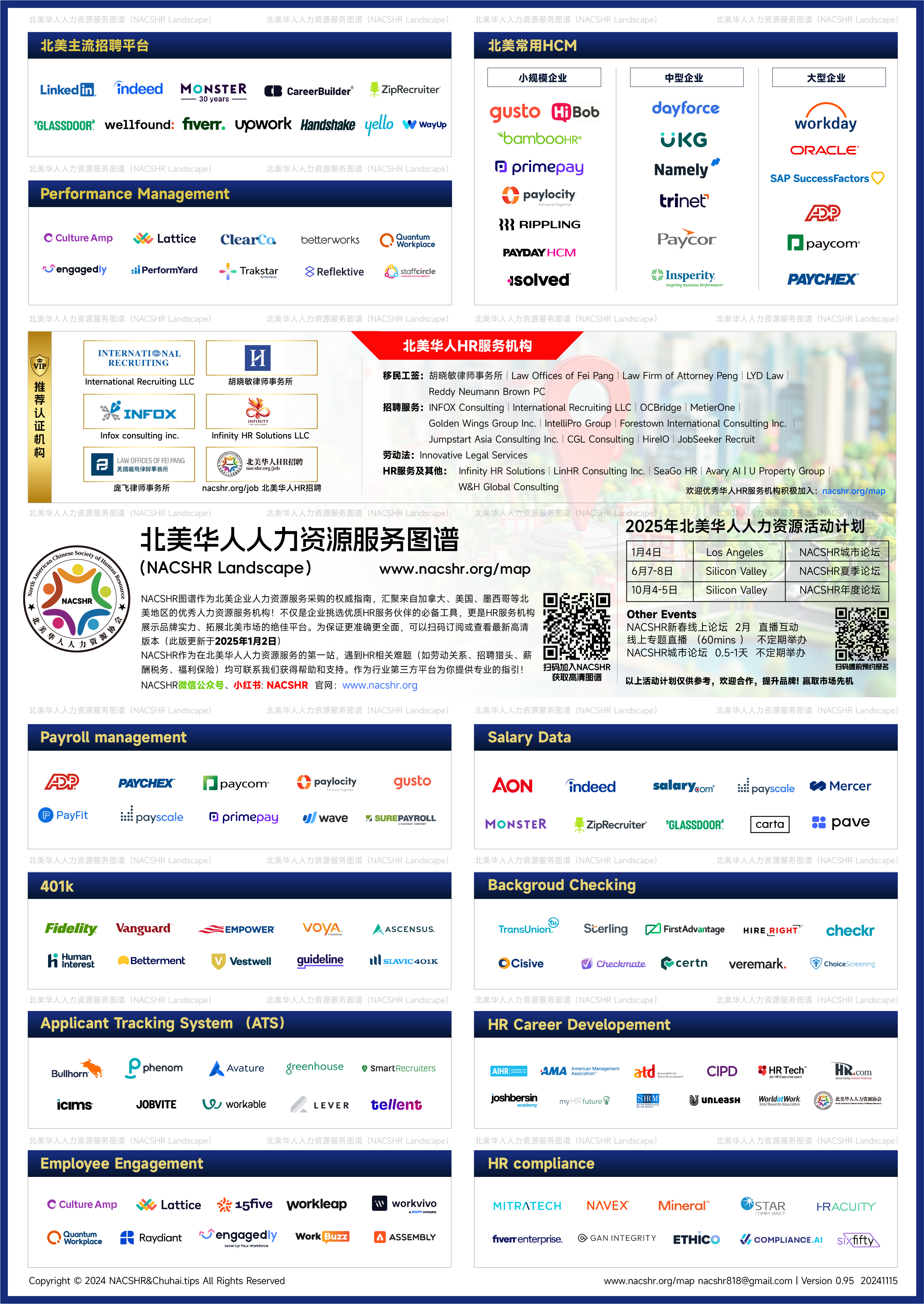
【免费加入】HR采购指南-北美华人人力资源服务机构图谱开放登记中
New Opportunity: North American Chinese HR Service Companies Landscape Now Open for Registration, Setting a New Standard for Chinese HR Services in North America
我们诚挚邀请您加入北美地区最全面的华人人力资源服务机构图谱(North American Chinese HR Service Companies Landscape)。此图谱旨在助力HR服务机构树立强大品牌形象,帮助企业更高效地寻找专业HR服务。该图谱由北美华人人力资源协会(NACSHR)联合权威媒体全力打造。这将成为众多企业在北美地区采购HR服务的重要指南。
覆盖范围广泛
北美华人人力资源服务机构图谱将汇聚来自加拿大、美国、墨西哥等地的优秀华人人力资源服务机构,涵盖HR服务的各个方面,包括但不限于:招聘服务(猎头,RPO,校招等)、HR咨询培训、移民签证,劳动关系、薪酬福利、人力资源外包、薪酬外包、EOR、灵活用工等等。
参与机构条件
在北美地区设有实体和工作人员的HR服务机构均可参与。无论是华人创办的机构,还是客户对象包含华人公司,亦或是希望开拓企业市场的公司,皆欢迎加入。
加入NACSHR服务图谱的理由
加入NACSHR服务图谱将为您提供诸多好处:
品牌推广:通过NACSHR多个渠道展示您的品牌,提升品牌知名度。
客户获取:成为企业寻找HR服务的首选指南,带来潜在客户。
专业背书:与NACSHR和权威媒体合作,提升机构信誉和美誉。
市场拓展:扩大在北美地区的市场影响力。
如何加入
扫码登记:扫描提供的二维码登记相关信息。
点击链接:https://www.nacshr.org/map/Register/join
表现形式与收益
NACSHR服务图谱将以多种形式展示,包括图谱、海报、网页、短视频等,这些形式将确保您的品牌获得最大程度的曝光(部分形式仅限于VIP服务)。
北美华人人力资源服务机构图谱下载:https://www.nacshr.org/map/Index/download/
如何加入北美华人人力资源服务机构图谱
为了方便大家参与北美华人人力资源服务机构图谱,我们提供两种服务选择:
免费服务:适合所有希望加入的机构,只需要填写链接提交相关资料即可。
VIP服务:优惠:2000美元/年,3600美元/2年 包含诸多额外权益,是提升品牌的最佳选择。VIP服务将为您提供更全面的推广和支持,帮助您在竞争中脱颖而出。(2024年12月31日后,3000美元/年)
NACSHR图谱VIP服务权益:
· NACSHR图谱版本LOGO+简称展示,优先前排展示(其他仅为文字简称)
· 网页版本分类优先显示,LOGO展示,品牌形象好,实力展示
· 网页版本页面提供推荐的VIP徽章
· NACSHR推荐服务机构海报
· 客户需求优先对接
· NACSHR活动优先\优惠参加
覆盖人群
NACSHR服务图谱将覆盖北美地区的NACSHR用户和会员。我们将通过微信群、小红书、网站、LinkedIn等社交媒体渠道进行广泛传播,确保您的品牌信息触达更多潜在客户。
加入北美华人人力资源服务机构图谱,是提升品牌和拓展市场的绝佳机会。立即行动,抓住这次难得的机遇,成为众多企业信赖的HR服务提供者!
期待您的参与!
北美华人人力资源协会
North American Chinese Society of Human Resource, (known as NACSHR)
关于北美华人人力资源服务图谱
北美华人人力资源服务图谱(NACSHR Landscape)汇聚来自加拿大、美国、墨西哥等北美地区的顶尖华人人力资源服务机构,全面覆盖企业所需的各类HR服务。作为北美企业人力资源服务采购的权威指南,NACSHR图谱不仅是企业挑选优质服务伙伴的必备工具,更是服务机构展示品牌实力、拓展北美市场的绝佳平台。
NACSHR图谱将通过全方位、多渠道的广泛传播,精准触达北美地区的华人管理精英,成为企业开拓北美市场的首选资源。无论是本土扩张还是海外发展,NACSHR图谱都将助您抢占先机,赢得市场。加入NACSHR图谱,您的品牌将与北美最优秀的HR服务商齐名,共同引领行业未来!
常见问题
·哪些机构可以参与?
在北美地区有实体和工作人员的HR服务机构均可,华人创办或客户对象包含华人公司,希望开拓中企市场等
·为什么要加入NACSHR服务图谱?
太多理由!无论从品牌推广到获取客户,NACSHR服务图谱都是你不可错过的重要渠道
·如何加入?
请扫码登记,或者点击这里登记相关信息,并选择相关权益,所有服务为1年有效期
·图谱有哪些表现形式,收益有哪些?
多个形式,图谱、海报、网页、手册等诸多形式。
·是否需要支付费用?
为更广泛的参与,提供免费和VIP服务2种供选择。
VIP服务收费为2000美元(优惠价 原价3000美元/年),包含诸多权益,是你最佳的选择,当然你可以先从免费开始。
从收集整理到发布推广,都是需要相当成本。
·NACSHR服务图谱会覆盖哪些人群?
首先会覆盖北美地区NACSHR用户和会员,我们会通过诸多微信群、小红书、网站、LinkedIn等社交媒体等渠道发布和传播。
诸多推广海报,供参考
头条
2024年07月14日
头条
【报名事项】付款方式—欢迎参加NACSHR年度峰会,注意事项及付款方式,请查看相关信息(不断更新中)
hi您好,欢迎参加2024NACSHR年度峰会,相关信息如下,我们会不断更新!
时间:2024年10月5日-6日 周六周日,其中周六上午 8点开放签到,9点会议开始
地点:Crowne Plaza Silicon Valley North ( Union City) 如需预定酒店,直接拉到最下方查看
32083 Alvarado-Niles Rd. Union City CA 94587
10月5日周六第一天日程安排
10月6日周日第二天日程安排
会议详情:https://www.nacshr.org/2024.html (会不断更新)
付款方式如下:(为方便大家,特别提供2种付款方式)
因EventBrite手续费非常高,应大家要求,今年特别提供 Zelle 方式付款,收款人为本次会议运营负责人. 付款zelle地址为 gawain520@qq.com 或者扫码支付。支付时请memo处备注您的报名姓名及参会人数,感谢! (这个是没有手续费的)
您可以选择通 Eventbrite的NACSHR会议链接进行报名和付费。报名及付费链接(https://nacshr10.eventbrite.com/) (注:Eventbrite 会收取一些手续费,信用卡或者美国之外的或如果无法使用zelle 建议可以使用,或者联系我们)
备注:如需银行账号转账或企业支付,或写支票,请直接联系我们获取详细信息(nacshr818@gmail.com)
如果人民币支付,请添加客服联系沟通。
NACSHR会议费用供参考:
费用:400美元/人 优惠票 (10月4日前报名支付) 现场门票 500美元。
晚宴:150美元/人(不单独销售,需购买门票,名额有限,售完为止 参与者为分享嘉宾、特邀专家、VIP参会等40人规模)
如有嘉宾推荐,可以根据优惠券扣除相关金额。
————————————————————————————————————————————
备注:
· 如果您有HR职位招聘,可以点击这里免费发布:https://www.nacshr.org/job
如果有任何问题可以联系我们:
联系人:Annie 邮件: nacshr818@gmail.com 网站:https://www.nacshr.org
*报名收到此邮件,意味着您已经报名参加NACSHR及合作伙伴主办的论坛,亦表示您已经清晰了解参会注意事项和用户隐私条款等事宜。
若非本人报名,请邮件告知:nacshr818@gmail.com
会议酒店:Crowne Plaza Silicon Valley North ( Union City)
32083 Alvarado-Niles Rd. Union City CA 94587
如需住宿,可以使用以下链接预定或者直接通过携程预定
点击这里可以直接预定酒店: ( https://www.ihg.com/crowneplaza/hotels/us/en/find-hotels/select-roomrate?fromRedirect=true&qSrt=sBR&qIta=99801505&icdv=99801505&qSlH=SFOUC&qCiD=04&qCiMy=092024&qCoD=06&qCoMy=092024&qGrpCd=NAZ&qAAR=6CBARC&qRtP=6CBARC&setPMCookies=true&qSHBrC=CP&qDest=32083%20Alvarado-Niles%20Road,%20Union%20City,%20CA,%20US&srb_u=1&qChAge=&qRmFltr= )
头条
2024年07月07日
头条
California Small Businesses Can Apply Now for Up to $2,000 Per Employee for Paid Family Leave Grants 加州小型企业现在就可以为每位员工申请最高 2000 美元的带薪探亲假补助金从2024年6月1日起,加利福尼亚州拥有1-100名员工的小企业可以申请每名员工高达2000美元的补助,用于应对员工使用加州带薪家庭假期(PFL)计划时增加的成本。加州的带薪家庭假期计划允许员工在需要照顾新生儿(通过出生、收养或寄养)或照顾重病家属时,享受最多8周的带薪休假。
这个补助计划旨在帮助企业应对员工休假期间的成本增加,例如培训现有员工、招聘和培训额外员工等。符合条件的企业必须在加州注册,在加州州务卿办公室处于活跃状态,并拥有一个有效的加州雇主账号。了解更多信息并申请补助,请访问CaliforniaPFL.com
Attention small businesses in California with 1-100 employees! If you have at least one employee who will be using California’s Paid Family Leave program on or after June 1, 2024, you may be eligible to apply for grants up to $2,000 per employee on PFL. This grant is designed to help offset the increased costs you may face while the employee is on leave. California’s Paid Family Leave program allows workers to take paid leave to bond with a new child (through birth, adoption, or foster care) or to care for a seriously ill family member. Businesses impacted by this program may have increased costs, such as training and upskilling existing staff to cover the duties of the employee on leave, hiring and training additional staff, and other related expenses. For more information and to apply for the grant, please visit CaliforniaPFL.com.
LOS ANGELES--Small businesses across California can now receive grants of up to $2,000 per employee through California’s Paid Family Leave (PFL) program. The online application is now open.
This initiative, funded by the California Employment Training Panel and the California Labor and Workforce Development Agency, aims to support small businesses in managing additional costs when employees take leave. These grants can help cover expenses such as cross-training existing staff and hiring and training new or temporary employees, ensuring business continuity during employee absences.
California’s PFL program provides eligible employees with up to 8 weeks of wage replacement benefits when they are off work for certain qualifying reasons, such as bonding with a new child or caring for a seriously ill family member. The grant is available to small businesses with 1 to 100 employees that have at least one employee utilizing PFL on or after June 1, 2024.
Grants are available in the following amounts:
Businesses with 51–100 employees may receive up to $1,000 per employee utilizing Paid Family Leave.
Businesses with 1–50 employees may receive up to $2,000 per employee utilizing Paid Family Leave.
To qualify, businesses must:
Employ between 1 and 100 employees;
Be registered to do business in the State of California;
Be in active status with the office of the California Secretary of State;
Have an active California Employer Account Number under which employees are listed for payroll and
Have at least one employee on California’s Paid Family Leave on or after June 1, 2024.
For more information or to apply for a grant, visit CaliforniaPFL.com.
头条
2024年06月25日
头条
The Key to a Thriving Workforce? A Smart Approach to AI微软的最新数据强调了人工智能对员工赋权、活力和生产力的积极影响。领导者可以通过关注其员工队伍是否在“繁荣”中来促进良好表现,微软将“繁荣”定义为被赋予权力和充满活力地进行有意义的工作。员工信号调查显示,人工智能的使用能通过减少乏味工作并促进有意义的工作来提高生产力、努力和影响。人工智能工具还与更高的赋权和活力得分相关,表明员工队伍的“繁荣”。成功的关键在于将人工智能与支持性文化相结合,提供必要的培训,并使人工智能项目与公司目标保持一致。
New data reveals how access to AI can help employees feel more empowered and energized, and find more meaning in their work.
what’s the best way for leaders to foster good performance? How can they tell if their efforts are successful or not? Often, companies try to answer these questions by measuring metrics like engagement or financial results. And while those are critical to business success, at Microsoft, we also want to explore whether the workforce is thriving.
“Thriving has become the North Star for how we understand employees,” says Microsoft VP of People Analytics Dawn Klinghoffer, who leverages data to help leaders understand and improve employee’s experience. “We define thriving as being empowered and energized to do meaningful work. Are people excited to come to work every day, excited about the opportunities ahead?”
One of the ways we gauge this at Microsoft is with our Employee Signals survey, a biannual company-wide poll. The recent results not only offered insights into the tangible benefits of thriving, they also uncovered a key catalyst for fostering it: access to AI.
The Benefits of Thriving
We are focused on fostering a culture of thriving because our research suggests that doing so can boost how effective our workforce perceives itself to be. We also found that employees who are thriving are likely to have the highest scores on our indicators of high performance, like productivity, effort, and impact
Additionally, survey results suggest that employees who are thriving are more likely to go above and beyond what is expected of them. They take more pride in their work and they are less apt to look for employment elsewhere.
Recent Employee Signals survey results give us some new insights about what it means to thrive in this new era of work. We discovered that higher scores on what we’ve identified as the most important factors that support thriving—finding meaning in work, feeling empowered, and feeling energized—also translate to a measurable boost in productivity. Furthermore, access to AI seems to correlate with higher scores on each of these pillars.
Meaningfulness: According to our data, employees who find their work meaningful are 59% more likely to say they are productive at work—and 28% more likely to say they put in extra effort. Key to that is minimizing time spent on tasks that don’t feel meaningful. This is where AI comes in: AI assistants can lighten the load by generating rough drafts, sifting through piles of data, or simply acting as a sounding board and brainstorming partner to help people nail down a plan of action. Crucially, incorporating AI into the day correlated to a 20% jump in scores relating to meaningful work.
“What we find is that AI is really there to help you take friction and toil out of the system, and to remove the drudgery of work,” Klinghoffer says. “And when people are able to remove some of that drudgery, we see that they’re more productive, and they thrive more.”
Empowerment: Survey results also point to a future in which AI empowers people in their jobs. People who are empowered do not feel they have resource constraints, and they aren’t overburdened with people telling them how to do their work, Klinghoffer says, “so they have more freedom to do things the way they want and need to get the job done.” Access to AI tools and resources, we found, correlated to 34% higher scores for questions related to empowerment.
Energy: Our employees who say they feel energized are 44% more likely to say they feel proud of their work, and 22% more likely to say they take the initiative to be productive and put discretionary effort into their work. All levels of AI use— learning about it, grasping its value, incorporating it into processes and products, or simply having AI resources—correlated to higher reported energy levels. In fact, scores on energy-related questions for those using AI jumped almost 27%.
These results offer solid evidence that AI can be a catalyst for thriving and high performance. But how a company goes about making AI available will determine whether the company can reap these benefits. If employees are equipped with the right knowledge, tools, training, and resources to leverage AI in their work, they can begin to tap the full potential of an AI companion.
The key to success, Klinghoffer says, is integrating AI in a way that spans culture, learning, and people management. That way, everyone will understand how AI can help them focus on the most meaningful work.
The ABCs of Thriving with AI
Klinghoffer recommends keeping the following blueprint top of mind.
Accelerate alignment: Strengthen connections between employees, the company’s mission, and the transformative potential of AI. Clarify how AI initiatives align with the company’s goals and employees’ roles. Celebrate contributions to AI projects to highlight their impact on the company and customers.
“Employees who felt more connected to the mission and really understood how their work fits into the larger system were also the ones who were really thriving,” says Ketaki Sodhi, Senior HR Data Analyst at Microsoft. “When we looked at Copilot and employee sentiment around AI, these were also the folks who were willing to experiment and find ways to use AI to take some of the drudgery out of the day-to-day.” Smart leaders should seek out those internal champions and offer them support and encouragement.
Be inclusive: Create an environment where all employees feel equipped to engage with AI. This includes providing AI education, training, and resources, as well as fostering a culture of innovation and supporting a safe space for experimentation. Regular check-ins and feedback sessions can help employees express concerns and share ideas related to AI. Once users are encouraged and equipped to explore the possibilities of AI, our research suggests that a time savings of just 11 minutes a day is all it takes for them to start to appreciate its value.
Cultivate collective growth: Create a culture that empowers employees to decide how to do their best work, while investing in moments that matter together. Provide employees with the flexibility to plan their days and create time to meaningfully engage with AI. Encourage them to explore how AI can help them free up time for creative and strategic work. Then highlight use cases and foster collaboration among teams to encourage knowledge sharing.
Collective growth encompasses in-role experiences (how do we create time and space for employees to learn within their role?) and beyond (what comes next for me? Is there a viable career that excites me at this company?). AI can help with both—by eliminating the drudgery that keeps employees from doing more creative work, and by facilitating positive employee movement. “You see a huge boost. People get excited doing something new, growing their skills and experiences, and furthering their career,” Klinghoffer says. “A couple of months ago on my team we had people who were interested in a different role raise their hands, and we facilitated changes for about 20% of my org.”
头条
2024年06月24日
头条
HR如何可以成为组织中的影响者 How HR Can Become an Organizational Influencer文章《HR如何成为组织的影响者》强调了HR在推动组织变革中的关键作用,通过战略影响而非正式权力来驱动变革。HR专业人员可以通过利用他们对人力动态的深入理解、战略思维和沟通技巧,成为关键的影响者。文章列出了HR需要掌握的八项核心能力,包括战略影响力、讲故事的能力、公共演讲、协作影响力、外交、信息传递、冲突解决和执行力。
通过发展这些技能,HR可以有效地驾驭变革,激励行动,并将人员战略与业务目标对齐。
变革不仅是不可避免的,而且是推动个人和组织成长与创新的动力。在工作中,变革可以推动一个组织向前发展并提升其水平,也可以摧毁它(包括其中的员工)。组织如何应对变革?是通过纯粹的角色权威?还是通过高层领导的强制命令?亦或是通过那些没有“正式权威”的人以更微妙的方式来推动和引导变革的方向?
在大多数组织中,人力资源(HR)没有像其他部门那样拥有正式的权力或影响力。通常,HR人员不足,资源匮乏。即使在过去几年中人力资源职能快速发展,HR在工作中仍在努力建立其战略价值。对于HR来说,推动或引导变革的力量不是正式的权力或“蛮力”,而是战略影响力(strategic influence)。
本质上,战略影响力不是关于权威,而是关于灵感、创新以及对工作中人类元素的深刻理解。讽刺的是,一些拥有强大职位的领导者除了他们头衔赋予的权力外,没有任何影响力。相反,一些在工作中没有头衔的普通人,却是通过利用他们的影响力来推动和引导变革的真正变革者。
有时HR确实有正式的权力,但更多时候没有。这就是为什么它必须更多地依赖影响力而不是正式的权威。
组织中的影响者 组织中的影响者是变革的催化剂,是能够理解业务战略与人类动态之间联系的愿景者。不同于源自层级权力的传统影响力,组织中的影响者的影响力来自于他们连接、理解和激励人的能力。
组织中的影响者具有一些基本特质,包括:
战略思考:看到更大的图景,并将努力与整体组织目标对齐。
以同理心领导:理解并重视他人的观点和需求。
有效沟通:通过清晰和信念表达想法并激励行动。
适应力强:拥抱变革并帮助他人应对变革。
用数据决策:利用数据洞察来决策和制定策略。
与他人合作并建立伙伴关系:建立伙伴关系并在组织各个层面促进团队合作。
创新:不断寻找和实施创造性的解决方案。
有韧性:在面对挫折时保持专注和积极。
伦理和诚信:坚持诚信并促进信任和尊重的文化。
让HR成为组织影响者的8种方式 以下是HR可以用来成为组织影响者的八种方法:
1 - 战略影响力 战略影响力是关于利用HR在人员领导和业务管理方面的独特见解来推动业务策略,确保人员与业务目标对齐并推动其前进。这个概念体现了HR领导者不仅是参与者,而且是董事会中的关键策略家,倡导促进组织成长和员工满意度的政策和实践。 这些是需要掌握的五项能力:
制定并执行与组织领导力对齐的有影响力的HR策略。
通过战略性HR举措影响高层管理和决策。
在整个组织中建立战略伙伴关系以增强HR的影响力。
使用HR洞察分析和解决复杂的组织挑战。
指导和发展HR团队以增强战略思维能力。
2 - 讲故事 讲故事是HR专业人士的一个强大工具,使他们能够将组织的价值观、文化和目标联系起来形成引人入胜的叙述。这种方法不仅增强了沟通,还建立了情感连接,使HR举措更易于理解和影响深远。通过讲故事,HR可以有效地倡导变革,庆祝成功,并阐明业务决策中的人性化一面,将抽象概念转化为在整个组织中产生共鸣的有意义的故事。 这些是需要掌握的五项能力:
创作引人入胜的叙述以传达HR的愿景和价值观。
使用有说服力的讲故事技巧吸引多样化的受众。
利用讲故事推动组织变革。
根据不同的沟通媒介调整讲故事的风格。
使用叙事智能增强HR的说服力。
3 - 出色的公众演讲 出色的公众演讲使HR领导者能够以权威和激情进行沟通,影响并激励他人。出色的公众演讲不仅仅是大声说话或喋喋不休,而是关于自信、同理心和理解。这项技能对于倡导HR举措、分享洞察和引导塑造组织未来的讨论至关重要。精通的公众演讲使HR领导者成为能够吸引听众的强大演说者,无论是在小型团队会议还是大型企业聚会上,都能有效传达HR的战略价值。 这些是需要掌握的五项能力:
掌握适用于HR背景的公众演讲技巧。
通过有效的演讲技巧吸引和激励受众。
利用公众演讲作为HR倡导和影响的工具。
根据不同类型的受众和组织层级调整演讲内容。
制作能够引起利益相关者共鸣的引人入胜的演讲内容。
4 - 协作影响力 协作影响力侧重于HR建立和维护推动组织成功的战略业务伙伴关系的能力。它突显了HR在弥合部门间差距、促进跨职能团队合作以及将HR策略与更广泛的业务目标对齐方面的作用。通过协作,HR可以打破孤岛,促进团结,并确保人员策略是实现公司目标的重要组成部分。 这些是需要掌握的五项能力:
建立和维持支持HR目标的有影响力的业务伙伴关系。
促进HR与其他业务单位之间的合作。
利用人际交往技能增强HR的协作影响力。
协商并对齐HR策略与更广泛的业务目标。
培养支持和倡导HR举措的盟友网络。
5 - 外交技巧 HR的外交技巧是关于以策略性智慧和策略性技巧驾驭复杂的组织政治网络。它涉及以尊重不同观点的方式倡导HR政策和举措,同时推动进步性变革。HR外交官善于建立共识、管理冲突,并将HR定位为组织决策中的中立但有影响力的参与者,确保在业务策略中始终考虑人员因素。 这些是需要掌握的五项能力:
利用外交技巧驾驭和影响组织政治。
使用策略性沟通技巧倡导HR驱动的变革。
通过外交解决复杂的组织问题。
在不同利益相关者群体中建立共识。
在所有HR举措中以诚信和伦理领导。
6 - 信息掌控 HR的信息掌控是关于编写和传达清晰表述HR策略价值和影响的信息。它是将沟通调整到不同受众的能力,确保清晰、参与和支持HR举措。通过有效的信息传达,HR专业人士可以解密HR政策,倡导组织变革,并巩固HR在组织内作为关键沟通者的角色。 这些是需要掌握的五项能力:
制定清晰有影响力的HR举措沟通策略。
调整HR信息以引起不同组织受众的共鸣。
以易于理解的方式传达复杂的HR概念。
有效利用各种沟通渠道传递HR信息。
测量和分析HR沟通策略的影响。
7 - 冲突解决和达成共识 冲突解决和达成共识在维护和谐和高效的工作环境中至关重要。这个概念围绕HR调解争议、促进谈判和培养合作与相互尊重环境的能力。通过为HR专业人士配备解决冲突的技能,组织可以确保更顺畅的运营、增强的团队合作以及一个重视建设性对话而非对抗的文化。 这些是需要掌握的五项能力:
有效调解和解决工作场所冲突。
促进合作和建设性的谈判过程。
在冲突各方之间建立共识以实现组织和谐。
实施预防和管理冲突的主动策略。
培训和指导团队冲突解决和达成共识的技能。
8 - 领导风范 HR影响者的领导风范和领导力是关于体现那些在组织各个层面上赢得尊重和激发信心的品质。这包括培养一种真实、权威和平易近人的领导风格,使HR领导者能够有效地倡导战略举措并以身作则。凭借强大的领导风范,HR专业人士可以更有效地影响结果、推动战略决策,并倡导以人为本的业务方法。 这些是需要掌握的五项能力:
培养权威且真实的领导风格。
提升高层沟通技巧。
建立战略关系。
以自信和愿景领导。
通过变革性领导实践激励团队和个人。
英文原来来自:https://www.linkedin.com/pulse/how-hr-can-become-organizational-influencer-hacking-hr-0xnlc/
作者:Hacking HR
Change is not just inevitable, but the driving force behind personal and organizational growth and innovation.
At work, change can either propel an organization forward and lift it up, or break it (including its people).
How can organizations navigate change? Is it through pure role-based authority? Is it through the brute force of senior leadership mandates? Or is there a more subtle way in which people, without “formal authority”, may drive and even steer the direction of change?
In most organizations, Human Resources (HR) does not have the formal authority or power that some of its counterparts have. Generally, HR is understaffed and under-resourced. And, even with the rapid advancement of the people function in the past few years, HR is still on the road to building its strategic value at work.
For HR, it is not formal authority or “brute force” that drives or steers change, it is the power of strategic influence.
In essence, strategic influence is not about authority, but inspiration, innovation, and a deep understanding of the human element at work.
Ironically, some leaders with a powerful position have no influence other than that given to them by their titles. In contrast, some ordinary people at work, without a title, are real change makers with potent network effects at work given how they leverage their influence to drive and steer change.
Sometimes HR does have the formal authority, but often it does not. That’s why it has to rely more on the power of influence than on the power of formal authority.
Organizational Influencers
An organizational influencer is a catalyst for change, a visionary who understands the connection business strategy and human dynamics. Unlike traditional notions of influence that stem from hierarchical power, organizational influencers derive their impact from their ability to connect, understand, and inspire people.
An organizational influencer has some foundational attributes, including:
Thinking strategically: Sees the bigger picture and aligns efforts with overarching organizational goals.
Leading with empathy: Understands and values the perspectives and needs of others.
Communicating effectively: Articulates ideas and inspires action through clarity and conviction.
Adapting: Embraces change and helps others navigate through it.
Informing decisions with data: Leverages insights from data to inform decisions and strategies.
Collaborating with others and building partnerships: Builds partnerships and fosters teamwork across all levels of the organization.
Innovating: Constantly seeks and implements creative solutions to challenges.
Being resilient: Maintains focus and positivity in the face of setbacks.
Behaving ethically and with integrity: Upholds integrity and promotes a culture of trust and respect.
8 Ways for HR to Becomes an Organizational Influencer
These are nine ways HR can use to become an organizational influencer.
1 - Strategic Influence
Strategic influence is about leveraging HR's unique insights into people leadership and business management to drive business strategies, ensuring that people align with and propels business objectives forward. This concept embodies the idea that HR leaders are not just participants but key strategists in the boardroom, advocating for policies and practices that foster both organizational growth and employee satisfaction.
These are five competencies to master:
Develop and execute impactful HR strategies aligned with organizational leadership.
Influence top-level management and decision-making through strategic HR initiatives.
Foster strategic partnerships across the organization to enhance HR's influence.
Analyze and address complex organizational challenges using HR insights.
Mentor and develop HR teams to strengthen strategic thinking skills.
2 - Storytelling
Storytelling is a powerful tool for HR professionals, enabling them to connect the dots between organization's values, culture, and goals into compelling narratives. This approach not only enhances communication but also builds emotional connections, making HR initiatives more relatable and impactful. Through storytelling, HR can effectively champion change, celebrate successes, and articulate the human side of business decisions, transforming abstract concepts into meaningful stories that resonate across the organization.
These are five competencies to master:
Craft compelling narratives to communicate HR vision and values.
Engage diverse audiences with persuasive storytelling techniques.
Leverage storytelling to drive organizational change.
Adapt storytelling styles to fit various communication mediums.
Use narrative intelligence to enhance HR's persuasive power.
3 - Public Speaking Excellence
Public speaking excellence empowers HR leaders to communicate with authority and passion, influencing and inspiring others at work. People speaking excellence is not about being loud or never shutting up, but about confidence, empathy and understanding. This skill is crucial for advocating HR initiatives, sharing insights, and leading discussions that shape the organization's future. Masterful public speaking turns HR leaders into powerful orators who can captivate their listeners, whether in small team meetings or large corporate gatherings, effectively conveying the strategic value of HR.
These are five competencies to master:
Master public speaking skills tailored for HR contexts.
Engage and motivate audiences through effective speech delivery techniques.
Utilize public speaking as a tool for HR advocacy and influence.
Adapt speeches to various audience types and organizational levels.
Develop compelling presentation content that resonates with stakeholders.
4 - Collaborative Influence
Collaborative influence focuses on HR’s capacity to forge and maintain strategic business partnerships that drive organizational success. It highlights HR’s role in bridging gaps between departments, facilitating cross-functional teams, and aligning HR strategies with broader business objectives. Through collaboration, HR can dismantle silos, encourage unity, and ensure that people strategies are integral to achieving corporate goals.
These are five competencies to master:
Build and sustain influential business partnerships that support HR goals.
Facilitate collaboration between HR and other business units.
Leverage interpersonal skills to enhance HR’s collaborative impact.
Negotiate and align HR strategies with broader business objectives.
Cultivate a network of allies to support and advocate for HR initiatives.
5 - Diplomacy
HR diplomacy is about navigating the complex web of organizational politics with tact and strategic acumen. It involves advocating for HR policies and initiatives in a way that respects differing viewpoints while pushing for progressive change. HR diplomats are adept at building consensus, managing conflicts, and positioning HR as a neutral yet influential player in organizational decisions, ensuring that the people aspect is always considered in business strategies.
These are five competencies to master:
Utilize diplomacy to navigate and influence organizational politics.
Advocate for HR-driven change using tactful and strategic communication.
Resolve complex organizational issues with diplomatic problem-solving.
Build consensus among diverse stakeholder groups.
Lead with integrity and ethical considerations in all HR initiatives.
6 - Message Mastery
Message mastery in HR is about crafting and delivering messages that clearly articulate the value and impact of HR strategies. It’s the ability to tailor communication to diverse audiences, ensuring clarity, engagement, and support for HR initiatives. Through effective messaging, HR professionals can demystify HR policies, champion organizational change, and solidify HR’s role as a key communicator within the organization.
These are five competencies to master:
Develop clear and impactful communication strategies for HR initiatives.
Tailor HR messaging to resonate with different organizational audiences.
Communicate complex HR concepts in an accessible manner.
Utilize various communication channels effectively for HR messaging.
Measure and analyze the impact of HR communication strategies.
7 - Conflict Resolution and Agreement Building
Conflict resolution and agreement building are fundamental in maintaining a harmonious and productive workplace. This concept revolves around HR's ability to mediate disputes, facilitate negotiations, and foster an environment of cooperation and mutual respect. By equipping HR professionals with the skills to navigate and resolve conflicts, organizations can ensure smoother operations, enhanced teamwork, and a culture that values constructive dialogue over confrontation.
These are five competencies to master:
Mediate and resolve workplace conflicts effectively.
Facilitate collaborative and constructive negotiation processes.
Build consensus among conflicting parties to achieve organizational harmony.
Implement proactive strategies to prevent and manage conflicts.
Train and guide teams in conflict resolution and agreement-building skills.
8 - Executive Presence
Executive presence and leadership for HR influencers are about embodying the qualities that command respect and inspire confidence at all levels of the organization. This includes cultivating a leadership style that is authentic, authoritative, and approachable, enabling HR leaders to effectively advocate for strategic initiatives and lead by example. With a strong executive presence, HR professionals can more effectively influence outcomes, drive strategic decisions, and champion a people-centric approach to business.
These are five competencies to master:
Cultivate an authoritative and authentic leadership style.
Enhance executive communication skills.
Build strategic relationships.
Lead with confidence and vision.
Inspire teams and individuals with transformative leadership practices.