H-1B 进入“工资权重”时代:高薪岗位中签概率将被系统性放大2025年12月23日,美国国土安全部(DHS)与美国公民及移民服务局(USCIS)在官网新闻稿中确认,H-1B名额选择机制将迎来重大调整:未来当注册人数超过年度上限时,传统“纯随机抽签”将被“加权选择(weighted selection)”取代。USCIS表示,过去的随机抽签曾被部分雇主滥用,通过大量低薪岗位注册“冲池”,导致低技能、低工资外籍劳工更容易中签,从而损害美国本土劳工的工资、工作条件与就业机会。新规旨在提高更高技能、更高薪酬申请人的获选概率,以更符合国会对H-1B项目的初衷,并强化美国竞争力。以下是AI综合各个官方文件的清晰解读,供参考
一、官方确认了什么?2025 年 12 月 23 日,USCIS 在官网发布新闻稿确认:美国国土安全部(DHS)将修订 H-1B 名额选择规则,用“加权选择(weighted selection)”替代传统的“随机抽签(random lottery)”,以更优先分配给“更高技能、更高薪酬”的申请人,目标是更好地保护美国本土劳工的工资、工作条件与就业机会。USCIS
与新闻稿配套的 Final Rule(最终规则) 已以 Public Inspection 形式发布,文件明确该规则将于 2026 年 2 月 27 日生效,并用于 FY 2027(2027 财年)H-1B cap 注册季。Federal Register Public Inspection+1
二、最关键变化:不是“取消抽签”,而是“抽签概率倾斜”这次改革的重点不在于取消抽签,而在于:当注册人数超过名额上限、必须进行选择时,USCIS 不再让所有注册“同等概率随机”,而是根据工资水平给予不同权重,使高工资岗位获得更高被选中的概率。USCIS 在官方说明中强调,该机制会“总体上更偏向(generally favor)更高技能、更高薪酬的申请人”,同时“仍保留所有工资等级参与的机会”。USCIS+1
三、加权依据是什么?与 DOL 的 OEWS 工资等级挂钩Final Rule 的核心逻辑,是把“工资”作为技能与岗位价值的可量化代理指标(政策语言为优先高技能、高薪酬)。你的中文稿中提到的“四级工资(Level I–IV)”框架,来自美国劳工部的职业工资统计体系(OEWS)对应的 prevailing wage 分层概念;在 USCIS 的 H-1B 注册流程官方页面中,也明确提到该 Final Rule 将实施“weighted selection”并以更高工资/技能为倾向。USCIS
(注:权重如何具体落在 Level I=1、Level II=2、Level III=3、Level IV=4 的执行细则,应以 Final Rule 的条文与 USCIS 后续系统实施说明为准。你现在持有的 2025-23853 PDF 正是用于核对这一点的“法律文本本体”。Federal Register Public Inspection+1)
四、哪些“不变”?这点对雇主和 HR 很重要从官方文件表述看,本次改革有几项关键“保持不变”的部分:
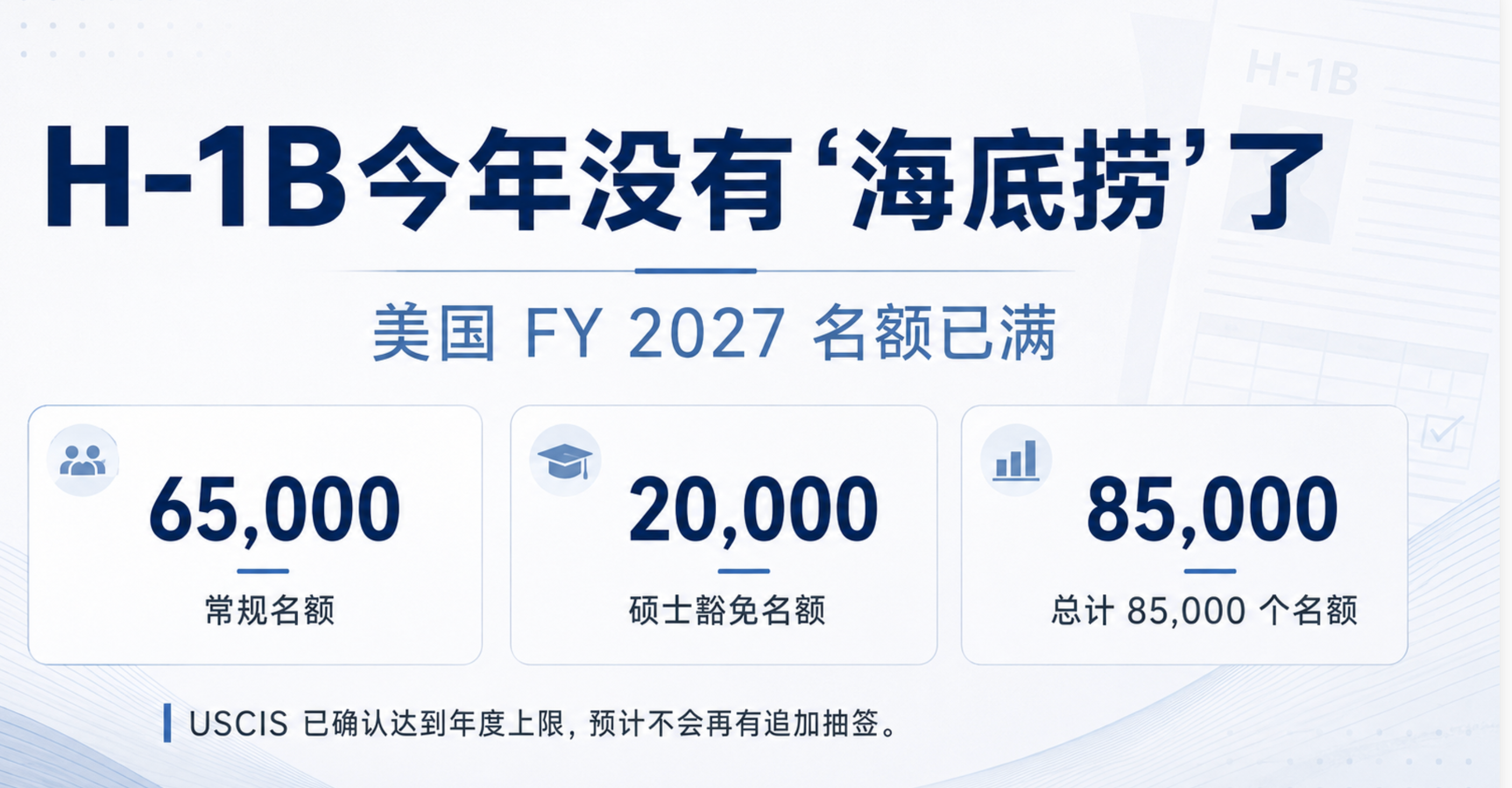
1)年度名额结构不变仍然维持 65,000 个常规名额 + 20,000 个美国高学历(advanced degree)名额。USCIS+1
2)仍然是注册阶段的选择机制调整官方表述将这次改革定位为“选择过程(selection process)”的修订。也就是说,它改变的是“谁更容易在注册阶段被选中”,并不等于“被选中就一定获批”。USCIS+1
3)实质审查与合规要求并未被取消Final Rule 与 USCIS 页面均指向:H-1B 后续仍要满足所有既有法规与合规要求(如职位专业性、薪资合规、LCA 等)。换句话说,加权机制只是改变“入场顺序”,不替代后续的合规与真实性审核。USCIS+1
五、潜在影响:谁受益、谁承压?基于规则设计本身(以工资分层作为权重),其影响方向相对清晰:
更可能受益的群体高薪资、资深或紧缺岗位(更容易落在更高工资分位/更高 Level),以及更有能力支付市场高位薪酬的大型雇主。这与官方“优先高技能、高薪酬”的政策目标一致。USCIS+1
更可能承压的群体初创公司、中小企业(预算约束更强),以及入门级岗位或薪资更接近 Level I/II 的候选人。虽然官方强调“各工资等级仍有机会”,但在概率权重机制下,实际中签率结构很可能出现倾斜。USCIS+1
六、对 HR / 雇主的现实建议:把 H-1B 从“运气”变成“可控变量”在加权抽签框架下,HR 和雇主在注册前的准备会更“策略化”:
1)岗位定级与薪资策略需要提前做同一岗位在不同地区、不同薪资定位可能对应不同工资分位/Level。提前对标市场薪酬并合理定薪,将直接影响进入抽签池的“权重”。(具体定级方法与合规口径建议与移民律师/合规顾问确认。)
2)招聘规划要前置到注册窗口之前过去很多公司把抽签视为随机事件;未来应把岗位级别、薪资结构与人才引进路径更早纳入年度 workforce planning。
3)合规底线不会降低,反而更容易被放大审视政策目标本身强调保护美国劳工与防止滥用,因此雇主在职位真实性、工作内容专业性、薪资合理性、LCA 流程等方面的合规管理更关键。USCIS+1
七、时间线:你需要核实的三个关键日期
2025/12/23:USCIS 官网发布新闻稿确认规则方向与政策目标。USCIS
2025/12/29:Final Rule 以 Public Inspection 形式显示“计划刊登于 Federal Register”的发布日期信息。Federal Register Public Inspection+1
2026/02/27:Final Rule 生效日期;用于 FY 2027 H-1B cap 注册季。USCIS+1
免责声明本文基于 DHS/USCIS 官方公开信息与联邦公报相关文件进行整理解读,旨在提供一般性信息参考,不构成法律意见或移民申请建议。H-1B 相关政策适用高度依赖具体事实与个案情况(包括但不限于岗位职责、薪资结构、工作地点、雇主资质、合规流程等),不同情形可能产生不同结论。建议雇主与申请人就具体问题咨询各自的移民律师或专业合规顾问,以获取针对自身情况的准确建议。
附录:官方原文链接(建议在文末以“参考资料/来源”呈现)1)USCIS 新闻稿(Release Date: 12/23/2025)
https://www.uscis.gov/newsroom/news-releases/dhs-changes-process-for-awarding-h-1b-work-visas-to-better-protect-american-workers USCIS
2)Final Rule(Public Inspection PDF:2025-23853)
https://public-inspection.federalregister.gov/2025-23853.pdf Federal Register Public Inspection
3)Federal Register(Public Inspection 页面:2025-23853)
https://www.federalregister.gov/public-inspection/2025-23853/weighted-selection-process-for-registrants-and-petitioners-seeking-to-file-cap-subject-h-1b Federal Register
4)USCIS H-1B Electronic Registration Process(流程说明页)
https://www.uscis.gov/working-in-the-united-states/temporary-workers/h-1b-specialty-occupations/h-1b-electronic-registration-process USCIS
附录新闻稿原文:
DHS Changes Process for Awarding H-1B Work Visas to Better Protect American Workers
Release Date
12/23/2025
WASHINGTON – The Department of Homeland Security is amending regulations governing the H-1B work visa selection process to prioritize the allocation of visas to higher-skilled and higher-paid aliens to better protect the wages, working conditions, and job opportunities for American workers. The new rule replaces the random lottery for selecting visa recipients with a process that gives greater weight to those with higher skills.
“The existing random selection process of H-1B registrations was exploited and abused by U.S. employers who were primarily seeking to import foreign workers at lower wages than they would pay American workers,” said U.S. Citizenship and Immigration Services spokesman Matthew Tragesser. “The new weighted selection will better serve Congress’ intent for the H-1B program and strengthen America’s competitiveness by incentivizing American employers to petition for higher-paid, higher-skilled foreign workers. With these regulatory changes and others in the future, we will continue to update the H-1B program to help American businesses without allowing the abuse that was harming American workers.”
The number of H-1B visas issued annually is limited to 65,000, with an additional 20,000 for U.S. advanced degree holders. The current random selection process has often been criticized for allowing unscrupulous employers to exploit it by flooding the selection pool with lower-skilled foreign workers paid at low wages, to the detriment of the American workforce. To address these concerns, the final rule will implement a weighted selection process that will increase the probability that H-1B visas are allocated to higher-skilled and higher-paid aliens while maintaining the opportunity for employers to secure H-1B workers at all wage levels. This final rule is effective Feb. 27, 2026, and will be in place for the FY 2027 H-1B cap registration season.
The rule is another crucial step to strengthen the integrity of the H-1B nonimmigrant visa program. It is in line with other key changes the administration has made, such as the Presidential Proclamation that requires employers to pay an additional $100,000 per visa as a condition of eligibility.
“As part of the Trump Administration’s commitment to H-1B reform, we will continue to demand more from both employers and aliens so as not to undercut American workers and to put America first,” said Tragesser.
For more information, see the final rule.
For more information on USCIS and its programs, please visit uscis.gov or follow us on X (Formerly Twitter), Instagram, YouTube, Facebook, and LinkedIn.
头条
2025年12月23日
头条
12 Opportunities for HR in 2026: Building Organisations That Thrive in the Agentic AgeThe best way to predict the future is to create it (Peter Drucker).
If 2024 and 2025 were years of experimentation with generative and agentic AI, 2026 is the year organisations must scale. CEOs now expect measurable productivity improvements, while CFOs demand disciplined value creation. Yet many organisations remain stuck in pilot mode - not because the technology is immature, but because their operating models, skills and structures cannot absorb AI at scale.
Two-thirds of CEOs say their competitive differentiation depends on having the right expertise in the right roles, supported by reskilling, selective hiring, AI agents and strategic partnerships - the “build, buy, bot, borrow” model. Workforce strategy has become a CEO-level concern.
Introduction: HR’s R&D Moment
In the AI future, HR becomes your R&D department (Ethan Mollick)
For HR, the implications are profound. As Ethan Mollick notes, “In the AI future, HR becomes your R&D department”. HR now sits at the intersection of work redesign, skills strategy, leadership capability, organisational health and AI governance. The choices HR makes in 2026 will determine whether organisations unlock agentic productivity - or continue to experiment with little or no impact.
During the 10+ years I’ve been publishing this annual look at the year ahead, it has evolved from predictions to opportunities, because the forces shaping work now unfold over multiple years – and as Niels Bohr wryly observed:
“Prediction is very difficult, especially if it's about the future!” (Niels Bohr)
As ever, the 2026 opportunities are informed by Insight222 research, conversations with CHROs and people analytics leaders, Digital HR Leaders podcast interviews, and extensive academic and market analysis.
What follows are 10 opportunities for HR to lead with clarity, evidence, purpose and humanity in the agentic age. As in past years, I will again crowdsource two additional opportunities from readers, so please add your ideas in the comments below. An extensive list of references and further reading are also provided at the end of the article.
"When HR is fully engaged, AI adoption accelerates" (Bain, You Can't Spell AI without HR)
THE 12 OPPORTUNITIES FOR HR IN 2026
FIG 1: 12 Opportunities for HR in 2026 - as envisaged by NotebookLM (Source: David Green)
#1. Redesign Work for a Human-AI Operating System
“Agentic AI is already changing the nature of tasks, workflows, and roles — and organisations must redesign work to fully capture the benefits.” (McKinsey, The State of AI in 2025)
Organisations are beginning to move beyond experimentation and rethinking how work is structured. HR should now take the lead in designing the operating system that orchestrates humans and AI agents: clarifying tasks, workflows, decision rights, escalation points and where humans add unique value.
The question is no longer “What can we automate?” but “What is the optimal blend of humans and agents to deliver what we need?” That means starting from outcomes, decomposing work into tasks, and then deciding which should be human-led, AI-augmented or agent-delivered.
A coherent operating system requires clear governance: transparency, ethical boundaries, decision thresholds, and norms for human oversight. With CEOs pushing for productivity and CFOs demanding cost discipline, HR has the opportunity to become the architect of safe, scalable, value-creating AI-enabled work. Organisations that get this right will accelerate productivity, decision quality and speed of execution; those that don’t risk remaining confined to pilot purgatory.
“The future of work will be shaped not by replacing humans, but by redesigning systems to optimise the partnership between people and technology.” (Oliver Wyman Forum, How Generative AI is Changing the Future of Work)
"When you redesign work around human strengths, AI becomes a multiplier, not a threat. The shift is from doing tasks to orchestrating outcomes." (Loren Shuster, Digital HR Leaders podcast episode)
FIG 2: Human Agency Scale (Source: Stanford)
#2. Elevate Strategic Workforce Planning into a Core Enterprise Discipline
“Strategic workforce planning is now a CEO-level priority.” (McKinsey, Workforce Planning in the Age of AI)
Strategic workforce planning (SWP) has been elevated from an HR process to a C-suite priority. CEOs now see talent, skills, automation and cost decisions as central to enterprise performance. Consequently, HR must transform SWP into a dynamic system connecting strategy, skills, cost and organisational design. This involves scenario modelling, internal mobility mapping, talent flow analysis and productivity forecasting- not traditional headcount planning.
The “build, buy, bot, borrow” portfolio CEOs expect HR to manage demands continuous decision-making, not annual cycles. In an agentic environment, demand for skills shifts constantly, and SWP becomes the mechanism that helps leaders decide: When to reskill. When to hire. When to deploy agents. When to partner
Done well, SWP becomes one of the CEO’s sharpest tools for competitiveness, enabling faster reallocation of talent, clearer trade-offs and more confident long-term investment.
"The companies that get ahead build workforce planning into the business rhythm, not as an annual HR exercise but as a strategic capability." (Diane Gherson, Digital HR Leaders Podcast episode)
FIG 3: Five shifts for the future of workforce planning (Source: Deloitte)
3. Build a Dynamic Skills and Capability Ecosystem
“Skills have become the currency of work — and organisations must create systems where people can move fluidly to opportunities.” (World Economic Forum, Global Skills Taxonomy Toolkit)
Static job architectures cannot keep up with the speed of work. HR must build a dynamic skills ecosystem that continuously identifies, updates and deploys skills. AI-driven inference can surface emerging capabilities in real time, replacing outdated self-reporting and static competency models.
This ecosystem supports transparent internal mobility, talent marketplaces, AI-enabled learning and capability building aligned to business priorities, not generic training. Employability shifts toward adaptability, breadth, and the ability to collaborate effectively with AI.
Skills ecosystems reduce external hiring, increase internal mobility and enable transformation at scale. In 2026, skills can become the operating layer of the enterprise, connecting strategy, workforce decisions and learning in one adaptive system.
“High-performing companies are shifting from jobs to skills, and from hierarchy to capability ecosystems that evolve as fast as the business.” (BCG, AI at Work 2025)
"The real reason to become a skills-based organisation is business agility. As strategy shifts and technology evolves, you have to continually understand who you have relative to the work that needs to get done." (Sandra Loughlin, Digital HR Leaders Podcast episode)
FIG 4: Core skills in 2030 (Source: World Economic Forum)
4. Reshape Leadership for the Agentic Age
“As AI changes how work happens, leadership must evolve.” (BCG, As AI Changes Work, CEOs Must Change How Work Happens)
Leadership models built for supervision, expertise and control are no longer fit for a world where agentic AI executes tasks, synthesises information and accelerates decision cycles. In the agentic age, the leader’s job shifts from managing work to orchestrating systems - framing problems, setting direction, governing risk and enabling people and agents to operate together productively.
The research appears to be unequivocal: organisations will only capture the value of AI if leaders develop new muscles- judgement, systems thinking, ethical reasoning, rapid learning, transparency and the ability to steward change at speed. Leaders must become designers of workflows, not reviewers of work; enablers of experimentation, not gatekeepers; role models for adaptability, not certainty.
Psychological safety becomes even more important. As Amy Edmondson notes, people need to feel safe challenging both leaders and AI outputs. Leaders who create clarity, connection and trust see far higher adoption of agentic tools. Insight222 research highlights that the most effective leaders use data and evidence to guide decisions, while staying deeply human in how they communicate and build culture.
Perhaps most importantly, leaders must unlearn. As Katarina Berg puts it, almost everything about how we lead “is being rewritten” - and clinging to legacy behaviours slows the organisation.
The leaders who thrive will be those who embrace humility, curiosity and the mindset of a system architect - guiding people and AI to create outcomes neither could achieve alone.
"Psychological safety extends to AI. People must feel safe to question outputs and raise concerns." (Amy Edmondson, Digital HR Leaders podcast episode)
“Leaders have to get comfortable unlearning…we can’t cling to practices that no longer help people thrive.” (Katarina Berg, Digital HR Leaders podcast episode)
5. Strengthen Organisational Health, Fairness & Inclusion to Unlock Sustainable Performance
“Improving worker wellbeing is a powerful mechanism to raise productivity — potentially by 10–15%.” (McKinsey Health Institute and World Economic Forum, Thriving workplaces: How employers can improve productivity and change lives)
Organisational health, fairness and inclusion are now fundamental economic multipliers. Organisations that prioritise wellbeing consistently outperform peers on innovation, retention, productivity and financial performance.
In the agentic age, these issues become even more central. Poorly implemented AI can increase cognitive load, reduce autonomy and introduce new fairness risks - from biased models to opaque decisioning. HR must embed fairness, safety and inclusion into workflows, hiring systems, performance management and career pathways. Work should be redesigned to reduce friction, protect autonomy and ensure equitable access to opportunity and skills.
Healthy organisations transform faster, retain scarce skills and build the trust required for AI adoption. “Make work better” shouldn’t just be a slogan (as well as the name of a rather excellent blog by Bruce Daisley); it should be a mandatory requirement for sustainable performance.
"Firms that prioritise wellbeing outperform the stock market… delivering higher shareholder returns.” (De Neve et al, Workplace Wellbeing and Firm Performance)
"Fairness matters more than ever. AI raises the stakes, so leaders must communicate clearly and build cultures of accountability." (Patricia Frost, Digital HR Leaders podcast episode)
FIG 5: The relationship between employee wellbeing and firm financial performance (Source: McKinsey, World Economic Forum, De Neve et al)
6. Reimagine Employee Experience for a Hybrid, AI-Augmented Workforce
“Employee experience is now the chief predictor of retention, productivity, and resilience.” (Deloitte, Global Human Capital Trends 2025)
Employee experience (EX) must now be designed as a system, not a collection of disconnected initiatives. Continuous listening, behavioural insights and real-time feedback loops replace annual surveys as the core instrumentation of EX.
AI is reshaping how people collaborate, solve problems and access support - from copilots in productivity tools to agents embedded in HR services. HR’s task is to ensure these tools remove friction, strengthen connection and enhance, rather than erode, meaning and craftsmanship.
Culture is experienced in small moments: team rituals, collaboration norms, clarity of roles, responsiveness of systems. Organisations that redesign EX holistically - across workflows, leadership behaviours, workplace design, technology and hybrid rhythms - should unlock higher levels of resilience, engagement and performance.
In 2026, EX should evolve to become the way strategy is felt by employees day-to-day, not a separate programme.
"Hybrid work isn’t a policy — it’s an ecosystem. You have to design experiences intentionally, otherwise you get the worst of both worlds." (Michael Fraccaro, Digital HR Leaders podcast episode)
Join me for a webinar on January 15 as we unveil the key findings from the Insight222 People Analytics Trends
Register to join Madhura Chakrabarti, PhD, Jonathan Ferrar and me for an exclusive webinar on January 15 as we unveil the findings of the sixth annual Insight222 People Analytics and AI Trends study. Based on data from 370+ companies across the globe. Sign-up here.
7. Scale People Analytics as a Strategic Intelligence Function
“People analytics must evolve from answering HR questions to shaping enterprise decisions.” (Insight222, People Analytics Trends Report 2025–26)
People analytics is becoming the intelligence system that guides enterprise decision-making. With skills data, workflow telemetry, organisational network insights and AI-usage patterns, organisations can finally understand how work actually happens rather than how it appears in org charts or process maps. This shift - from descriptive reporting to real-time organisational sensing - is fundamental in the agentic age.
To scale effectively, people analytics requires firm foundations: automated data pipelines, integrated skills and work data, responsible governance and the capability to design and run experiments at pace. The aim is not to produce more dashboards (heaven forbid); it is to produce clarity. Which behaviours drive productivity? How is value created in teams? Where are critical skills emerging or eroding? What is the impact of AI agents on work quality, decision velocity and employee experience?
Done well, people analytics becomes a strategic advantage: a system that enables early detection of risk, faster reallocation of talent, and continuous improvement of workflows and leadership behaviours. In an agentic organisation, the winners will be those who learn faster, not merely those who measure faster.
“The link between people data and business performance becomes clear when you can show how engagement and capability lift profitability.” (Sharon Taylor, Digital HR Leaders podcast episode)
"The power of people analytics comes when insight ties directly to business outcomes — performance, customer experience, productivity." (Dawn Klinghoffer, Digital HR Leaders podcast episode)
FIG 6: Insight222 Leading Companies in People Analytics Model (Source: Insight222)
8. Embed Responsible AI & Workforce Governance
“AI cannot scale without trust.” (Gartner, AI in HR: Hits, Misses and Growing Pains)
Trustworthy AI is now a business imperative. As organisations deploy agentic systems across workflows, HR must lead the creation of governance frameworks that ensure fairness, explainability and ethical use of both employee and organisational data. This means setting clear decision boundaries, defining human-in-the-loop oversight, stress-testing models for bias, and establishing transparent communication so employees understand how AI affects opportunities, assessments and career paths.
Effective governance also requires continuous monitoring of outcomes, not just initial risk assessments. Research shows that poorly governed AI erodes trust, increases cognitive load and amplifies inequity - while well-designed systems enhance autonomy, safety and performance at scale.
Governance is not a brake on innovation; it is the guardrail that enables safe acceleration. Organisations with explicit principles, documented guardrails and credible oversight adopt AI faster and with greater employee support. Responsible AI is no longer a peripheral concern - it is a core component of the modern social contract between employer and employee.
“Responsible AI must be embedded from the start, not retrofitted once problems occur.” (TI People, From AI Impact Assessment to Results)
"AI amplifies both good and bad decisions. Governance is not optional — it’s the difference between progress and harm" (Tomas Chamorro-Premuzic, Digital HR Leaders podcast episode)
9. Elevate the CHRO as Enterprise Co-Pilot in Organisational Reinvention
“The CHRO is now the CEO’s most important partner in navigating the AI transition.” (BCG, What CEOs Should Look For in an AI-First Chief People Officer)
With work, skills, leadership and operating models being redesigned simultaneously, the CHRO has become the CEO’s closest strategic partner. Boards increasingly rely on CHROs to assess leadership capability, organisational health, skills readiness, talent allocation and the workforce implications of AI-driven change.
The modern CHRO blends economics, organisational psychology, AI literacy, systems thinking, culture expertise and data fluency. They shape decisions on business model reinvention, automation strategy, productivity, leadership appointments, capability building and culture renewal.
This is a profound expansion of scope. CHROs who embrace this mandate will become architects of reinvention, not custodians of HR processes. The role is more complex, more consequential and more central to enterprise performance than at any point in the last 50 years – perhaps ever.
“The CHRO has moved from people expert to organisational architect — shaping how work evolves with technology.” (Lynda Gratton, Digital HR Leaders podcast episode)
"CHROs have a unique vantage point: they understand capability, culture and change. That combination is what drives transformation." (Janine Vos, Digital HR Leaders podcast episode)
10. Reinvent the HR Operating Model and HR Capabilities for the Agentic Era
“Traditional structures will not deliver the speed or integration now required.” (Mercer, Operating by Design: Mercer’s new outcome-driven operating model for HR and technology)
HR cannot deliver any of the nine opportunities presented in this article without reinventing itself. Traditional COEs and service-delivery models were designed for times of stability - not today’s world of continuous workflow redesign, dynamic skills needs and pervasive AI.
A modern HR operating model requires:
Cross-functional integration rather than siloed COEs
AI-enabled workflows that automate transactional work
Real-time intelligence from people analytics and skills data
Clear decision rights and owner–accountability for outcomes
HRBPs fluent in AI, economics, data and organisational diagnosis
HR teams need new foundational capabilities: systems thinking, experience design, product mindset, experimentation, behavioural science, data literacy and technical fluency.
Only by reinventing itself can HR enable reinvention everywhere else.
“The HR function of the future blends analytics, experimentation, organisational design and technology fluency. These are no longer optional skills—they are foundational.” (Insight222, People Analytics Trends Report 2025–2026)
“HR leaders need to think of themselves as product managers, where employment is the product. That mindset changes everything — from how we design experiences to how we drive adoption and co-create solutions with our stakeholders." (Tanuj Kapilashrami, Digital HR Leaders podcast episode)
FIG 7: The New HR Operating Model (Source: TI People)
WHAT HR MUST BECOME TO DELIVER THESE OPPORTUNITIES
To realise these ten opportunities, HR must evolve into a more integrated, insight-driven and future-defining organisational function. That transformation requires three essential shifts.
Operate as an integrated enterprise system.
Redesigning work, skills, leadership and employee experience cannot be achieved by isolated teams. Talent, learning, EX, people analytics and HR operations must function as an interconnected platform with shared outcomes, shared intelligence and shared accountability. The problems we are solving - skills scarcity, organisational redesign, leadership transformation and AI integration - are all system problems, and so therefore require system responses.
Become AI-fluent and evidence-led.
HR professionals do not need to become data scientists or engineers, but they must understand AI’s capabilities, risks and organisational implications. AI literacy, data fluency and scientific thinking are now foundational capabilities for those aspiring to successful careers in HR. As work becomes more agentic, judgement improves when paired with evidence - and HR must champion this partnership across the organisation, from frontline decisions to board-level discussions.
“If HR doesn’t understand how AI works, we can’t shape how work gets redesigned. Data and AI literacy isn’t optional anymore — it’s the entry ticket.” (Nickle LaMoreaux, Digital HR Leaders podcast episode)
Build a new capability portfolio.
The future HR function blends organisational psychology, behavioural science, systems thinking, experience design, experimentation, governance, talent economics and transformation leadership. These capabilities enable HR to redesign workflows, govern AI ethically, accelerate skill building and orchestrate complex, multi-year change.
In short, HR must become the function that designs, enables and accelerates organisational reinvention - not merely responds to it.
“The best HR teams are running experiments constantly. It’s not about having all the answers — it’s about learning faster than the organisation around you.” (Thomas Otter, Digital HR Leaders podcast episode)
CONCLUSION: HR'S MOMENT OF MAXIMUM INFLUENCE
2026 is a defining year. Organisations are no longer debating whether AI will reshape work - they are debating how fast, how safely and how humanely. That places HR at the centre of enterprise strategy in a way we have not seen in decades.
These opportunities are not tasks - they are capabilities to build. They demand a more integrated, experimental, analytical and courageous HR function. Some will challenge long-held assumptions. Most will stretch HR beyond its comfort zone.
But the prize is meaningful. Organisations that combine agentic technology with human judgement and care will outperform those relying on technology alone. HR—with its unique position at the intersection of people, work and strategy—holds the key for how organisations adapt, thrive and unlock value in the agentic age.
This is HR’s moment of maximum influence.
The question is not whether HR is ready — but whether we will seize the opportunity...
CROWDSOURCING: HELP SHAPE THE FINAL TWO OPPORTUNITIES
Each year, the best ideas come from this community. The challenges and innovations transforming HR rarely originate from a single company - they emerge from the everyday work of practitioners across industries.
So, once again, I’m opening up the final two opportunities to you.
If you were to add one opportunity HR must focus on in 2026, what would it be—and why?
It could be something emerging in your organisation, a challenge I have under-discussed in the first ten opportunities, or a shift you believe is coming faster than most expect.
Share your ideas in the comments. I’ll synthesise the strongest contributions into two additional opportunities - #11 and #12 - in an update of this article in the New Year.
Together, let’s shape the agenda for HR in 2026.
REFERENCES AND FURTHER READING
The following resources informed the 2026 opportunities and are all recommended reading (or listening!) for readers (Please note some resources informed more than one opportunity for in the interests of brevity have only been listed once):
Introduction: HR’s R&D Moment
PwC, 28th Annual Global CEO Survey (2025) | IBM Institute for Business Value, CEO Study: Five Mindshifts to Supercharge Business Growth (2025) | World Economic Forum (Attilio Di Battista, Sam Grayling, Ximena Játiva, Till Alexander Leopold, Ricky LI, Shuvasish Sharma, and Saadia Zahidi), Future of Jobs Report (2025) | Accenture (Karalee Close and Kestas Sereiva), Reinventing enterprise models in the age of generative AI (2025) | Ethan Mollick, One Useful Thing (Blog) | Jason Averbook, Now to Next (Blog) | Wharton and GBK Collective (Jeremy Korst, Stefano Puntoni and Prasanna Tambe), Accountable Acceleration: Gen AI Fast-Tracks Into the Enterprise (2025) | Bain (Vincent Greco, Ph.D and John Hazan), You Can't Spell AI without HR: The Surprising Secret to Scale (2025) | Peter Hinssen and David Green ?? - Uncertainty as an Opportunity: HR’s Role in Shaping the Future of Work (Digital HR Leaders podcast episode)
Opportunity 1 (Redesign Work for a Human–AI Operating System)
McKinsey Quantum Black (Alex Singla, Alexander Sukharevsky, Lareina Yee, Michael Chui, Bryce Hall and Tara Balakrishnan), The State of AI in 2025: Agents, Innovation and Transformation (2025) | Microsoft Work Trends, 2025: The Year the Frontier Firm is born (2025) | Kathleen Hogan - Becoming a Frontier Firm: Orchestrating Microsoft’s Next Transformation in the Age of AI | Deloitte (Kyle Forrest, Chetan Jain, Greg Vert, Franz Gilbert, Arthur Mazor, Simona Spelman, Bhawna Bist, Derek Polzien), HR Reimagined (2025) | McKinsey ( Alexander Sukharevsky, Alexis Krivkovich, Arne Gast, Arsen Storozhev, Dana Maor, Deepak Mahadevan, Lari Hamalainen, and Sandra Durth), The agentic organization: Contours of the next paradigm for the AI era (2025) | Oliver Wyman Forum (Ana Kreacic, Amy Lasater-Wille, Lucia Uribe, Ravin Jesuthasan, CFA, FRSA, John Romeo, and Simon Luong), How Generative AI Is Changing The Future Of Work (2025) | Ravin Jesuthasan, CFA, FRSA, Want AI-Driven Productivity? Redesign Work (2025) | McKinsey Global Institute (Lareina Yee, Anu Madgavkar, Sven Smit, Alexis Krivkovich, Michael Chui, María Jesús Ramírez Larraín and Diego A. Castresana Bao), Agents, robots, and us: Skill partnerships in the age of AI (2025) | Loren I. Shuster and David Green ??, How LEGO Integrates People, Places and Culture (Digital HR Leaders podcast, 2024) | Dave Ulrich, Talent Advantage = AI (Artificial Intelligence) * HI (Human Ingenuity): A Formula for Business and HR Leaders (2025) | McKinsey (Sandra Durth, Asmus Komm, and Charlotte Seiler), HR’s transformative role in an agentic future (2025) | Stanford (Yijia Shao, Humishka Zope, Yucheng Jiang, Jiaxin Pei, David Nguyen, Erik Brynjolfsson, Yang Diyi), Future of Work with AI Agents (2025)
Opportunity 2 (Elevate Strategic Workforce Planning into a Core Enterprise Discipline)
McKinsey (Neel Gandhi, Sandra Durth, and Vincent Bérubé, Charlotte Seiler, Kritvi Kedia and Randy Lim), The Critical Role of Strategic Workforce Planning in the Age of AI (2025) | Deloitte (Susan Cantrell, Russell Klosk (智能虎), Zac Shaw, Kevin Moss, Christopher Tomke, and Michael Griffiths), The Future of Workforce Planning (2025) | Ross Sparkman and David Green ??, How to Influence Business Strategy Through Workforce Planning, (Digital HR Leaders podcast, 2025) | David Edwards, The Strategic Workforce Planning Handbook (2026) | Gartner (Maggie Schroeder-O’Neal and Jonah Shepp), 3 Steps to Initiate a Strategic Workforce Plan (2024) | PwC, Saratoga Annual HR & Workforce Benchmarking Report (2025) | Diane Gherson, Lynda Gratton and David Green ?? - The Key Role of HR In Successfully Integrating a Blended Workforce (Digital HR Leaders podcast, 2024)
Opportunity 3 (Build a Dynamic Skills and Capability Ecosystem)
World Economic Forum (Neil Allison , Ximena Játiva, and Aarushi Singhania), Global Skills Taxonomy Adoption Toolkit: Defining a Common Skills Language for a Future-Ready Workforce (2025) | Lisa K. Simon, How Much Is a Skill Worth? (2025) | BCG (Vinciane Beauchene, Sylvain Duranton, Nipun Kalra, and David Martin), AI at Work 2025: Momentum Builds, But Gaps Remain (2025) | World Economic Forum ( Mario Di Gregorio, Genesis Elhussein, Ximena Játiva, Saadia Zahidi), New Economy Skills: Unlocking the Human Advantage (2025) | Amy Baxendale and David Green ??, How Arcadis is Building a Skills Powered Organisation (Digital HR Leaders podcast, 2025), Sandra Loughlin, PhD and David Green ??, Building a Skills-Based Organisation: Lessons from a 30-Year Journey(Digital HR Leaders podcast, 2024)
Opportunity 4 (Reshape Leadership for the Agentic Age)
BCG (Vinciane Beauchene, Orsolya Kovacs-Ondrejkovic and David Martin), As AI Changes Work, CEOs Must Change How Work Happens (2025) | Gartner, Top 3 Strategic Priorities for Chief HR Officers (2025) | Rebecca Hinds, PhD and Bob Sutton, The 5 AI Tensions Leaders Need to Navigate (2025) | Katarina Berg and David Green ??, The New CHRO-CEO Partnership: Leading with Insight and Humanity (Digital HR Leaders podcast, 2025)
Opportunity 5 (Strengthen Organisational Health, Fairness & Inclusion to Unlock Sustainable Performance)
McKinsey Health Institute and World Economic Forum (Barbara Jeffery, Brooke Weddle, Jacqui Brassey, PhD, MA, MAfN ?️? ?? (née Schouten) and Shail Thaker) - Thriving workplaces: How employers can improve productivity and change lives (2025) | Jan-Emmanuel De Neve, Micah Kaats and George Ward, Workplace Wellbeing and Firm Performance (2024) | Erin Meyer and David Green ?? - How to Bridge Cultures and Lead Global Teams for Success (Digital HR Leaders podcast episode, 2025) | Patricia Frost, Ruslan Tovbulatov, and David Green ??, The AI Pivot: Seagate’s Workforce Transformation in the Age of AI (Digital HR Leaders podcast, 2025)
Opportunity 6 (Reimagine Employee Experience for a Hybrid, AI-Augmented Workforce)
Deloitte (Susan Cantrell, David Mallon, Kevin Moss, Nicole Scoble-Williams GAICD, and Yves Van Durme), 2025 Global Human Capital Trends (2025) | Brian Elliott, Nick Bloom and Prithwiraj Choudhury, Hybrid Work Is Not the Problem — Poor Leadership Is (2025) | Michael Fraccaro and David Green ??, How Mastercard is Using AI to Drive Employee Success and Leadership Growth(Digital HR Leaders podcast, 2024)
Opportunity 7 (Scale People Analytics as a Strategic Intelligence Function)
Insight222 (Madhura Chakrabarti, PhD, Heidi Binder-Matsuo, Jay Dorio, and Jonathan Ferrar) Navigating AI & People Analytics from Ambition to Action: People Analytics Trends Report 2025–2026 (Available from January 15, 2026) | Thomas Hedegaard Rasmussen, Mike Ulrich, and Dave Ulrich, Moving People Analytics From Insight to Impact (2023) | Cole Napper, The Tree of Value (2025) | Dawn Klinghoffer and David Green ??, How Microsoft Uses People Data to Shape Flexible Working That Helps Teams Thrive (Digital HR Leaders podcast, 2025) | Amy Coleman, Flexible work update (Microsoft, 2025) | Sharon Taylor, Jaco Van Vuuren and David Green ??, Digitising HR for 55,000 Employees: Lessons from Standard Bank (Digital HR Leaders podcast, 2024)
Opportunity 8 (Embed Responsible AI & Workforce Governance)
Gartner (Helen Poitevin), AI in HR: Hits, Misses & Growing Pains (2025) | TI People, From AI Impact Assessment to Results (2025) | Amy Edmondson and David Green ??, How Learning to Fail Can Help People and Organisations to Thrive (Digital HR Leaders podcast, 2024) | Dr Tomas Chamorro-Premuzic and David Green ?? - Why Authenticity Is Overrated — and What Great Leaders Do Instead (Digital HR Leaders podcast, 2025)
Opportunity 9 (Elevate the CHRO as Enterprise Co-Pilot in Organisational Reinvention)
BCG (Julie Bedard and David Martin), Strategy and Soft Skills: What CEOs Should Look For in an AI-First Chief People Officer (2025) | Josh Bersin, The Pivotal Role Of Chief HR Officer in AI Transformation (2025) | Josh Bersin and Kathi Enderes, Secrets Of The High Performing CHRO (2025) | Eric Anicich and Dart Lindsley, Reimagining Work as a Product (2024) | Dave Ulrich, Dick Beatty, and Patrick Wright, The HR Inflection Points: What’s Next for HR and How to Respond (2025) | Janine Vos and David Green ??, The CHRO’s Playbook: How to Build an Agile and Data-Driven HR Function (Digital HR Leaders podcast, 2025)
Opportunity 10 (Reinvent the HR Operating Model and HR Capabilities for the Agentic Era)
Mercer (Emily Liddle, Jim Scully, Alexandra Zea, Jonathan Gordin, David Mitchell, Kristin Rhebergen and JESS VON BANK), Operating by Design: Mercer’s new outcome-driven operating model for HR and technology (2025) | McKinsey (Asmus Komm, Fernanda Mayol, Neel Gandhi, Sandra Durth, and Dr. Jasmin Kiefer), A new operating model for people management: More personal, more tech, more human (2025) | Volker Jacobs, AI is Reshaping the HR Operating Model: Here's What 15 Leading Companies Discovered (2025) | Volker Jacobs and David Green ??, How AI is Reshaping the HR Operating Model (Digital HR Leaders podcast, 2025) | Tanuj Kapilashrami, Ravin Jesuthasan, CFA, FRSA, and David Green ??, How to Build the Skills-Powered Organisation (Digital HR Leaders podcast, 2024)
What HR Must Become to Deliver These Opportunities
Jacqui Canney and Brandon Roberts, How to make AI work for people: A playbook for HR and business leaders (2025) | Insight222 (Naomi Verghese, Jonathan Ferrar and Jordan Pettman), Building the People Analytics Ecosystem Operating Model 2.0 Report (2024) | Insight222 (Naomi Verghese and Jonathan Ferrar), Upskilling the HR Profession: Building Data Literacy at Scale (2023) | John Golden, Ph.D., Alexis Fink, Steve Hunt, The Future of Work 2025: Why HR Holds the Pen to Rewrite the Playbook (2025) | Tima Bansal and Julian Birkinshaw, Why You Need Systems Thinking Now (2025) | Amy Edmondson and Dr Tomas Chamorro-Premuzic, The Perils of Using AI to Replace Entry-Level Jobs (2025) | Nickle LaMoreaux and David Green ??, How IBM Uses AI to Transform Their HR Strategies (Digital HR Leaders podcast, 2024), Thomas Otter and David Green ?? - AI in HR Tech: What Investors and Leaders Need to Know (Digital HR Leaders podcast, 2025)
ABOUT THE AUTHOR
David Green ?? is a globally respected author, speaker, conference chair, and executive consultant on people analytics, data-driven HR and the future of work. As Managing Partner and Executive Director at Insight222, he has overall responsibility for the delivery of the Insight222 People Analytics Program, which supports the advancement of people analytics in over 120 global organisations. Prior to co-founding Insight222, David accumulated over 20 years experience in the human resources and people analytics fields, including as Global Director of People Analytics Solutions at IBM. As such, David has extensive experience in helping organisations increase value, impact and focus from the wise and ethical use of people analytics. David also hosts the Digital HR Leaders Podcast and is an instructor for Insight222's myHRfuture Academy. His book, co-authored with Jonathan Ferrar, Excellence in People Analytics: How to use Workforce Data to Create Business Value was published in the summer of 2021.
MEET ME AT THESE EVENTS
I speak regularly at in-person and virtual events about people analytics, the future of work, and data driven HR. Below are the events I'm speaking at up to the end of May 2026:
February 25-26, People Analytics World, Zurich
March 17-19, Unleash America, Las Vegas
April 20-21, People Analytics World, London
May 18, Building Data Literacy in HR - Executive Masterclass, Warsaw
More events will be added as soon as they are confirmed.
THANK YOU
As the year draws to its close, I'd also like to thank a host of people: conference organisers that invited me to speak at their events in 2025, Digital HR Leaders podcast guests and sponsors and those that regularly share and comment on my content here. This is certainly not an exhaustive list but thank you to: Marc Coleman Jeremy Roden Barry Swales Louis Gordon Andreas De Neve ? Julius Schelstraete ? Tanya Arrowsmith Ben Harris Philip Arkcoll Parker Mitchell David Wilkins Julie Asselin Pushkaraj Bidwai Lewis Garrad Nick Lynn Anna A. Tavis, PhD Jeremy Shapiro Stela Lupushor Richard Rosenow Amit Mohindra Dan Riley Pietro Mazzoleni Dr Philip Gibbs Håvard Berntzen Even Bolstad Anne-Marie Andric Malgorzata SZARZEC Hung Lee Lucy Adams Maya Lane Deborah M. Weiss Matthew Bidwell Laura Zarrow Jennifer Neumann Ankita Jha Martha Curioni Sanja Licina, Ph.D. Serena H. Huang, Ph.D. Irada Sadykhova Irina Villacreces, M.S., SPHR, PMP Adam McKinnon, PhD. Hanadi El Sayyed Greg Newman David van Lochem Chin Yin Ong Swechha Mohapatra (IHRP-SP, SHRM-SCP, CIPD) Siobhan Savage ?? Dave Fineman Ben Zweig Jeff Schwartz Fatma Hedeya Meg Bear Dominic Boon Philippa Penfold FCIPD Narelle Burke Geetanjali Gamel Jonathon Frampton Dan Lapporte Shujaat Ahmad Blaine Ames Chris Long Rob Baker, FCIPD, MAPP Perry Timms Alicia Roach Catherine de la Poer Jeff Wellstead Paola Alfaro Alpízar Marta Gascón Corella Sergio Garcia Mora Sebastian Knepper Sebastian Kolberg Timo Tischer Bob Pulver Seth Hollander, MBA Melissa Arronte Victoria Holdsworth Alexandra Nawrat Nima Sherpa Green Gianni Giacomelli Phil Kirschner Roxanne Bisby Davis Amelia Irion Ekta Lall Mittal Arne-Christian Van Der Tang Stacia Garr Priyanka Mehrotra Laurent Reich Paul Rubenstein Dirk Jonker Jacob Nielsen Patrick Coolen Jaap Veldkamp Anish Lalchandani Michael Arena Greg Pryor David McLean Kate Bravery Brian Heger Anita Lettink Alan Susi Gal Mozes, PhD Prasad Setty Henrik Håkansson Dr. Tobias Bartholomé Colin Fisher Jenny Dearborn, MBA Toby Hough Jodie Evans Katarina Coppé Jurgen Hofstede Don Dela Paz Andrés García Ayala Angela LE MATHON Oliver Kasper Daisuke Ikegami Elson P. Kuriakose Phil Inskip Sophia Huang, Ed.D. Søren Kold Asaf Jackoby Joonghak Lee John Gunawan Josh Tarr Phil Willburn Ying Li Prabhakar Pandey Delia Majarín Tina Peeters, PhD Agnes Garaba Nico Orie Kouros Behzad Andrew Pitts Kristin Saboe, Ph.D. Nicole Lettich Al Adamsen Maria Alice Jovinski Miriam Daucher Chris Hare Avani Solanki Prabhakar Alex Browne Jaejin Lee Kevin Oakes Todd Raphael Ian OKeefe Amanda Nolen Kevin Le Vaillant
美国48% 员工认为需要 100 万美元才能安心退休:HR 正在面对怎样的长期风险?美国的员工对退休成本的认知正在迅速上升,48% 认为至少需要 100 万美元才能安心退休,但仅有 27% 预计自己能够实现这一目标,超过一半的员工因此考虑推迟退休。代际差异进一步加剧:Gen Z 在高度焦虑的同时最乐观,也最积极尝试 AI 财务工具;Gen X 则成为最不安的一代,夹在家庭责任与退休时间压力之间。详细请查看
在通胀高企、生活成本持续攀升、职场不确定性加剧的背景下,企业 HR 正站在一个关键的十字路口:员工的财务压力正在真实侵蚀生产力,但他们对未来的信心却并未消失。Betterment at Work 的《2025 Retirement Readiness Report》,给 HR 提供了一份极具现实意义的答案。这不是一份单纯讨论退休的报告,而是一张美国职场“财务心理结构”的全景图。
一、一个反直觉的现实:员工更焦虑了,却并没有放弃未来
报告最重要、也最容易被误读的发现是:90% 的员工表示存在中度到重度财务焦虑,但仍有 71% 的员工认为自己在“退休准备度”上是有信心的。
从 HR 视角看,这不是乐观主义,而是一种新的心理分层模式正在形成。
员工正在学会把财务生活拆成两层:
当下层:信用卡债务、房租、食品、医疗、突发支出
未来层:退休、长期储蓄、401(k)、资产增长
他们接受“现在很难”,但仍选择相信“未来可控”。这是一种高度理性的适应机制,也解释了为什么在财务压力上升的同时,401(k) 参与率却达到了 91% 的历史新高。
二、真正的危机不在焦虑,而在预期与现实的巨大断层
2025 年最值得 HR 警惕的数据之一是:48% 的员工认为退休至少需要 100 万美元以上,而只有 27% 预计自己最终能存到这一水平。
这意味着什么?
意味着员工对“退休成本”的认知正在快速升级,但对“实现路径”的把握并没有同步增强。直接后果是:
54% 的员工已认真考虑推迟退休
女性与婴儿潮一代受影响最为明显
财务不安全感开始向组织层面外溢,影响留任与绩效
对 HR 而言,这不是个人理财问题,而是长期劳动力结构风险。
三、代际差异不再是“偏好不同”,而是“财务世界不同”
报告非常清晰地呈现了一个趋势:不同代际员工已经生活在完全不同的财务生态中。
Gen Z
退休信心最高(88%)
日常财务焦虑也最高
更早使用 AI 做财务规划
却最不了解雇主福利内容
Gen X
退休信心最低(61%)
同时承担房贷、子女教育、赡养老人
是“最需要支持,却最容易被忽略”的一代
Baby Boomers
对市场波动高度敏感
更担心临近退休时的系统性风险
这对 HR 的启示非常直接:统一福利方案正在系统性失效。
四、福利的角色正在被重新定义:不再是“成本”,而是“稳定器”
76% 的员工表示:财务类福利比一年前更重要。57% 的员工明确表示:更好的福利(而非更高工资)会促使他们跳槽。
在员工眼中,真正有价值的福利高度集中在三类:
有竞争力的 401(k) 匹配
雇主支持的紧急储蓄机制
学生贷款与债务支持(尤其对年轻员工)
福利已经从“加分项”转变为留人、稳人、提效的基础设施。
五、AI 正在进入员工财务生活,但 HR 不能“全权外包”
目前仅 22% 的员工使用 AI 进行退休或财务规划,但在 Gen Z 中已达到 34%。使用 AI 的员工更可能:
增加 401(k) 缴费
更了解自身福利
报告财务状况改善
但员工的保留同样明确:
对数据隐私的担忧
对缺乏人类判断的担忧
对复杂财务决策“去人化”的不安
这意味着:AI 是放大器,而不是替代品。
HR 的价值恰恰在于:把 AI 工具嵌入一个“有人类解释、有信任、有边界”的体系中。
六、对企业 HR 的终极拷问:你提供的是福利,还是财务安全感?
报告最后给 HR 抛出的不是一个技术问题,而是一个战略问题:
员工并不是缺乏意愿,也不是不努力,而是越来越依赖企业是否能提供可持续的财务支持架构。
这要求 HR 做出三项根本转变:
从福利管理者 → 财务安全设计者
从统一方案 → 分代际、分阶段支持
从“成本视角” → “生产力与留任视角”
结语
2025 年的员工并不天真。他们清楚当下的压力,也清楚未来的风险。他们愿意继续相信,但前提是——企业要给他们一个“值得相信的结构”。
而这,正是 HR 在未来几年中最不可替代的价值所在。
头条
2025年12月15日
头条
北美华人HR新年论坛 · NACSHR 2026洛杉矶 | 全球视野 × 本地实践 · 1月3日盛大举办!NACSHR 2026 · 洛杉矶 NACSHR 2026 · Los Angeles
北美华人HR新年论坛 Chinese HR New Year Forum
时间:2026年1月3日(周六) 9:00-17:00 Saturday, January 3, 2026
地点: Residence Inn By Marriott Anaheim Brea (180 S State College Blvd , Brea, California, USA, 92821)
报名:https://www.nacshr.org/Survey/0A2575B1-DABC-432A-BF2F-7EF6E8898D1A
在全球人才格局加速重塑、AI技术深度渗透职场、合规与监管持续升级的背景下,出海企业亟需精准落地本地HR策略,而北美华人职场专业人士也在不断寻找走向更广阔舞台的路径。NACSHR 2026 · 洛杉矶华人HR新年论坛,正是在这样的时代需求与群体共鸣中诞生。
这不仅是一场人力资源行业的专业论坛,更是一场专属于北美华人HR与企业高管的年度盛会。我们关心的不是空洞的愿景,而是切中当下的关键议题:
如何在北美市场 招到人、留住人、管好人?
如何在 AI加速变革 的趋势中找到个人与组织的定位?
如何更好地链接 服务机构、工具平台与优秀人才,实现企业与个人的共赢?
在这里,你将收获:
高密度信息沉浸:一线实践者的经验框架与最新行业打法(AI、薪酬、合规、招聘);
多元互动场景:岗位机会对接、午餐社交、会员交流、快速展示秀,让你不仅仅是听众;
可信赖的人脉网络:结识值得深交的同行、未来的合作伙伴,甚至下一份工作的雇主;
持续延展的社群价值:论坛只是起点,你将融入 NACSHR 的长期社群,获得持续资源共享与影响力拓展。
这是一场属于你我共同塑造的盛会。对于HR,这是认清趋势、校准方向的机会;对于服务机构,这是展示专业、赢得客户的舞台;对于出海企业,这是重建组织能力、抓住人力关键的节点。
我们用心准备的不只是内容,而是一段值得你出发的旅程。
Stay Together. Stay Powerful.
NACSHR 2026 · 洛杉矶 华人HR新年论坛
时间:2026年1月3日(周六) 9:00-17:00
地点: Residence Inn By Marriott Anaheim Brea (180 S State College Blvd , Brea, California, USA, 92821)
报名:https://www.nacshr.org/Survey/0A2575B1-DABC-432A-BF2F-7EF6E8898D1A
门票类型:提前报名获得早鸟门票(无忧退票:会前两周可退、可保留名额至下次)
HR Leader Pass:仅限InhouseHR和学生及企业内部HR相关职能
General Pass:适用于HR服务机构、顾问、猎头人才服务等非InhouseHR相关
——————
· HR Pass优惠票: 198美元/人 12月15日前 (原价300美元)
· General Pass优惠票:300美元/人 12月15日前(原价600美元)名额按比例分配,额满为止
· HR Pass优惠票: 250美元/人 12月31日前 (原价300美元)
· General Pass优惠票:450美元/人 12月31日前(原价600美元)名额按比例分配,额满为止
· 展览展示门票:资料现场发放和5分钟展示机会,含门票一张:2000美元 仅剩一个名额
· 三人同行,享受8折优惠
· 赞助合作模式,具体请联系工作人员,多种模式对论坛支持!
因酒店费用过高,会议不提供午餐,但提供咖啡茶、软饮和小零食等
为了确保所有参会者的最佳体验,NACSHR论坛管理团队将定期审核注册名单,并可能根据需要调整注册类别。如果您的注册类型被调整,您需补缴相应的费用差额。本政策旨在维护公平性,并提升所有与会者的参会体验。
付费指南:https://www.nacshr.org/3016/
更多会议相关内容,我们会不断更新,并通过NACSHR官网和社交媒体发布。
会议参展及赞助演讲合作
联系人:Annie(nacshr818@gmail.com)或 点击申请 : https://www.nacshr.org/Survey/CDBE9324-6291-EB0E-3E50-91532A2A70BB
媒体合作: nacshr818@gmail.com(备注媒体合作)
你为什么不能错过NACSHR峰会:
聆听行业大咖的精心分享:演讲嘉宾包括成功的企业家、重量级的行业内大咖、优秀的人才战略专家,精通中国以及北美的人力资源市场。
学习新知识,掌握新动态:不论您是职场老将还是新兵,更新知识库是一个永恒的课题,峰会设置了多种会议形式,帮助您打开新视野。
职业发展新机遇,更广泛的选择:NACSHR设置了北美地区HR岗位需求,提供面对面沟通交流机会。
北美地区最大的华人HR行业盛会:汇聚北美职场华人力量,打造北美唯一、最大的华人HR盛会。
交流新资讯,结交新伙伴:探讨行业热点话题,激发创新思维,共同推动HR行业的发展。
启发职场新思维,实现职业新突破:探讨华人管理者如何实现职场发展目标,与嘉宾和行业专家共同探讨如何在美国职场实现自我价值。
谁应该参加 NACSHR 洛杉矶新年论坛?
无论你正处于职场探索、企业拓展,还是希望建立行业影响力的阶段——这场论坛都为你准备了专属的参与价值:
· 华人HR从业者如果你正在美国从事招聘、HRBP、薪酬福利、HRIS或劳资合规工作,这里将为你带来最前沿的工具方法、最佳实践案例、招聘与职业发展机会,以及一群志同道合、可信赖的专业伙伴。
· 出海企业的人力负责人、总经理、创始人如果你是正在北美拓展的中资企业管理者,这场论坛将帮你快速掌握本地人力合规策略、人才招聘路径、激励制度与管理模式,同时链接有执行力的HR顾问、法律与运营资源。
· 想进入HR领域的在美新移民与学生群体如果你对HR感兴趣、正在寻找转型路径,这里能让你迅速理解真实市场需求、建立人脉基础、并找到前辈指引。
· 希望触达中资企业的HR服务机构与个人顾问如果你提供薪酬、保险、移民、福利、培训、工具或法律等服务,这场论坛将让你直接接触高意向的HR决策者与出海企业客户,为品牌建设、客户合作和市场推广提供精准舞台。
HR服务机构为什么要积极参与?
在北美市场,中资企业与华人HR决策者对本地服务资源的信任与合作机制尚在建设中。作为HR服务机构,这是一次进入高质量圈层、建立品牌心智、拓展真实客户的黄金机会。
· 精准触达:来自中资企业、HR团队的决策者直接面对面接触,远高于线上广告转化效率
· 主动参与:不仅限于展示位,你还可参与5分钟展示秀、圆桌讨论、联合活动策划等环节,展现专业能力
· 品牌曝光:通过资料包、海报、主持口播、社群渠道等形式,实现论坛前中后全周期品牌露出
· 内容共创:有机会与NACSHR联合发布报告、访谈、白皮书,共建行业影响力
· 进入长期社群体系:不仅是一次参会,更是成为NACSHR生态服务网络的一员,持续获取线索与合作
这不是一次参展,而是一次可信、可持续的市场进入。
NACSHR 2026 · Los Angeles
Chinese HR New Year Forum
Date & Time | Saturday, January 3, 2026 · 9:00 AM – 5:00 PMLocation | Greater Los Angeles Area (convenient access)
Registration | https://www.nacshr.org/Survey/0A2575B1-DABC-432A-BF2F-7EF6E8898D1A
As the global talent landscape rapidly reshapes, AI penetrates deeply into the workplace, and compliance and regulation continue to evolve, outbound enterprises urgently need to localize their HR strategies with precision. At the same time, Chinese professionals in North America are constantly seeking pathways to broader opportunities. The NACSHR 2026 · Los Angeles Chinese HR New Year Forum was born out of this shared demand and resonance.
This is not just a professional HR forum—it is an annual gathering dedicated to Chinese HR professionals and business executives across North America. The forum focuses on pressing, practical issues rather than abstract visions:
How to hire, retain, and manage talent in the North American market?
How to position both organizations and individuals in an era of accelerated AI transformation?
How to better connect with service providers, platforms, and outstanding professionals to achieve win-win outcomes?
What You Will Gain
High-density insights: First-hand frameworks and cutting-edge practices in AI, compensation, compliance, and recruiting.
Diverse participation formats: Job-matching, networking lunch, member exchanges, and lightning showcases—making you more than just an audience.
A trusted professional network: Build meaningful connections with peers, potential partners, and even future employers.
Sustained community value: The forum is just the beginning—you will be integrated into NACSHR’s ongoing HR community for continued collaboration and growth.
Ticket Categories & Pricing
HR PassExclusively for In-house HR professionals, internal HR functions, and students
Early Bird (before Dec 1: 150/person (Regular $300, limited availability)
Discounted (before Dec 31): $250/person (Regular $300)
General PassFor HR service providers, consultants, headhunters, and other non In-house HR professionals
Early Bird (before Dec 1): $350/person (Regular $600, limited availability)
Discounted (before Dec 31): $450/person (Regular $600)
Exhibition Pass
$2,000 limited availability)
Includes brochure distribution, 5-minute presentation slot, and 1 entry ticket
Additional Information
Group Discount: 20% off for three attendees together (not applicable to Early Bird tickets)
Lunch will not be provided due to high hotel catering costs, but coffee, tea, soft drinks, and light snacks will be available
NACSHR reserves the right to review and adjust registration categories; if a registration type is updated, the difference in ticket fees must be paid. This policy ensures fairness and an optimal experience for all attendees.
Payment Guide: https://www.nacshr.org/3016/
Why You Can’t Miss the NACSHR Forum
Hear from industry leaders: Featured speakers include successful entrepreneurs, senior industry experts, and talent strategists with deep knowledge of both the Chinese and North American HR markets.
Learn and stay updated: Whether a seasoned professional or a newcomer, continuous learning is essential. The forum offers multiple formats to broaden your HR perspective.
New career opportunities: NACSHR highlights HR job openings across North America and facilitates in-person networking.
The largest Chinese HR event in North America: Bringing together Chinese HR professionals and executives, creating the only and largest gathering of its kind.
Expand your network and insights: Explore hot topics, spark new ideas, and collaborate to advance the HR profession.
Inspire new thinking: Learn how Chinese professionals can achieve their career goals and personal growth in the U.S. workplace.
Who Should Attend the NACSHR Los Angeles Forum?
This forum is designed for you—whether you are exploring your career, expanding your business, or building professional influence:
Chinese HR professionalsIf you are working in the U.S. in recruitment, HRBP, compensation & benefits, HRIS, or labor compliance, you’ll gain access to cutting-edge tools, best practice case studies, career opportunities, and a trusted peer community.
HR leaders, GMs, and founders of outbound enterprisesIf you are managing Chinese enterprises expanding in North America, this forum will help you quickly master local compliance strategies, recruitment pathways, incentive systems, and management models, while connecting with experienced HR consultants, legal advisors, and operational resources.
New immigrants and students in North AmericaIf you are interested in HR or looking to transition into the field, this forum will help you understand real market demands, build a network, and find mentors to guide your path.
HR service providers and independent consultantsIf you provide payroll, insurance, immigration, benefits, training, tools, or legal services, this forum will connect you directly with decision-makers and outbound enterprise clients, offering a highly targeted stage for branding and client acquisition.
Why HR Service Providers Should Participate
In the North American market, trust and collaboration between Chinese enterprises and local HR service resources are still being established. For HR service providers, this forum is a golden opportunity to access a high-quality network, build brand recognition, and secure real clients.
Targeted access: Direct interaction with decision-makers from Chinese enterprises and HR teams—far more effective than online ads.
Active participation: Beyond booths, you can join the 5-minute showcase, panel discussions, and co-hosted activities to demonstrate expertise.
Brand exposure: Gain visibility before, during, and after the event through brochures, posters, host mentions, and community channels.
Content co-creation: Collaborate with NACSHR on reports, white papers, and interviews to build long-term influence.
Integration into the NACSHR ecosystem: Participation is not a one-time event but an entry into NACSHR’s service network for continuous leads and collaboration.
This is not just an exhibition—it is a credible, sustainable entry into the market.
Sponsorship & Media Partnerships
Exhibition & Sponsorship OpportunitiesContact: Annie (nacshr818@gmail.com)Apply here: https://www.nacshr.org/Survey/CDBE9324-6291-EB0E-3E50-91532A2A70BB
Media PartnershipsEmail: nacshr818@gmail.com (Please indicate "Media Partnership")
Stay Together. Stay Powerful.The annual flagship gathering for Chinese HR professionals in North America—see you in Los Angeles!