HR Predictions for 2024: The Global Search For Productivity2024年的HR预测强调了生产力和AI在商业和雇佣实践中的关键作用。这篇文章讨论了公司在动态的经济条件和不断变化的劳动力市场背景下,如何适应他们的人才管理和招聘策略。强调了员工赋权的增加,劳动力市场的变化,以及技能发展的重要性。文章还探讨了劳动力囤积、混合工作模式和员工激活等关键概念。此外,还涉及领导力挑战、薪酬公平、DEI计划,以及可能的四天工作周。
一起来看Josh Bersin 带来新得见解
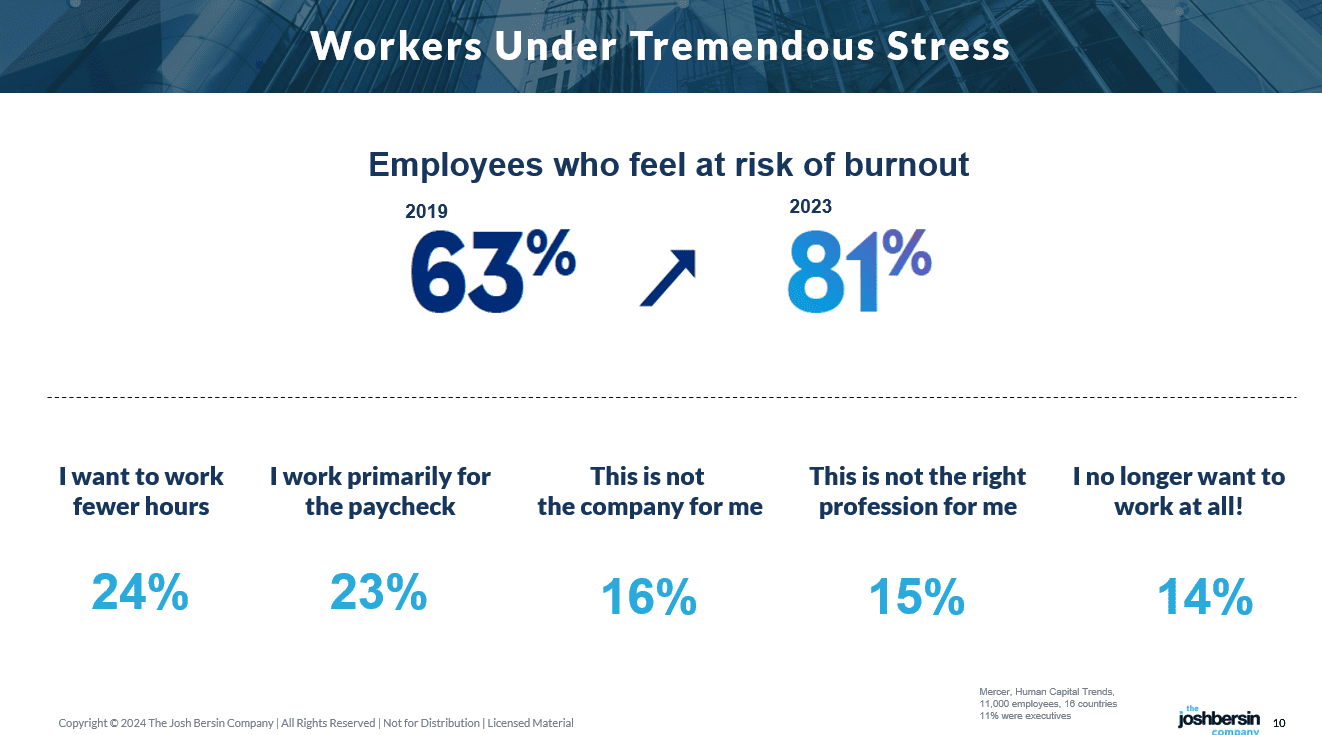
For the last two decades I’ve written about HR predictions, but this year is different. I see a year of shattering paradigms, changing every role in business. Not only will AI change every company and every job, but companies will embark on a relentless search for productivity.
Think about where we have been. Following the 2008 financial crisis the world embarked on a zero-interest rate period of accelerating growth. Companies grew revenues, hired people, and watched their stock prices go up. Hiring continued at a fevered pace, leading to a record-breaking low unemployment rate of 3.5% at the end of 2019.
Along came the pandemic, and within six months everything ground to a halt. Unemployment shot up to 15% in April of 2020, companies sent people home, and we re-engineered our products, services, and economy to deal with remote work, hybrid work arrangements, and a focus on mental health.
Once the economy started up again (thanks to fiscal stimulus in the US), companies went back to the old cycle of hiring. But as interest rates rose and demand fell short we saw layoffs repeat, and over the last 18 months we’ve seen hiring, layoffs, and then hiring again to recover.
Why the seesaw effect?
CEOs and CFOs are operating in what we call the “Industrial Age” – hire to grow, then lay people off when things slow down.
Well today, as we enter 2024, all that is different. We have to “hoard our talent,” invest in productivity, and redevelop and redeploy people for growth.
We live in a world of 3.8% unemployment rate, labor shortages in almost every role, an increasingly empowered workforce, and a steady drumbeat of employee demands: demands for pay raises, flexibility, autonomy, and benefits. More than 20% of all US employees change jobs each year (2.3% per month), and almost half these changes are into new industries.
Why is this the “new normal?”
There are several reasons. First, as we discuss in our Global Workforce Intelligence research, industries are overlapping. Every company is a digital company; every company wants to build recurring revenue streams; and soon every company will run on AI. Careers that used to stay within an industry are morphing into “skills-based careers,” enabling people to jump around more easily than ever before.
Second, employees (particularly young ones) feel empowered to act as they wish. They may quietly quit, “work their wage,” or take time out to change careers. They see a long runway in their lives (people live much longer than they did in the 1970s and 1980s) so they don’t mind leaving your company to go elsewhere.
Third, the fertility rate continues to drop and labor shortages will increase. Japan, China, Germany, and the UK all have shrinking workforce populations. And in the next decade or so, most other developed economies will as well.
Fourth, labor unions are on the rise. Thanks to a new philosophy in Washington, we’ve seen labor activity at Google, Amazon, Starbucks, GM, Ford, Stellantis, Kaiser, Disney, Netflix, and others. While union participation is less than 11% of the US workforce, it’s much higher in Europe and this trend is up.
What does all this mean?
There are many implications.
First, companies will be even more focused on building a high-retention model for work (some call it “labor hoarding.”) This means improving pay equity, continuing hybrid work models, investing in human-centered leadership, and giving people opportunities for new careers inside the company. This is why talent marketplaces, skills-based development, and learning in the flow of work are so important.
Second, CEOs have to understand the needs, desires, and demands of workers. As the latest Edelman study shows, career growth now tops the list, along with the desire for empowerment, impact, and trust. A new theme we call “employee activation” is here: listening to the workforce and delegating decisions about their work to their managers, teams, and leaders.
Third, the traditional “hire to grow” model will not always work. In this post-industrial age we have to operate systemically, looking at internal development, job redesign, experience, and hiring together. This brings together the silo’d domains of recruiting, rewards and pay, learning & development, and org design. (Read our Systemic HR research for more.)
What does “business performance” really mean?
If you’re a CEO you want revenue growth, market share, profitability, and sustainability. If you can’t grow by hiring (and employees keep “activating” in odd ways), what choice do you have? It’s pretty simple: you automate and focus on productivity.
Why do I see this as the big topic in 2024? For three big reasons.
First, CEOs care about it.
The 2024 PwC CEO survey found that CEO’s believe 40% of the work in their company is wasted productivity.
As shocking as that sounds, it rings true to me: too many emails, too many meetings, messy hiring process, bureaucratic performance management, and more. (HR owns some of these problems.)
Second, AI enables it.
AI is designed to improve white-collar productivity. (Most automation in the past helped blue or gray collar workers.) Generative AI lets us find information more quickly, understand trends and outliers, train ourselves and learn, and clean up the mess of documents, workflows, portals, and back office compliance and administration systems we carry around like burdens.
Third, we’re going to need it.
How will you grow when it’s so hard to find people? Time to hire went up by almost 20% last year and the job market is getting even tougher. Can you compete with Google or OpenAI for tech skills?
Internal development, retooling, and automation projects are the answer. And with Generative AI, the opportunities are everywhere.
What does all this mean for HR?
Well as I describe in the HR Predictions, we have a lot of issues to address.
We have to accelerate our shift to a dynamic job and organization structure. We have to get focused and pragmatic about skills. We have to rethink “employee experience” and deal with what we call “employee activation.” And we are going to have to modernize our HR Tech, our recruiting, and our L&D systems to leverage AI and make these systems more useful.
Our HR teams will be AI-powered too. As our Galileo™ customers already tell us, a well-architected “expert assistant” can revolutionize how HR people work. We can become “full-stack” HR professionals, find data about our teams in seconds instead of weeks, and share HR, leadership, and management practices with line leaders in seconds. (Galileo is being used as a management coach in some of the world’s largest companies.)
There are some other changes as well. As the company gets focused on “growth through productivity,” we have to think about the 4-day week, how we institutionalize hybrid work, and how we connect and support remote workers in a far more effective way. We have to refocus on leadership development, spend more time and money on first line managers, and continue to invest in culture and inclusion. We have to simplify and rethink performance management, and we have to solve the vexing problem of pay-equity.
And there’s more.
DEI programs have to get embedded in the business (the days of the HR DEI Police are over). We have to clean up our employee data so our AI and talent intelligence systems are accurate and trustworthy. And we have to shift our thinking from “supporting the business” to “being a valued consultant” and productizing our HR offerings, as our Systemic HR research points out.
All this is detailed in our new 40-page report “HR Predictions for 2024,” launching this week, including a series of Action Plans to help you think through all these issues.
And let me remind you of a big idea. Productivity is why HR departments exist.
Everything we do, from hiring to coaching to development to org design, is only successful if it helps the company grow. As experts in turnover, engagement, skills, and leadership, we in HR have make people and the organization productive every day. 2024 is a year to focus on this higher mission.
One final thing: taking care of yourself.
The report has 15 detailed predictions, each with a series of action steps to consider. The last one is really for you: focus on the skills and leadership of HR. We, as stewards of the people-processes, have to focus on our own capabilities. 2024 will be a year to grow, learn, and work as a team. If we deal with these 15 issues well, we’ll help our companies thrive in the year ahead.
Details on the Josh Bersin Predictions
The predictions study is our most widely-read report each year. It includes a detailed summary of all our research and discusses fifteen essential issues for CEOs, CHROs, and HR professionals. It will be available in the following forms:
Webinar and launch on January 24: Register Here (replays will be available)
Infographic with details: Available on January 24.
Microlearning course on Predictions: Available on January 24.
Detailed Report and Action Guide: Available to Corporate Members and Josh Bersin Academy Members (JBA). (Note you can join the JBA for $495 per year and that includes our entire academy of tools, resources, certificate courses, and SuperClasses in HR.)
Talent Management
2024年01月19日
Talent Management
AI in Hiring: How to Weigh the Tech’s Benefits Against its RisksKaren Boyle, senior vice president of human resources at the Graham Company, asks: Do the pros outweigh the cons when using AI in the hiring process? (Karen Boyle, SHRM - SCP, is senior vice president, human resources at the Graham Company.)
The demand for a strong workforce along with the competitive hiring landscape has put increased pressure on human resource executives. The average corporate position receives approximately 250 applications per job opening, according to Zippia.
HR professionals are tasked with narrowing down the pool of applicants, conducting an extensive interview process, and hiring talent that fits the culture and needs of their respective companies.
Artificial intelligence has been introduced as a way to improve efficiencies throughout that process, and many say they’ve already implemented the tech. Sixty-five percent of recruiters say they’re currently using AI in the recruitment process and 96% of senior HR professionals say they expect AI to greatly enhance the talent acquisition process, Zippia also reported. Those numbers speak for themselves.
As a HR executive, I have witnessed the benefits of what AI can do but I’m also cautious about the potential risks.
AI’s benefits
HR pros stand to gain benefits from AI in a number of ways, namely in interview prep, candidate vetting and overall time savings.
In terms of preparation, AI tools can be used to help HR craft appropriate questions for interview teams to ensure every interview is thoughtful. Interviewing doesn’t come naturally to everyone, so this step is critical in making sure employees are properly prepared and positioned for success. Among other things, AI can assist with strategic questions that go beyond typical prompts like,“tell me about yourself,” which are generic and often leave interviewees unsure where to begin. For example, at my company, we look for candidates who display traits of grit, tenacity and resilience. For us, being able to ask specific questions that demonstrate those traits is key. With adequate preparation throughout the hiring process, companies are more likely to secure the right talent. It’s also a two-way street: Interviewees want to know those they are being interviewed by are just as prepared as they are.
AI is similarly capable of streamlining the vetting process. When companies are hiring for multiple positions at one time, HR departments have limited bandwidth to properly review and vet candidates. By tapping into AI, the process is expedited and becomes more efficient for HR professionals. For instance, if a job listing requires certain industry expertise or a specific certification, AI can quickly identify the appropriate resumes that meet those requirements. This can help HR executives go from 250 applications to, let’s say,100. That makes the job exponentially faster and easier, as you have already weeded out those who would not qualify.
One common theme among those benefits? Time savings. Most hiring managers and recruiters who have used AI say it saves time in the talent acquisition process. Knowing how important time is, AI can certainly serve as a resource to let HR leaders execute their jobs more efficiently. This is especially important as HR executives spend several hours a day reviewing applications, vetting candidates and preparing interviewers for conversations. With AI, HR pros may have more time to focus on other important elements of the job.
AI’s risks
Despite AI’s ability to streamline hiring processes and ease HR’s workload, companies must also account for the risks. Just like with any technology, there are some concerns that cannot be ignored.
When considered for use in the hiring process, AI inherently loses some of the nuance that comes from the human element. The tech often functions based on algorithms and because of this, there exists the potential for entire groups of candidates to be disregarded. In a situation like this, an algorithm-based outcome could stunt the growth and promotion of a company’s diversity, equity and inclusion efforts. Additionally, some companies are using AI to conduct actual interviews, which fully eliminates the human approach to hiring, inhibiting the discovery of certain attributes in applicants like work ethic, dedication and drive.
An organization also must weigh the significant security risks that AI can pose. When using this technology, hiring managers working with personal data must be aware that some tools use any data entered to train the system. This can increase the risk for breaches in privacy. We’ve already seen troubling headlines of the security flaws of various AI tools. In fact, a major multinational appliance and consumer electronics company announced earlier this year that it would be banning employees from using AI tools after sensitive company information was leaked.
Finally, HR professionals need to be mindful of how AI can be used by potential candidates to manipulate resumes and skill sets to better position themselves for listed job qualifications. For example, a candidate can use AI to determine the best key words or phrases to use when applying for a specific position. Trying to combat this issue adds a challenging layer to the already complex and time-consuming hiring process. This further underscores how crucial the human element is to the hiring process, allowing HR leaders to identify inconsistencies between what is on a resume and what it said in an interview.
So, the question remains: Do the pros outweigh the cons when using AI in the hiring process? That is for each company to determine. For me, it’s about striking a balance and using the technology to serve as a complementary element.
SOURCE HRDIVE
Talent Management
2024年01月18日
Talent Management
Public Insight Releases Fall Update of TalentView SolutionPublic Insight, a leading provider of talent management solutions, has announced the release of its Fall update for the TalentView solution. This update brings new features and enhancements designed to further support organizations in managing their talent effectively.
Zip Code Analysis, LinkedIn® Data, Shift and Benefit Reporting Provide Hyper-Targeted Talent Intelligence for Recruiting and Business Development
(Akron, OH) Dec. 21,2023 Public Insight announces the fall release of its TalentView job market data and analytics solution. New features and capabilities such as zip code analysis and 3D mapping, LinkedIn organizational data, and shift and benefit reporting provide a unique level of hyper-targeted talent market intelligence for recruiting and business development.
Granular analysis is available for over 160 talent market metrics. The number of organizations available in employer analysis and benchmarking has increased from 400,000 to 1.7 million. TalentView insights inform and justify recruiting decisions and influence hiring manager discussions. Use cases for identifying prospective companies to target, expanding product/service offerings, benchmarking, competitive intelligence and content development support business development strategies.
Key Feature Highlights of the Fall Update of TalentView
Zip Code Analysis and 3D Mapping – Job postings can now be analyzed at the zip code level generating more targeted regional insights for posting volume, turnover, supply and demand, and compensation. Job postings were previously analyzed at the metro (CBSA) level. This level of targeting will help inform sourcing strategies and improve ability to fill jobs. 3D mapping provides a quick, visual way to understand posting activity by specific locations.
In the example below, nurse posting volumes and reposting rates in CA are analyzed over time.
LinkedIn Organization Data – The addition of LinkedIn data increases the number of organizations in TalentView reporting to 1.7 million. Indeed® and Glassdoor® company data for postings and reviews/ratings has been mapped to LinkedIn organizations. These organizations cover 95% of job posting activity in the U.S.
In addition to the posting volume, supply and demand, time-to-fill and compensation analysis available by employer in TalentView, LinkedIn data provides more volume, depth and details to employer analysis. This enhances the ability to do targeted employer selection, analysis and benchmarking. Organizational reporting now includes specialty tags, multiple locations, LinkedIn follower counts and more. Reports include LinkedIn profile and company website links.
Employer Analysis Use Cases
TalentView insights have several use cases for sales, account management, recruiting, benchmarking, competitive intelligence and content development:
Target prospective companies by company size, type and location for business development
Add insights to expand product/service offering and increase revenue
Justify recruiting decisions and prepare for hiring manager discussions
Share client/competitor/market insights and trends with clients
Utilize employer insights as content for recruitment marketing and social media
Benchmark employer job/talent market KPIs over time and against competitors and the industry (including employer brand and DEI ratings)
Utilize employer, competitor and industry benchmarks to supplement HR/Executive reporting
Utilize employer, competitor and industry benchmark in new business pitches
Analyze who and where competitors are hiring to understand their growth strategies and direction
Shift and Benefit Reporting – Analysis and reports for job posting volumes, supply/demand and compensation can be created at the shift, schedule and benefit category levels. This capability is beneficial for companies and solution providers that recruit candidates that work in job shifts or schedules, such as those in healthcare, manufacturing and transportation.
Benefits reporting provides a more holistic understanding of competitive job postings and trends related to new benefit offerings.
In the example below, nurses’ compensation is analyzed by shift over time.
Ad Indicators – Advertising indicators from Indeed job postings are now captured and analyzed. These include: Sponsored Ad, Quick Apply and Fair Chance Job. Sponsored ads can help identify which companies have job titles that may need to be filled more quickly and have budget to spend on filling them. Quick Apply jobs may indicate a company doesn’t have an ATS or may need recruitment marketing services. Fair Chance Jobs could be a competitive advantage for companies recruiting alternative sources of candidates and it is helpful to see these trends over time.
Integrated KPI Reporting – Analyze over 160 KPI metrics easily and quickly using the new visualization with integrated tables and KPI metrics.
In the example below, registered nurse posting volumes, reposting rates, compensation, and urgency rates are analyzed over time by simply clicking on the table row.
“This release enables our most targeted and granular level of analysis yet to report on 160 talent market metrics,” explains Dan Quigg, Public Insight Chief Executive Officer. “Several new features were customer driven, which is yet another indicator of market demand for hyper-targeted talent market intelligence for decision making,” adds Quigg.
About TalentView
TalentView integrates and transforms jobs, talent and labor market data from Indeed®, Glassdoor®, LinkedIn® and government agency publications into strategic insights. Hyper-targeted market intelligence helps solution providers with business development and practitioners to inform and justify recruiting decisions. TalentView market insights are provided via reports and dashboards in our analytics platform and data integration with third party applications.
SOURCE Public Insight
Talent Management
2024年01月10日
Talent Management
Top 10 HR and People Analytics Themes of 2023
As we near the end of another successful year here at Insight222, we want to reflect on the top themes that have emerged in our content.
From data-driven insights to real-world examples, our team has worked meticulously to deliver informative and persuasive articles that aim to enhance the HR and people analytics function. And we have seen some exciting changes and advancements in the field this year.
So, without further ado, here are the top themes that have taken front stage in our content during 2023.
Psychological Safety in the Workplace
Psychological safety in the workplace has been proven time and time again that without it, a team cannot thrive. In fact, we like to think of it as the epitome of successful teams.
Therefore, it's no surprise that this theme carries over from last year. Some of our most popular blogs discuss measuring psychological safety in the workplace, understanding how organisational culture impacts it and exploring how companies like Microsoft are transforming their organisational culture to prioritise psychological safety and promote a positive work environment.
Behavioural Science in HR
(Source: People Analytics Trends 2021)
The integration of behavioural science into HR and people analytics practices has been gaining traction for the past few years, and this year was no exception. With the changing nature of skills and roles in HR, the need for understanding human behaviour and decision-making has become increasingly important in driving impactful business outcomes.
With this, our article on exploring the role of behavioural science in HR and how it can be leveraged to improve employee engagement, performance, and productivity was one of our most popular reads of 2023.
How AI is Changing the HR Landscape
No discussion about the future of work is complete without considering the role of artificial intelligence (AI).
(Source: The Impact of GPT and Generative AI Models on People Analytics (Interview with Andrew Marritt))
AI has been incorporated into HR for some time now. We have been using it to automate routine tasks, streamline recruitment processes and improve HR analytics. However, with the birth of generative AI models like Chat-GPT, it is an understatement to say that AI has revolutionised every aspect of HR. Better yet, it's safe to say that it has and will continue to revolutionise every business function within an organisation.
From utilising AI in people analytics to how it is transforming the HR landscape, our articles on the impact of Chat-GPT and generative AI models and how AI is changing HR analytics have been among the most popular reads of this year. And for good reason - with the potential to improve decision-making, streamline processes, and enhance employee experience, AI is a topic every HR and people analytics professional should pay attention to.
The Impact of Analytics on HR
Our Insight222 research has shown time and time again that organisations that invest in people analytics drive better business outcomes, which is why, this year, we continued to dig deeper into this topic by exploring the New Model for People Analytics.
With the rise of digital transformation and the increasing importance of data in driving strategic business decisions, our articles on using statistics to drive actionable outcomes, why people analytics is so important for HR, and how social capital can be measured have been highly sought-after reads.
Upskilling the HR Function and Building Data Literacy at Scale
Considering the previous points, it's understandable that upskilling the HR function and building data literacy at scale have emerged as key themes this year. To fully leverage the benefits of AI and data analytics, HR professionals must develop a strong understanding of data and how it can be used to drive strategic decision-making.
As such, in July, we released our research, Upskilling the HR Profession: Building Data Literacy at Scale, which outlines the skills and competencies that HR professionals need to succeed in the digital age. It also highlights how HR leaders need to build an effective skill-based workforce planning capability.
(Source: Measuring the ROI of Employee Training and Development)
Interestingly, this research has also sparked discussions on who holds the responsibility for scaling data literacy across HR, which we explore in our article Who Holds the Responsibility for Scaling Data Literacy Across HR?
Measuring the ROI of Employee Development
Building upon the theme of upskilling and data literacy, it's important to also focus on measuring the ROI of employee development. As professionals in the HR sector, we know all too well that investing in employee training and development is crucial for an organisation's long-term success.
But with senior executives increasingly asking (and expecting) HR to demonstrate the value of these investments, our article on measuring the ROI of employee training and development has been one of the most popular reads this year.
Delivering Greater Value for the Business Through People Analytics
At its core, people analytics is about delivering greater value for the business. Our 2022 research, Impacting Business Value: Leading Companies in People Analytics, is a testament to this. Leading Companies (organisations that drive the most business impact through people analytics) have consistently shown better financial performance, higher employee engagement and retention rates, and overall greater success compared to their less data-driven counterparts.
This is why, in 2023, we have seen a surge of interest in articles on delivering greater value for the organisation with people analytics and the growing influence of people analytics in strategic business decisions.
And this trend will only continue as more and more organisations recognise the importance of incorporating data-driven insights into their decision-making processes.
Challenges to Building Data Literacy
If there is one thing we have identified as a common theme this year, it's the challenges of building data literacy within HR. From understanding the technical aspects of data analysis to gaining buy-in from senior leadership, organisations face various hurdles when trying to build a culture of data literacy.
(Source: Insight222 Research: Upskilling the HR Profession: Building Data Literacy at Scale)
However, as we continue to uncover the value that analytics brings to HR and the business as a whole, these challenges will become easier to overcome. And with more resources and tools available to support data literacy efforts within organisations, we are confident that this theme will evolve in 2024.
Evolving the HR Practice
In all, as we wrap up another year, it's clear that people analytics and data-driven HR practices have become even more ingrained in our work. From the importance of psychological safety and behavioural science to the impact of AI, measuring ROI, and delivering greater value to the business - these are just a few key themes that have shaped our content this year.
However, as we move forward, HR professionals must continue developing their data literacy and upskilling themselves to drive the success of their organisations further.
To that end, we look forward to seeing how these themes will evolve and shape the future of HR in the coming years.
Manpreet RandhawaDecember 18, 2023

 Talent Management
 Talent Management
 Talent Management
 Talent Management



 扫一扫
添加客服
扫一扫
添加客服


