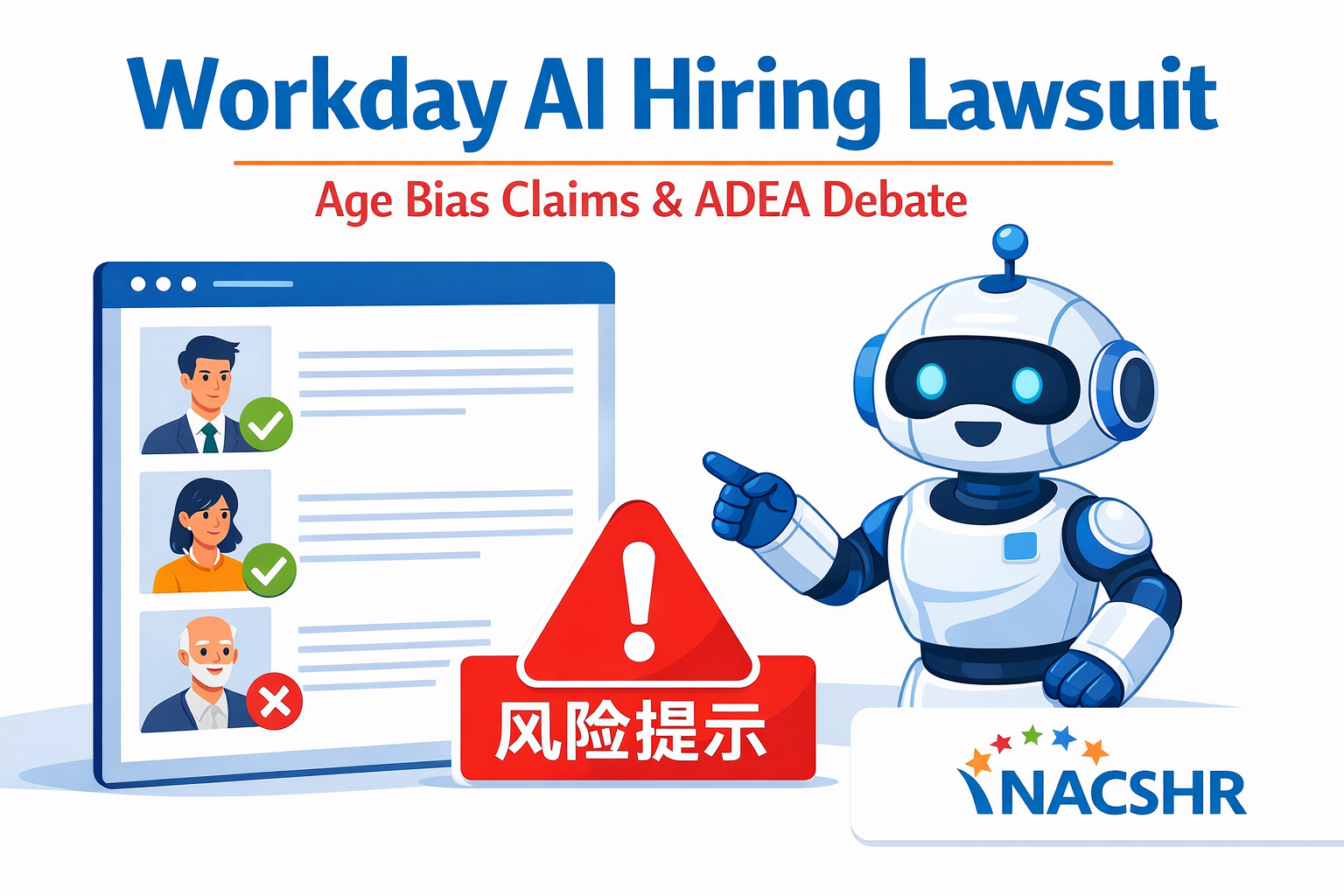
Workday 请求法院驳回年龄歧视索赔:AI 招聘首次进入全国集体诉讼核心,北美华人 HR 需要关注什么?HR科技巨头 Workday 近日在一起备受关注的 AI 招聘诉讼中采取了最新法律行动。根据其在 2026 年 1 月 21 日向法院提交的文件,Workday 正式请求法官驳回原告提出的“差别影响(disparate impact)年龄歧视”指控,并主张《Age Discrimination in Employment Act(ADEA)》的适用范围仅保护在职员工,而不涵盖求职者。因此,公司认为应当撤销求职者基于年龄歧视提出的相关索赔。这一动议,是目前 Mobley v. Workday 案件的最新进展,也标志着该案正式进入核心法律博弈阶段。
该诉讼最早于 2023 年提起,原告为一批求职者,他们指控 Workday 的 AI 招聘与筛选工具在算法决策中对年龄等受保护群体造成系统性不利影响,从而构成歧视。2025 年 2 月,法院批准该案以 nationwide collective action(全国集体诉讼) 形式推进,使其从个体纠纷升级为覆盖全美范围的大规模案件。与此同时,法官还曾要求 Workday 提供使用其 HiredScore technology 的雇主完整名单,进一步扩大了潜在影响面。Workday 则公开回应称,其 AI 工具并不会识别或使用种族、年龄或残疾等受保护属性,并强调最终决策仍由人工主导。
从法律层面看,Workday 当前的策略并非直接围绕“算法是否存在偏见”展开,而是聚焦更基础的问题——求职者是否具备提起“差别影响”诉讼的法律资格。换言之,公司希望通过对法律条款的解释,缩小案HR件的适用范围。无论法院最终是否采纳这一主张,这一动作本身已经说明:AI 招聘正在从技术问题转变为司法问题。
对于北美华人 HR 从业者而言,这一点尤其值得重视。许多 NACSHR 社群成员所在的企业多为中小规模公司、跨州运营团队或初创组织,HR 通常身兼招聘、合规、员工关系与系统管理等多重角色。现实情况是,当企业采购 ATS 或 AI 筛选工具时,系统上线往往被视为效率优化;但一旦候选人质疑筛选结果或提起投诉,站出来解释流程、提供记录、应对律师函的人,往往是 HR 本人,而不是技术供应商。
这正是 Workday 案件释放的真正信号:算法并不会分担雇主责任。即便筛选由系统完成,法律仍然认定这是雇主的用工行为。企业不能以“系统自动决定”为由规避风险,HR 也无法以“工具问题”完全免责。
更广泛地看,Workday 并非孤例。此前 Eightfold AI 也因招聘流程涉及 FCRA 合规问题而遭遇诉讼调查。两起案件虽然分别涉及 ADEA 与 FCRA,不同的法律框架,却指向同一个趋势:只要算法影响到候选人的就业机会,它就等同于招聘决策本身,必须接受同等甚至更严格的监管与审查。这意味着,HR 科技行业已经进入“强合规时代”。
与此同时,监管环境也在不断收紧。包括 California 在内的多个州已开始要求企业在使用自动化招聘工具时提供候选人退出机制(opt-out),并进行风险评估与透明度披露。这类规定实际上将“算法治理”正式纳入 HR 日常合规管理范畴,而不再是技术团队的内部事务。
在这一背景下,HR 的能力模型正在悄然改变。过去我们关注的是招聘速度、转化率和成本控制;而未来更关键的问题是:系统是否可解释、是否可审计、是否留存记录、是否经得起监管问询。如果无法清晰说明筛选逻辑或提供合规证明,那么效率提升带来的收益,很可能被一次诉讼完全抵消。
对 NACSHR 的华人 HR 同行来说,这些案例并非遥远的大公司新闻,而是与日常工作直接相关的风险提醒。无论企业规模大小,只要开始使用 AI 招聘工具,就已经进入同一套法律框架之中。真正成熟的数字化升级,不是简单上线更多自动化,而是在效率、合规与信任之间取得平衡。
Workday 当前的法律动作,或许只是这场变革的开端,但它已经清晰地勾勒出一个趋势:未来的招聘竞争,不再只是“谁更智能”,而是“谁更合规、谁更可解释、谁更负责任”。这将成为所有北美 HR 必须面对的新现实。
Workday is seeking dismissal of disparate impact age discrimination claims brought by job applicants in the ongoing Mobley v. Workday lawsuit, arguing that the Age Discrimination in Employment Act (ADEA) does not extend such protections to applicants. In a court filing on January 21, 2026, the company stated that the law’s “plain language” limits disparate impact claims to employees, not candidates. The case, originally filed in 2023 and certified as a nationwide collective action in 2025, alleges that Workday’s AI recruiting tools discriminated based on age and other protected factors. Workday denies the claims, asserting that its AI systems neither use nor identify protected characteristics. The dispute highlights growing legal and compliance risks tied to AI-driven hiring technologies. Meanwhile, states including California are tightening regulations, requiring opt-out mechanisms and risk assessments for automated decision tools. The case could significantly shape how HR technology vendors and employers deploy AI in recruitment.
Josh Bersin: When Will The Trillions Invested In AI Pay Off? Sooner Than You Think.近年来,生成式人工智能(GenAI)的投资已达数万亿美元,但围绕其回报问题的争论不断升级。一些分析师,如麻省理工学院教授达隆·阿西莫格鲁(Daron Acemoglu)和纽约大学心理学与神经科学教授加里·马库斯(Gary Marcus),对AI的经济影响持悲观态度,认为其对美国生产力和GDP增长的推动作用有限,甚至可能导致市场崩溃。相反,另一派如高盛的全球经济学家则乐观地认为,AI有望在未来十年内大幅提高生产力。然而,文章指出,生成式AI的真正价值在于其特定领域的应用。例如,Paradox和Galileo等HR技术平台通过高度专业化的解决方案,显著提升了招聘和人才管理的效率。最终,文章强调,AI行业仍处于早期阶段,成功的关键在于找到具有专注性和精确性的创新解决方案。
In the last few weeks there has been a lot of concern that Gen AI is a “bubble” and companies may never see the return on the $Trillion being spent on infrastructure. Let me cite four analyst’s opinions.
Will Today’s Massive AI Investments Pay Off?
MIT professor Daron Acemoglu estimates that over the next ten years AI will impact less than 5% of all tasks, concluding that AI will only increase US productivity by .5% and GDP growth by .9% over the next decade. As he puts it, the impact of AI is not “a law of nature.”
On a similar vein, Gary Marcus, professor emeritus of psychology and neural science at New York University, believes Gen AI is soon to collapse, and the trillions spent will largely result in a loss of privacy, increase in cyber terror, and a lack of differentiation between providers. The result: a market with low profits and big losses.
Goldman Sachs Head of Equity Research Jim Covello is similarly pessimistic, arguing simply that the $1 Trillion spent on AI is focused on tech that cannot truly automate complex tasks, and that vendors’ over-focus on “human-like features” will miss the boat in delivering business productivity. (He studies stocks, not the economy.)
And Goldman Sachs Global Economist, who is a fan, estimates that AI could automate 25% of work tasks and raise US productivity by 9T and GDP by 6.1% over the next decade. He follows the traditional business meme that “AI changes everything” for the better.
What’s going on? Quite simply this new technology is very expensive to build, so we’re all unsure where the payoffs will be.
Buyers Are Looking For A Return Soon
If we discount the work going on at Google, Meta, Perplexity, and Microsoft to build AI-based search businesses, which make money on advertising (Zuckerberg essentially just said that in a few years AI will guarantee your ad spend pays off), corporate IT managers are asking questions.
An article in Business Insider pointed to a large Pharma company that cancelled their Microsoft Copilot licenses because the tool was not adding any significant value (Chevron’s CIO was quoted similarly in The Information).
Another quoted a Chief Marketing Officer who stated Google Gemini’s email marketing tool and the new AI-powered ad-buying tool performed worse than the human workers it was intended to replace (or support).
Given that these tools almost double the “price per user” for the productivity suites, I think it’s fair that CIOs, CMOs, to expect them to pay for themselves fairly quickly.
What’s Going On? The Big Wins Will Be Domain Specific
As with all new technologies that enter the market quickly, “the blush on the rose” is over. We’ve been dazzled by the power of ChatGPT and now we’re searching for real solutions to problems. And unlike the internet, where research was funded by the government, there’s going to be a lag (and some risk) between the trillions we spend and the trillions we save.
Given that ChatGPT is less than two years old and OpenAI has morphed from a research company into a product company, it’s easy to see what’s happening. Every vendor and tool provider is narrowing its AI “strategy” and not just pasting little AI “stars” on their websites, looking for useful things to do. And this process may take a few years.
In the world of HR, I think we can all agree that a “push the button job description generator” is a bit of a commodity. However if the AI analyzes the job title, identifies the skills needed through a large skills engine, and tunes the job description by company size, industry, and role, then it’s a fantastic solution. (Galileo does this, as does SeekOut, SAP, and some other vendors.)
The more “specific” and “narrow” the AI is, the more useful it becomes. Generic LLMs that aren’t highly trained, optimized, and tuned to your company, business, and job are simply not going to command high prices. So while we all thought ChatGPT was Nirvana, we’re now figuring out that highly specialized solutions are the answer.
Let me give you some examples.
The first is the platform built by Paradox, a pioneering company that started work on AI-based recruiting agents in 2016. Paradox, now valued at around $2 Billion, delivers an end-to-end recruitment platform that automates the entire process of candidate marketing, candidate experience, assessment, selection, interview scheduling, hiring, and onboarding. Most people believe its a “Chatbot” but in reality it’s an AI-powered end-to-end system that radically simplifies and speeds the recruitment process in a groundbreaking way. Companies like 7-11, FedEx, GM, and others see massive improvements in operational efficiency and both candidates, managers, and recruiter adore it. It took Paradox eight years to build this level of integrated solution.
The second is our platform Galileo. Galileo, which is now licensed by more than 10,000 HR professionals, is a highly tuned AI agent specifically designed to help HR professionals (leaders, business partners, consultants, recruiters, and other roles) do the “complex work” HR professionals do. It’s not a generic LLM: it’s a highly specialized solution designed specifically for HR professionals, and we’ve added specialized content partners and are building special integrations with other HR platforms. Our clients tell us it’s saving them 1-2 hours a day.
The third is the platform HiredScore, that was recently acquired by Workday. Founded in 2012, the HiredScore team built tools to help identify “fit” between individuals and jobs, and tuned its AI to be highly explainable, unbiased, and very easy to use. It took Athena Karp and the team a few years to nail down the use-cases and user interface but now HiredScore is considered one of the most powerful recruitment “orchestration” tools in the market, and is also used for internal hiring and many other applications. Every customer I talk with tells me it’s essential and saves them months of manual, error-prone effort.
The fourth is the platform Eightfold, which was invented in 2016 as a way to build “Google-scale” matching between job seekers and jobs. Through many years of engineering, product management, and ongoing sales process the company has become the leader in a new space called “Talent Intelligence,” now a billion dollar rapid-growing category. The company is about ten years old and now has some of the world’s largest companies building their hiring, career management, and talent management processes using AI. Companies like EY, Bayer, and Chevron now use it for all their strategic talent programs.
Each of these vendors, including others like Gloat, Sana, Arist, Lightcast, Draup, Uplimit, Firstup, and hundreds of others have patiently taken the power of Generative AI and applied it with laser precision to their solutions. Each of these companies is different, and as we work with them we see lightning bolts of innovation: not in AI itself, but in finding new ways to solve problems and do what I call “crawling up the value curve.”
This is the path for AI in the coming years. As with all new technologies, the “trough of disappointment” is always followed by the “bowling pin” of hitting the nail on the head. Innovators, entrepreneurs, and startup founders are the ones who will take GenAI and apply it in unique ways to solve problems. And soon enough, “AI-powered” will be a phrase we barely even need to say.
The Best Solutions Will Be Narrow Not Wide
GenAI solutions require a large “platform” of data, infrastructure, and software. That alone is not where the value resides. Rather, the big productivity advantages come after years of effort, focusing the data sets and working with customers to find the features, UI designs, and data sets that add enormous value. And we are still in the early stages.
If you want to learn more about HR Technology and AI, join me at the HR Technology Conference on September 24-25 in Vegas, or at Unleash in Paris in October 16-17. While I can’t predict who will win the core AI platform game (Microsoft, OpenAI, Google, Meta, Amazon will fight it out), I can predicts this: Generative AI will deliver massive improvements in business productivity. You just have to shop around a bit and wait for just the right solutions to arrive.
HiredScore
2024年08月10日
HiredScore
Workday收购HiredScore的意义,这可能颠覆人力资源科技领域Workday计划收购HiredScore,这是人力资源技术领域的一次重大变革。HiredScore是一家领先的基于AI的招聘匹配工具提供商,此举将大大增强Workday在人才智能和招聘方面的能力。这次收购预计将整合HiredScore的专长到Workday的系统中,显著改善其应聘者追踪系统(ATS)、技能云和整体人才智能产品。此战略性收购可能会重塑人力资源软件市场,迫使其他供应商加速他们的AI计划,可能激发一轮新的收购热潮。
以下是原文:
This week Workday announced intent to acquire HiredScore, a leading provider of AI-based matching tools for recruiting (called “talent orchestration”). While it wasn’t discussed much in the earnings call, this deal is a big positive for Workday and could have many implications for the HR Tech market.
Let me explain. (I have not been briefed by Workday yet, so more information will come as I learn more.)
Right now there is a massive marketplace war for high-powered AI-based recruiting tools (estimated at $30.1 billion). Historically dominated by applicant tracking systems (ATS), this market provides essential technology to help every company grow.
The ATS market, which is more than 25 years old, has been rapidly transformed with high-powered AI tools that help with candidate matching, search, skills inference, and sourcing. And now that AI tools are readily available, these systems are becoming big data platforms loaded with billions of employee profiles, running complex AI models to help match people to jobs, projects, and gigs.
Most ATS vendors (including Workday) have slowly extended into this space through matching. The original idea of a resume parser (software that reads a resume and scores it against a job description) has evolved into complex text analysis and AI-powered inference technology, forcing ATS vendors to invest.
As the ATS vendors enhance their AI capabilities, a parallel universe of AI-first Talent Intelligence vendors emerged. These vendors, like Eightfold, Gloat, Beamery, Phenom, Seekout, Skyhive, Retrain, and Techwolf are building skills-centric big data platforms to match people to jobs, gigs, and mentors. These systems do much more than rate matches: they identify skills, find adjacent skills, match people to careers, find mentors, and more. They are essentially open big-data AI platforms built on vector databases that can be used for many enterprise apps (job architecture design, skills planning, internal mobility, pay equity analysis, etc.). In many ways they represent the future of HR Tech.
(Read our Talent Intelligence Primer for more.)
As the Talent Intelligence vendors grow, they start to deliver “HCM-threatening” platforms that impinge on the HCM “System of Record” idea. If you have all your employees, candidates, alumni, and prospects in Eightfold, Phenom, Seekout, or Gloat, for example, Workday or SAP look like a tactical payroll and workflow management system. (ServiceNow also understands this, and is building talent intelligence into its workflow platform.)
Up until now the big HCM vendors like Workday, Oracle, and SAP have struggled to build these new systems, largely because their original architectures were not AI-based. So they’ve attracted customers with offerings like the Workday Skills Cloud or SAP Opportunity Marketplace that aren’t fully completed yet. We have talked with dozens of Workday Skills Cloud customers, for example, and they see it as an important “skills system of record,” but its real AI matching and inference capabilities have been limited.
Along comes HiredScore, a well respected AI-based matching system with 150 employees and 40+ seasoned AI engineers in Israel. These folks are experts at candidate matching (quite a complex problem), and they’ve built a very innovative “orchestration” system to help line managers coordinate activities with HR business partners and recruiters (more on this later). While I’m sure they’ll continue to build out HiredScore, they can also contribute to Workday’s overall talent intelligence offering, improving the entire system – including the Skills Cloud, Workday Learning, Workday’s Talent Marketplace.
As large as the recruiting software market is, the market for internal career tools, talent mobility, skills inference, and corporate learning is five times bigger. This acquisition gives Workday a shot in the arm to accelerate its entire AI platform strategy. (As the Identified acquisition did back in 2014. Identified was the roots of the Workday Skills Cloud.)
Market Implications Of This Move
This move could change the market for HR software in a few significant ways.
First, Workday Recruiting customers will be thrilled. Workday’s ATS now benefits from a first class matching and candidate scoring solution. This helps Workday compete with the bigger ATS players and gives Workday a new revenue source as they sell HiredScore to the existing 4,000+ Workday ATS customers. (Similar to the Peakon acquisition in Employee Experience.) And the talent orchestration features (kind of like a “staffing copilot”) gives Workday a very unique feature set.
Second, this forces Workday’s talent intelligence partners to step up their game. Remember when Apple acquired Dark Sky, the most compelling micro-weather app on the market? Once they integrated it into Apple’s other apps, the market for third party weather apps went away. Workday could limit its partner network to avoid letting HiredScore competitors into the ecosystem.
Third, this forces HCM vendors to accelerate their AI. Since HiredScore is such a well-respected product (every client we talk with adores it), it will become part of Workday demos and sales proposals quickly. Workday’s HCM competitors will start scratching around to find a similarly mature AI vendor to acquire. And that could kick off another round of acquisitions, similar to the frenzy that took place in the mid 2010s.
Finally, there’s one more scenario, and I give this good odds. Not to be outdone by Workday, the Talent Intelligence vendors may just expand their ATS capability and decide to go “full stack.” I wouldn’t be surprised to see this happen.
Why Is AI-Based Candidate Matching So Important
Why is this technology so important? Well if you’ve ever tried to recruit on Indeed or LinkedIn, you know why. The quality and reliability of “candidate matching technology” is a lynchpin of a talent platform. Just as Google Search crushed Yahoo, Excite, and Inktomi, a powerful next-gen matching tool adds an enormous amount of value. Not only does it speed talent acquisition, it fuels all the internal mobility, career portals, skills, and eventually learning and pay systems.
Why do I say this? A “match” is a sophisticated problem. Unlike a Google search which looks at text and traffic, when you search for a person to fill a role you have to think about dozens of complex relationships. What are this person’s skills and capabilities? What are their credentials or certifications? Who else are they connected with? How likely will they fit into the job, role, and company? What is the impact of their industry experience? What tools and technologies do they understand?
And it gets much more complex. The Heidrick Navigator platform (built on Eightfold), uses AI to assess functional skills for management and leadership, identifies a person’s “ability to drive results,” and more. This important application of AI powers many of the most important decisions we make in business.
That’s why the Talent Intelligence space is growing so fast. As of this week there are more than 1,800 Director or VPs of “Talent Intelligence” in LinkedIn, and that number is up almost six-fold from one year ago.
Can Workday take the lead in this emerging space? It’s impossible to tell at this point, but the horses have left the gate and the race is on. This deal sets the players in the right lanes and feels like the earthquake to shake things up.

 HiredScore
 HiredScore
 HiredScore
 HiredScore




 扫一扫
添加客服
扫一扫
添加客服


