Hiring Trends 2024: For Tech And Digital Global Employers
ANWESHA ROY 8 MINUTE READ
The hiring landscape has gone through a lot of fluctuations in the last two years. The United States and the European Union (EU) fell into recession, triggering widespread panic amongst tech and digital companies. Businesses had to lay off a large chunk of their workforce as a cost-cutting measure, some even freezing hiring temporarily.
Fast-paced digital agencies and startups understood that they needed a flexible hiring approach to adapt to these circumstances. They realized that hiring remote talents from offshore locations like LatAm, East EU, East Asia, and India was a viable way to grow their workforce. Recruiters soon realized that they needed to prioritize both skills and cultural adaptability while looking for remote talents. Hiring platforms emerged as the helping hand in this matter, with their comprehensive solutions geared to deliver a fast and reliable hiring experience.
In this blog, we will discuss these developments and other hiring trends for 2024, and the job roles that will grow in the near future.
Hiring Trends That Will Define 2024
Adaptable hiring strategies will help tackle the talent shortage
Remote hiring for remote positions is here to stay
Skill-based hiring will gain more prominence
India’s rising talent pool to meet global needs
Talent expectations from global employers are changing
Organizations will look for culture-fit talents
Emergence of hiring platforms
Artificial Intelligence (AI) and Machine Learning (ML) will play a crucial role in optimizing the hiring process
1. Adaptable hiring strategies will help tackle the talent shortage
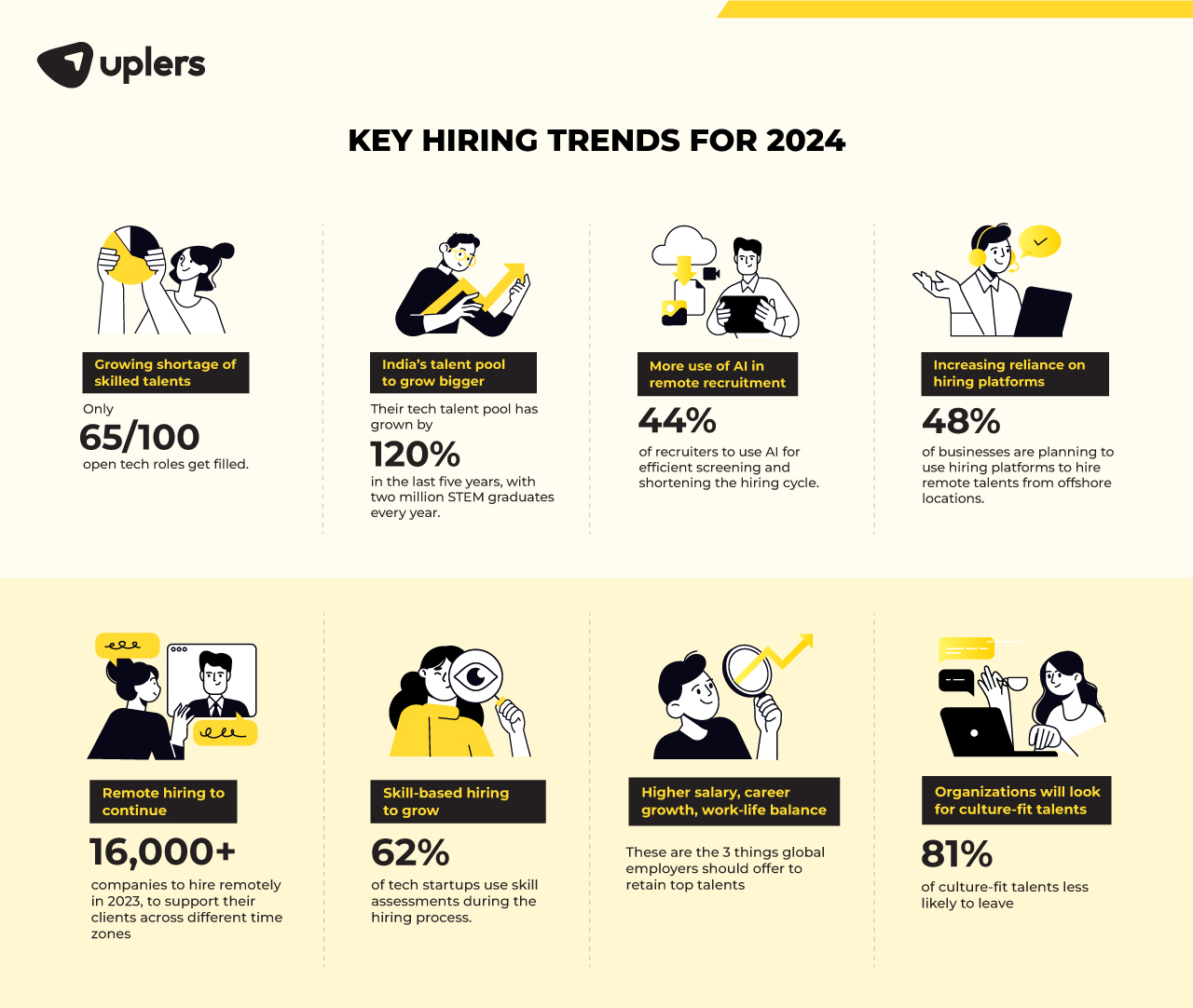
By 2030, the global tech talent shortage will rise to 85.2 million, leading to a massive loss in revenue. Global employers will be more careful and strategic when hiring in 2024. The demand-supply gap of skilled tech and digital talents is growing every year, which means startups have to work harder to onboard the best talents. They will also look to hire remote talents from offshore locations to upscale as per their budget and resources.
2. Remote hiring for remote positions is here to stay
In 2023, tech and digital startups have to deal with the growing tech talent shortage amidst a precarious global economic scenario. Remote hiring is the most viable solution for these organizations, as they can easily access skilled and cost-effective talents across the globe, with a faster hiring process. Even companies following on-site or hybrid workstyles are hiring certain roles remotely, due to its benefits. contract hiring – uncertain economic conditions are compelling companies to hire full-time long-term contractual employees for flexibility and scalability. Global employers are also open to long-term contractual engagements for full-time employees, to ensure flexibility and scalability.
The number of startups hiring remotely has grown from 900 in 2019, 2,500 in 2020, and 14,000+ in 2022. With a growing number of talents preferring remote workstyle, companies will be able to retain their top talents by setting up distributed teams instead of strictly adhering to local hiring.
3. Skill-based hiring will gain more prominence
92.5% of companies have seen a reduction in their mis-hire rate when implementing skills-based hiring, with 44% reporting a decrease of more than 25%. Going ahead, the qualification of a candidate will be defined by their hard and soft skills, and not just their education and work experience. Technical skills, problem-solving abilities, leadership, adaptability, and more will be closely evaluated by companies. A study shows that hiring for skills is five times more predictive of job performance than hiring for work experience.
To drive this initiative, startups will rely on vetting tools and integrate them within their hiring process. The assessment will be tailor-made for tech and digital roles to aid in finding the most suitable talent. Furthermore, startups have to drop degree requirements from job descriptions and become more specific about the capabilities they are looking for.
4. India’s rising talent pool to meet global needs
Contrary to the talent crisis across the globe, India is generating tech and digital talents consistently in large numbers. Their tech talent pool has grown by 120% in the last five years, with two million STEM graduates every year. The country also has a surplus of 2.5 million digital talents, presenting a great opportunity for global employers.
The average salaries of Indian talents is lower than that of US, EU, and AUS talents, which means global companies can hire equally or better-skilled professionals at a lesser cost.
India also has a wide network of talents specializing in emerging technologies. The number of Indian AI experts on LinkedIn has grown by 14x in the last seven years, the 5th fastest growth after Singapore, Finland, Ireland, and Canada.
These reasons have helped India become the most preferred talent-sourcing hub in the world.
5. Talent expectations from global employers are changing
The global labor market is very tight and the talents have an upper hand in deciding their next employer. To remain competitive, startups have to reexamine their hiring strategies and cater to what the top talents are looking for.
A study reveals that top Indian remote talents want better pay, good work-life balance, and prospects of career growth while choosing an employer. Before hiring from India, global employers have to prepare an offer that fulfills the expectations of these talents.
6. Organizations will look for culture-fit talents
Technical proficiency makes a candidate qualified for the job role, but a cultural fitment aligns makes them the perfect addition to the organization. Both large-scale companies and startups need talents who take initiative, have a positive attitude, and handle situations in a non-confrontational manner. Such skills will uphold the work environment and promote a healthy culture. An org-culture fit talent will be more engaged and satisfied with their job than just a skilled professional.
Finding and hiring culture-fit professionals also impacts the retention rates, as a study shows that 73% of talents have left a job due to poor cultural fitment.
7. Emergence of hiring platforms
According to a 2022 survey by Upwork, 50% of businesses outsource at least some of their work. Of those businesses that outsource, 38% use hiring platforms to find freelancers and contractors. Another report reveals that 48% of companies are planning to increase their use of hiring platforms for offshoring in the next two years.
Hiring platforms offer a number of advantages to businesses, including access to a large pool of skilled and experienced freelancers and contractors, the ability to scale their workforce up or down as needed, and cost savings on labor costs. They also help in vetting candidates to find the right technical and cultural fit, helping in making an informed hiring decision. With their end-to-end solutions, hiring platforms help both fast-paced businesses and enterprises in upscaling confidently within a short period of time.
8. Artificial Intelligence (AI) and Machine Learning (ML) will play a crucial role in optimizing the hiring process
44% of recruiters find AI useful in shortening the hiring cycle, which is the main priority, 32% found it a good way to cut down overhead costs, and 24% found it helpful in identifying the right talents.
Studies suggest that it takes 29 to 66 days to fill tech-based vacancies, which is a very long hiring cycle for startups. In a fast-paced environment with constant deadlines, open roles must be filled as quickly as possible. As time is of the essence, startups are beginning to leverage Artificial Intelligence (AI) and Machine Learning (ML) in their hiring process.
By reducing the time to hire, small-scale startups are also able to cut down overhead and operational costs. In fact, AI/ML have helped companies in North America cut down their costs by 40%, in Europe by 36%, and in the APAC region by 25%.
Application Tracking System (ATS) is also being used by startups to ensure a seamless hiring process. The ATS is useful in organizing applications, managing communications, and tracking the status of candidature. 99% of Fortune 500 Global companies are using ATS for an elevated hiring experience and short cycle, so why shouldn’t startups? After all, it oversees all the tedious processes in hiring, so managers can focus their energy on decision-making and other important tasks.
Region-wise Job Roles Which Will Grow In Demand in 2024
United States
Europe
Australia
According to a survey by NASSCOM, future skills demand is expected to grow to 3.5-3.7 million by 2024, rising from the present 1.2-1.3 million currently employed by the industry. Building on that, here are a few predicted jobs that will be in demand in the next few years, sorted region-wise.
United States
The United States is leading the world in next-gen technology, which reflects in their plans to hire more cloud engineers, machine learning engineers, data scientists, and salesforce developers. The digital sector is also growing at an average of 8.5% CAGR, and the startups are looking to hire more web developers, ad specialists, UI/UX designers, and digital marketing managers.
Europe
European tech startups will focus increasingly on their core services and hire more front-end developers, DevOps engineers, and blockchain developers. Similarly, digital companies will look for PHP developers, web developers, and digital marketing managers. SaaS-based startups in the EU will focus on building next-gen products and user privacy, which is why they will hire more product managers, customer success managers, and security engineers.
Australia
Despite fears of recession, Australian tech startups are focussing on resilient hiring to support their services. They will look to onboard more back-end developers, database administrators, and systems engineers. In the digital sector, SEO specialists, web analytics specialists, and digital sales representatives will be in demand. SaaS-based startups in the country will focus on better customer service by hiring account executives, customer success managers, and e-commerce managers.
Jobs created by AI to look out for in 2024
Prompt Engineer
Prompt engineers are experts in designing and developing AI-generated text prompts for improving the AI prompt generation process for several applications. They use data analysis and programming skills to deliver an elevated user experience in tech and SaaS products.
AI Trainer
AI trainers are responsible for teaching AI systems how to think and interact with users. They work with the development team to ensure the chatbots and virtual assistants respond to customer queries and resolve them effectively. These experts have a strong background in data science, natural language processing (NLP), and machine learning.
AI Auditor
AI auditors evaluate the safety, legality, and ethics of AI systems so they can be put to good use. They review codes, conduct data analysis, and test the systems to ensure the system does not produce biased or discriminatory responses.
Machine Managers
Machine managers oversee the AI-operated hardware and systems, and ensure everything is intact for peak performance. They are responsible for the efficient operation and minimum downtime of AI tools, making them indispensable for the tech sector.
Final Thoughts
The secret to success in talent acquisition is to identify the trends, adapt your strategy, and prepare for the future. It is important to constantly monitor the ever-changing hiring landscape to build a productive workforce for the long run.
As we enter 2024, the major focus for global employers will be on identifying the best candidates for the role and leveraging digital tools for a smarter process. Digital agencies also have to offer what talents seek in their employer in order to improve their chance of hiring the best candidates.
By aligning these hiring trends in advance, global recruiters like digital agencies, IT services companies, and SaaS-based tech companies can stay ahead of the curve and hire methodically.

 灵活性
灵活性
 灵活性
灵活性






 扫一扫
添加客服
扫一扫
添加客服


