

On May 16, 2026, the NACSHR Summer Forum was held in Silicon Valley. Discussions centered on how AI is reshaping HR, HR management in global enterprises, recruiting and talent strategy, organizational collaboration models, employee benefits, and career development for Chinese-American HR professionals in North America. The forum brought together more than 70 HR leaders, business executives, and industry experts from Canada, Boston, New York, Dallas, Los Angeles, Seattle, Singapore, and beyond, representing AI, clean energy, finance, manufacturing, biopharma, high tech, new retail, and global-expansion service and professional firms. The result was a professional community gathering defined by its small scale, high density, and depth of exchange. Special thanks to BIPO for its sponsorship and support.
Unlike many large industry conferences, this forum did not aim for broad coverage of topics. Instead, it brought the conversation back to the workplace realities Chinese-American HR professionals in North America are actually facing: AI is changing HR workflows and organizational boundaries; Chinese and global companies are entering a more complex phase of overseas operations; recruiting and talent strategy are being redefined by AI tools; employee benefits and compliance are becoming non-negotiable issues for small and mid-sized businesses; and Chinese-American HR professionals themselves are moving from execution and support roles toward becoming business influencers.
That is what made this forum most valuable. It was not a conference that only discussed trends; it put trends, business, organization, compliance, and personal growth on the same table. For Chinese-American HR professionals in North America, AI is not a distant technology topic, and globalization is not a strategic concept reserved for senior executives. Both are entering everyday work: candidate screening, employee services, performance conversations, reorganizations, cross-cultural management, benefits purchasing, compliance judgments, and career paths.
AI Is Not Simply Replacing HR. It Is Redesigning Work Itself
In the morning, Jiajia Chen, Senior Group Product Manager at Nvidia, delivered a keynote titled “See how AI turns HR upside down.” She noted that AI has already entered multiple HR workflows, including recruiting, employee services, interview feedback summaries, learning content generation, and HR analytics. As her presentation materials explained, the first wave of AI applications is affecting repetitive, rules-based, high-frequency work first, such as job descriptions, candidate screening, employee policy Q&A, interview notes, learning content generation, and HR analytics.
The truly important point in her talk, however, was not how many HR tasks AI will automate, but how companies will need to rethink the very idea of a workforce. In Jiajia’s view, productive capacity in future organizations will no longer come only from employees in the traditional sense, but from a combination of human employees, AI agents, copilots, bots, platform capabilities, and even physical robots. In other words, companies will no longer be managing headcount alone, but a more complex form of productive capacity.
This places entirely different demands on HR. In the past, HR managed primarily around people: how many to hire, how to evaluate them, how to develop them, how to retain them, and how to handle employee relations. In the AI era, HR must also take part in designing how work gets done. Which tasks should be done by people, which by agents, which processes should be carried by platforms, which decisions must retain human judgment, and which risks require governance safeguards: these will all become questions HR cannot avoid.
Jiajia argued that HR is moving toward workforce architecture. The concept means HR is no longer just a manager of people processes, but a designer of work, capabilities, governance, and the boundaries of accountability. For many HR professionals, this may be both the biggest challenge and the biggest opportunity of the AI era. As a company’s workforce structure changes, people who truly understand the organization, the business, people, and AI workflows will become exceptionally scarce.

From Writing Code to Managing Agents: Organizational Redesign Through a Technology Leader’s Eyes
Next, 2026 NACSHR Conference Chair Bijun Zhang held a Business Fireside Chat with Dongxu, Co-Founder and CTO of PingCAP. The conversation became one of the most striking moments of the forum. Drawing on his experience as a hands-on technology leader and executive, Dongxu shared how AI, and agents in particular, are affecting software engineering, organizational structure, and talent development.
His central observation was that AI’s impact on R&D is not just higher coding productivity; it is pushing engineers from doing the work themselves toward managing teams of AI agents. An engineer’s future value will no longer rest only on whether they can write code, but on whether they can define goals clearly, build verification environments, judge the quality of results, and enable agents to keep completing complex tasks within a system that provides feedback.

Three key capabilities underpin this shift: goal engineering, verification engineering, and environment engineering. Goal engineering addresses the question of what people actually want. Often, humans do not lack execution capacity; they have simply not turned vague needs into clear, executable, verifiable goals. Verification engineering addresses whether the AI got it right. As long as a task’s output can be verified, agents can keep iterating through feedback. Environment engineering builds the infrastructure in which agents can work, experiment, and have their results checked.
This holds powerful lessons for HR. Talent evaluation in the AI era cannot look only at the fixed skills a person has mastered or the projects they have done in the past. What matters more is whether they can define problems, marshal resources, judge outcomes, use tools, manage systems, and keep learning in uncertain environments. A person’s ability to collaborate with AI is becoming a new foundational capability.
At the organizational level, Dongxu offered a forward-looking observation. As agent capabilities keep improving, future teams may become smaller, flatter, and closer to high-density “super nodes.” The core human team taking a new product from zero to one may need only a handful of key roles, each person leading their own team of agents across different parts of the work. This will challenge traditional reporting lines, role boundaries, management layers, and ways of measuring performance.
For HR, this is not just a change within technical teams; it is a change in how future organizations are designed. Traditional HR systems were largely built around positions, levels, reporting relationships, and functional boundaries. In AI-native ways of working, organizations may increasingly run around tasks, goals, workflows, and talent density. HR needs to understand this shift early, or it will be easy to interpret problems in new kinds of organizations through outdated talent management frameworks.

Globalization Enters Deep Water: HR Moves from Support Function to Organizational Stabilizer
If the AI discussions focused on the future shape of work, the talk by Michael Chen, Founder & CEO of BIPO, brought the conversation back to the real challenges global enterprises are facing. Speaking on “Long-Term Focus: Delivering HR Certainty for Global-Scale Enterprises,” he addressed the long-term issues involved in going global and managing HR across borders.
Michael noted that globalization is not just about taking business overseas; it is the systematic building of organizational, talent, and cultural capabilities. In the early stages of going global, many companies rely on personal trust, ad hoc experience, or headquarters habits to handle overseas management. Once the business enters a phase of long-term operations across multiple countries and regions, that approach quickly reaches its limits. As global compliance requirements tighten and localization demands rise, companies must ask not only “Can we get established?” but “Can we run steadily over the long term?”
BIPO also noted that corporate global expansion is moving from an exploratory phase into long-term, multi-country parallel operations. HR is no longer dealing with one-off market entry, but with the systematic building of global organization, global culture, global talent, global mechanisms, global governance, and a global operating platform.

This means the HR role is changing fundamentally. In the past, HR was largely seen as a back-office support function focused on recruiting, payroll, benefits and social insurance, onboarding and offboarding, and employee relations. In global enterprises, however, HR is increasingly involved in risk management, organizational stability, cross-border coordination, and building long-term operating capabilities. Particularly where cross-border employment, compensation and tax, employment contracts, leave policies, data compliance, local culture, and employee relations are concerned, HR’s judgment directly affects whether a company can operate steadily in overseas markets over the long run.
Michael’s talk also echoed the forum’s overall theme: AI is changing how work is done, globalization is increasing organizational complexity, and HR must find a new position between these two forces. The best HR professionals of the future will need to understand both the efficiency gains technology brings and the compliance and cultural constraints that globalization imposes, helping companies move both faster and more steadily.

Chinese Companies Going Global: Neither Copying Home Nor Going Fully Local
The morning roundtable, “HR Management at Chinese Companies in the U.S.: Adapting and Exploring Amid Change,” was moderated by Angela Rui, Global HR Director at Canadian Solar, and featured senior HR leaders with backgrounds at Chinese companies operating overseas, including TAL Education, Midea, Tencent, and China Mobile. Compared with discussions of macro trends, this conversation came much closer to the day-to-day management realities of Chinese companies operating in North America and globally.
Panelists repeatedly returned to one core tension: Chinese companies going global can neither simply copy their domestic management approach nor give up their own organizational strengths entirely to fit the local market. The real difficulty lies in striking a balance between preserving the company’s core DNA and adapting its management language.
Much of Chinese companies’ competitiveness in global markets comes from high efficiency, strong execution, fast response, and deep commitment. This “China speed” should not simply be abandoned. In the U.S. and other overseas markets, however, management behavior must be more transparent, specific, quantified, and predictable. Managers in China are used to giving relatively broad instructions and relying on employees to interpret them and fill in the context; in the American workplace, employees need clear goals, explicit steps, measurable standards, and well-defined responsibilities.

Cross-cultural collaboration tools became one concrete entry point into the discussion. As Chinese companies roll out unified workplace systems globally, many seemingly ordinary software settings can create cultural-fit and compliance issues overseas. Cross-time-zone instant messaging, read receipts, meeting recordings, data storage, and employee privacy settings all shape how overseas employees perceive work boundaries, trust, and compliance risk. In this process, HR is not just a facilitator of system rollouts, but a cross-cultural interpreter, a risk identifier, and a designer of organizational communication mechanisms.
Panelists also examined how HR strategy differs across models of global expansion. Companies expanding through investment and acquisition need to respect the local management systems of the companies they acquire; companies seeking research and technology resources need to give overseas teams greater decision-making latitude; and companies focused on market sales must pay close attention to local labor law, employment relationships, termination procedures, leave policies, and employee relations. Different expansion goals call for different talent deployment, management delegation, and organizational coordination, and require HR to exercise stronger situational judgment.
The significance of this roundtable was that it brought “Chinese companies going global” down from a grand strategic phrase to the real problems HR handles every day: headquarters wants speed while local employees need boundaries; the business needs to execute while compliance demands caution; headquarters wants uniformity while overseas teams need autonomy; Chinese managers are used to high-intensity communication while American employees value work-life boundaries. HR sits at the intersection of all these tensions.

Employee Benefits Are Not Just a Cost Line. They Are Talent Infrastructure for Small and Mid-Sized Businesses
Opening the afternoon, Annie, a California-licensed health and commercial insurance broker, gave a focused presentation on group health insurance for California employers. While less sweeping than the AI topics, this session addressed a very practical issue for small and mid-sized businesses and HR teams in North America.
She noted that many companies designing group health insurance face three pain points at once: rising budgets, diverse employee needs, and provider network coverage challenges created by a geographically dispersed workforce. In the California market in particular, employers must control benefits costs while meeting employees’ differing preferences for HMO, PPO, HSA, high-deductible plans, specific provider networks, and family coverage. A traditional one-size-fits-all group plan is increasingly unable to meet all of these needs.
Annie introduced the Defined Contribution model, in which the employer first sets a fixed monthly contribution amount or percentage per employee, and employees then choose the plan that fits their needs on a single platform. The core value of this model is that it gives employers better budget control while giving employees greater choice. For HR, flexible enrollment platforms also help simplify administration by bringing multiple carriers, multiple plan options, and varied employee needs into a relatively unified system of contracts, billing, and service support.
The session reminded HR that employee benefits are not a simple purchase, nor a passive comparison of quotes at each annual renewal. They are fundamentally part of a company’s talent infrastructure. A sound benefits strategy affects employee experience as well as cost control, compliance risk, and the ability to attract talent. For Chinese-American startups, small and mid-sized businesses, and companies expanding into the U.S. in particular, health insurance is often the key step in moving from informal, family-style management to a professional employer brand.

The HR AI Product Ecosystem Is Taking Shape Fast, but HR Cannot Stop at Using Tools
Next, Tom Zhang, a Silicon Valley talent expert and contributing commentator for 硅新社, presented “AI Reshaping HR: Reviews of 10 HR AI Companies and Trend Insights.” He organized his talk along two dimensions: “HR the day after tomorrow,” meaning the long-term changes in HR functions, organizational structures, and talent roles driven by AI; and “HR today,” meaning the AI-native HR products and platforms already emerging in Silicon Valley.
Tom Zhang argued that AI will first make deep inroads into high-frequency processes such as recruiting, employee services, training, and HR operations. AI agents may become employees’ first point of access to HR services, handling policy questions, process guidance, onboarding reminders, information summaries, and personalized services. As AI capabilities enter day-to-day HR processes, the boundaries between traditional HR modules will break down further, and the future HR skill set will look more like that of a hybrid, product-minded, business-oriented professional than a specialist executing within one vertical module.
His presentation also outlined the core characteristics of HR in the AI era: AI agents becoming the first point of access for employee services; more self-service and automated processes; stronger data-driven talent planning and organizational decision-making; and personalized employee experiences gradually replacing standardized policies. At the same time, the traditional HRBP, COE, and Shared Services model may be redefined: HR Operations will look more like an AI-driven digital HR service platform, HRBPs will become more like Strategic Talent Leaders, and COEs will evolve into HR Product Designers.
In the product review section, Tom Zhang assessed a range of representative companies and tools, including Scale AI for efficient recruiting and expert data labeling; Rippling and Gusto as next-generation HR platforms for small and mid-sized businesses; Ashby as a leading AI-native ATS; and Peoplebox and Paradox for AI skills assessment, performance management, and conversational recruiting. He also noted that recruiting tools are moving from traditional ATS and talent pool management toward AI-assisted search, automated outreach, interview note generation, funnel analysis, and candidate matching recommendations.
The key takeaway was that AI’s impact on HR is not the replacement of individual tools, but the gradual rebuilding of HR’s operating system. HR cannot ask only which tool works best; it must ask which workflow a tool changes, how it affects organizational efficiency, what governance risks it introduces, and whether it genuinely improves employee experience and the quality of management decisions. HR’s future competitiveness will lie not just in using AI, but in judging how AI should enter business processes, organizational mechanisms, and talent strategy.

Recruiting in the AI Era: Candidates Use AI, So Hiring Must Be Redesigned Too
The “AI in recruiting and talent strategy” roundtable was moderated by Julian Lu, Technical Recruiter at Zoox, with Cindy Zheng, Director of HR and Ops at Hesai; Tan Huangfu, Executive Talent Acquisition at NewsBreak; Qiuyi Chen, Technical Recruiter at Otter.ai; and Tom Zhang. Panelists discussed AI’s impact on recruiting processes, candidate assessment, competition for technical talent, recruiting efficiency, and the transformation of talent strategy.
Recruiting is one of the fastest areas for AI adoption in HR. On one hand, AI can help recruiting teams move faster on job descriptions, candidate sourcing, résumé screening, outreach, interview notes, and funnel analysis. On the other hand, candidates are also using AI to polish résumés, prepare for interviews, and in some remote interview settings even get real-time help answering questions. This means traditional assessment methods based on résumés and Q&A are facing a credibility challenge.
The core capability in future recruiting will shift from who can find more candidates to who can more accurately judge a candidate’s real ability. Panelists discussed the need for recruiting teams to focus more on real work samples, project collaboration, problem-solving processes, how candidates work with a team, and AI proficiency itself. This is especially true for technical roles, where whether a candidate can use AI, and use it to improve the quality of their work, is becoming a new dimension of assessment.
This raises the bar for HR and recruiting teams. Recruiting is no longer just moving a process forward; it is an integrated discipline combining talent market judgment, understanding of business needs, candidate experience design, updated assessment methods, and organizational capability building. AI will make recruiting more efficient, but it will also amplify the risk of hiring misjudgments. The most valuable recruiting teams will need to strike a balance between speed and judgment.

Organizational Collaboration in the AI Era: From Tool Adoption to Workforce Transformation
The afternoon roundtable on “Organizational and collaboration model in AI” was moderated by Libby Sun, Head of People at OpusClip, with panelists Ethan Zheng, Co-Founder of Jobright.ai; Tina Weinberge, Senior Manager, People Partner at Cisco Splunk; Warren, CEO of Doublefin; and Tim Xiong, Startup Advisor and Venture Investor. Unlike traditional HR topics, this discussion approached AI’s deep impact on future organizational forms, collaboration models, and talent management largely from the perspectives of business strategy, organizational redesign, investment trends, and startup practice.
The discussion first pointed to a core shift: AI is significantly amplifying the output of a small number of high-density talents and pushing companies to rethink traditional organizational hierarchies. When AI gives individuals or small teams the execution capacity that once required much larger teams, the organization’s communication costs, collaboration chains, and middle-management transmission mechanisms all come under review. Highly effective organizations of the future may emphasize being smaller, flatter, and more autonomous, letting people with strong judgment, strong learning ability, and AI fluency work directly around goals, data, and product outcomes.
Panelists from large technology companies cautioned that AI transformation cannot stop at tool adoption. Many companies see employees starting to use AI tools and mistakenly assume their AI transformation is complete. Real workforce transformation requires moving from scattered tool use to reliable AI workflows, and then further to AI-native business processes and organizational capabilities. The key to AI-driven change is not that everyone has access to a certain tool, but whether the company can systematically redesign how work is done, how decisions are made, how roles are divided, and how performance is measured.
The investor perspective added a framework for judging how quickly AI will change a company. The pace depends both on the nature of the industry and on the company’s DNA. Software, SaaS, and knowledge-intensive industries, which align closely with the capabilities of large models, are seeing faster changes in ways of working and business models. Manufacturing, robotics, and hardware-related industries are changing at a different pace, but as data collection, automation, and embodied intelligence advance, they too will gradually see deeper change.
The lesson for HR was clear: do not treat AI transformation as a one-time, company-wide tool training. Start with a pilot in one specific team, one critical process, and one measurable business problem. Recruiting, employee services, knowledge management, performance feedback, onboarding, and manager support can all serve as entry points for an AI pilot. Only when AI moves from a personal productivity tool to a repeatable organizational workflow does it truly become part of organizational capability.

The Opportunity for Chinese-American HR: AI Lowers the Language Barrier, but Does Not Replace Trust and Judgment
The forum’s final roundtable focused on “Challenges and Opportunities for Chinese-American HR in North America.” It was moderated by Joki Jin, VP-HRBP at East West Bank, and featured senior HR leaders from Yahoo, Seyond, Silergy, and NewsBreak. Compared with the earlier macro discussions of AI and globalization, this conversation came closer to the real career circumstances of Chinese-American HR professionals in North America.
Panelists broadly agreed that to increase their influence, Chinese-American HR professionals must first go beyond understanding the business to being able to explain, organize, and influence it. Great HR professionals do more than receive business requests, fill roles, handle employee relations, or execute processes. They understand the company’s stage, its growth logic, how organizational resources are allocated, and how its talent structure is changing, and they can communicate in frameworks the business understands.
Data and logic are essential foundations for earning the business’s trust. In technology companies and organizations with strong engineering cultures, HR that starts only from policy or sentiment is easily seen as process friction. Instead, HR needs to deeply understand business goals, project progress, and team pain points, and engage the business with data, year-over-year analysis, industry benchmarks, and structured problem breakdowns. Especially on sensitive issues such as performance, promotion, organizational efficiency, and staffing, HR needs to reframe problems from “people and emotions” into “goals, facts, data, and actionable plans.”
Panelists also noted that HR should not wait until a business plan is fully formed and then execute passively; it should enter the decision-making process early. When a business unit proposes expanding headcount, reorganizing, changing levels, or adjusting incentives, HR needs the confidence to ask upward: Why now? What is the underlying business goal? Can the organization bear the cost? Does the talent structure support it? Will it create new management complexity? When HR takes part early in talent reviews, role definition, organizational design, and communication planning, it can move from intermediary coordinator to genuine strategic partner.
How AI can help Chinese-American HR professionals break through career ceilings was another major topic. Panelists believe AI is significantly lowering the barriers of language expression and information synthesis, an important opportunity for the many Chinese-American HR professionals who are not native English speakers. In the past, fluency could affect their confidence in written communication, presentation materials, and cross-functional discussions; today, AI can help refine English expression, organize logical structure, and produce more professional reports and communications. Real competitiveness will increasingly come back to problem judgment, clarity of thinking, business understanding, and organizational insight.
Panelists also stressed, however, that AI will not replace HR’s core value in interpersonal trust and complex relationships. In executive communication, key talent attrition, organizational turbulence, cross-cultural misunderstandings, and sensitive employee relations issues, AI can offer options, talking points, and analysis, but it cannot replace the trust, empathy, business judgment, and situational awareness HR builds over time. HR’s future value lies precisely in combining the efficiency gains AI delivers with human strengths in trust, judgment, and complex communication.

The Value of NACSHR: Not a Single Event, but a Long-Term Professional Network
Looking back across the forum, a clear throughline emerged: AI is reshaping how HR works, globalization is raising management complexity, recruiting and organizational collaboration are being redesigned, employee benefits and compliance are becoming operating infrastructure, and Chinese-American HR professionals in North America stand at the intersection of all these changes.
For NACSHR, this forum was not just an in-person event, but a reflection of the continued growth of the North American Chinese HR professional community. As AI accelerates the reshaping of management, global employment grows more complex, and the HR role keeps evolving, Chinese-American HR professionals need more than access to information. They need high-quality professional connections, trusted peer relationships, and a community foundation built for long-term mutual support.
Attendees came from a wide range of fields, including technology, AI, clean energy, finance, manufacturing, biopharma, global-expansion services, recruiting, and organizational management. Speakers who presented publicly included representatives of Nvidia, PingCAP, BIPO, Canadian Solar, Tencent Americas, Zoox, Hesai, NewsBreak, Otter.ai, OpusClip, Cisco Splunk, East West Bank, and other companies and organizations.
Going forward, NACSHR will continue to build on the real needs of Chinese-American HR professionals in North America, driving more high-quality conversations, professional content, and industry connections. In an uncertain era, the value of a professional community is not just access to information; it is helping every HR professional find peers, experience, trust, and the strength to keep moving forward amid change.
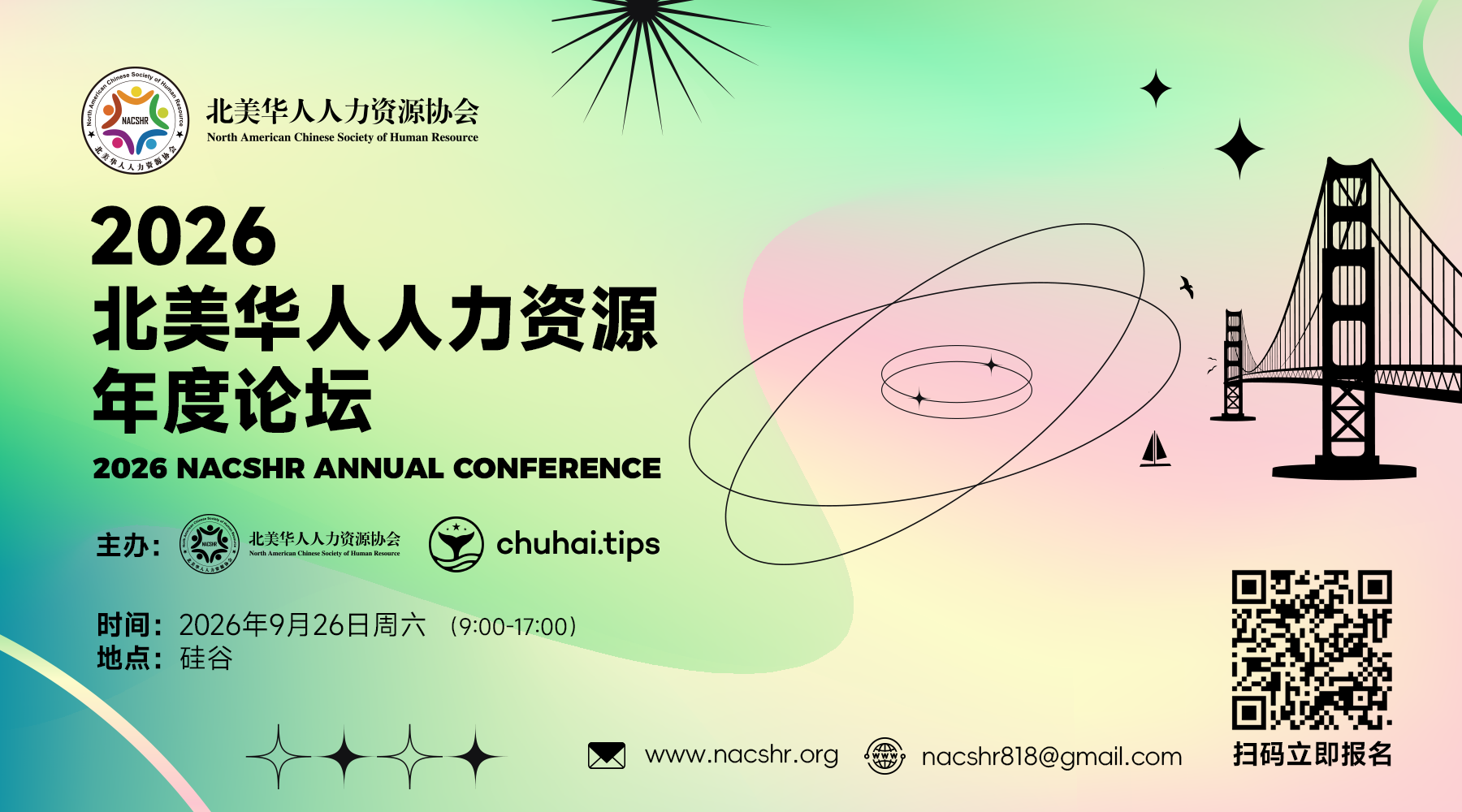
Next, NACSHR will host its Annual Conference in Silicon Valley on September 26, continuing the conversation on AI, global organizational management, HR compliance, talent strategy, and career development for Chinese-American HR professionals, and inviting more HR leaders, business managers, founders, and industry experts to join in-depth discussions. Follow NACSHR, save the date, and join us again in Silicon Valley.
Annual Conference details: https://nacshr.org/Public/html/926.html